

DeWalt Vs. Bosch: Whose Hammer Drill Is More Powerful?
We may receive a commission on purchases made from links.
It's a no-brainer, right? You go looking for a cordless hammer drill, and you want the most powerful one you can reasonably afford. It's a hammer drill, after all, not a delicate tap drill — the entire point is to pound through tough material. Well, inevitably you'll consider the newest DeWalt and Bosch offerings and naturally want to know which is the more powerful. And the answer is DeWalt's DCD1007, though not all the immediate specs make it apparent.
There are a lot of difficult choices and comparisons between competing tool brands that emerge when setting up a garage workshop, and hammer drills are no exception. The DeWalt DCD1007 and the Bosch GSB18V-1330CN seem, on the surface, pretty similar. Both are lithium-ion stills with three-gear transmissions and variable-speed triggers. Both have ½-inch chucks and brushless motors. The DeWalt is 20 volts and the Bosch is 18 volts — a distinction that means little, because they are virtually identical, battery-wise. The 20 and 18 simply have to do with how you measure the voltage.
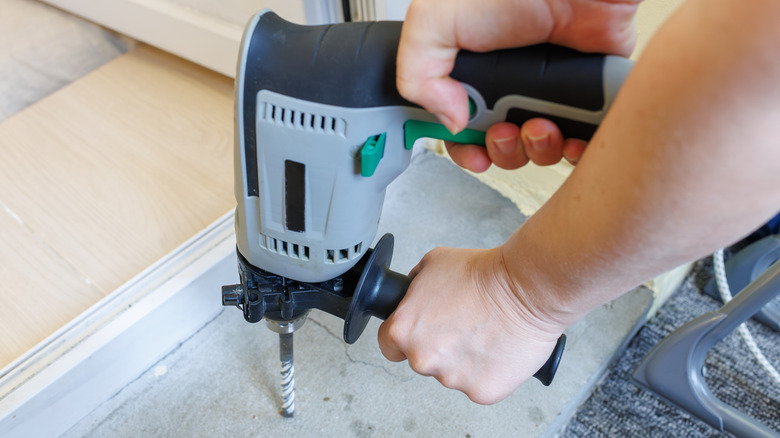
To understand why the DeWalt is more powerful than the Bosch, it helps to understand what a hammer drill really is ... and what it isn't. Sometimes called a percussion drill, a hammer drill adds a very fast and weak linear hammering action to the basic drill rotation, which is helpful for relatively light DIYer tasks like drilling into thick lumber and some types of masonry; you'll get better results with brick than with concrete, for example. Better than you would with a standard drill-driver, anyway, thanks to all of that powerful hammering action, but not as powerful as a piston-driven rotary hammer or an even higher-powered demolition drill.
Measuring the power of the Bosch and DeWalt hammer drills
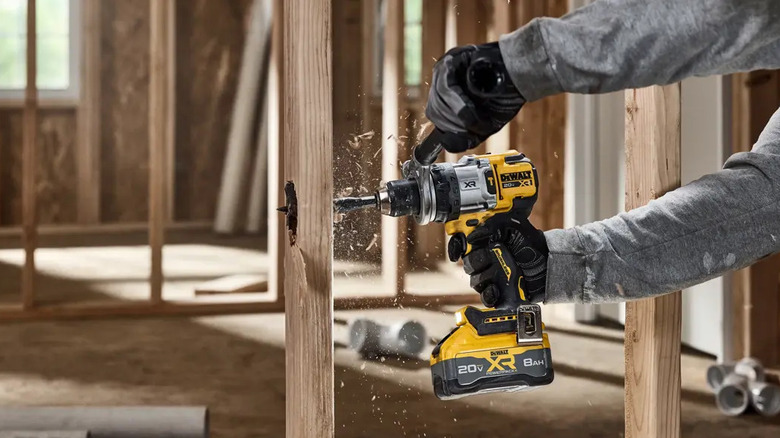
For many years, DeWalt has used a power rating called unit watts out (UWO) to measure drill power. Unfortunately, only Stanley Black & Decker tool brands use UWO ratings, making comparisons among different hammer drills difficult. And while UWO ratings provide a roughly useful point of comparison for a drill's aggregated power and speed, the rating obscures the tool's maximum torque, so we have to look at more traditional performance markers.
Drill speed is important, of course, but actual power centers on torque, the rotational force to twist a bit into wood or masonry. While the Bosch GSB18V-1330CN technically has a higher no-load rotational speed with 2,200 max RPMs than the DeWalt DCD1007's 2,000 max RPMs, the DeWalt's design allows it to top out at 38,250 blows per minute, compared with the Bosch's 30,000. Because the hammer effect is small for a hammer drill, torque is probably more meaningful. And due to the typical inverse relationship between torque and RPMs, it's unsurprising that DeWalt wins this hands-down with a maximum of 2,100 inch-pounds of torque, versus Bosch's 1,330.
So, the DeWalt DCD1007 has a higher BPM rating, a much higher torque rating, and a slightly lower RPM speed than Bosch's GSB18V-1330CN. The maximum recommended bit sizes can also be used to grok the power of a drill. But since the recommended capacities of the Bosch are presented in substantially less detail than those of the DeWalt, it's not possible to make a meaningful comparison. The takeaway here is that, whether you drill into materials like concrete using regular tools or specialized tools like a rotary hammer, making sure you use the right bit at the right size will be critical in maximizing your drill's power.