

Try Being Helpful — Barn Raisings, Not Fences Or HOAs, Make Good Neighbors
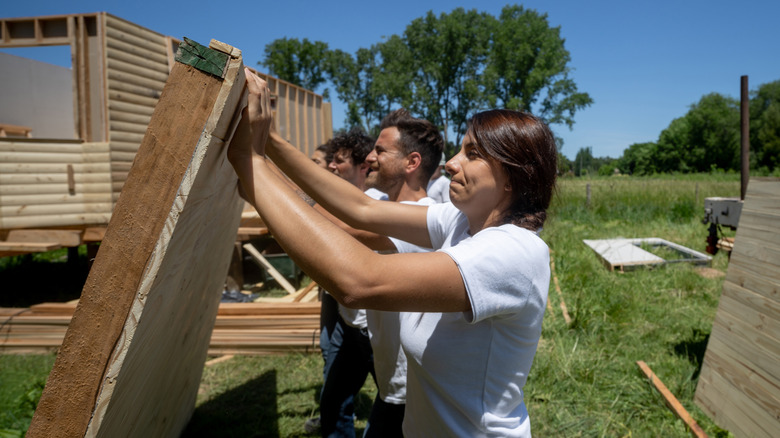
What if your default reaction when something unpleasant happens on your street were to ask how you can help? What if your HOA bylaws were written so that the first response to any issue were offering a hand? I'm not talking about passive-aggressive mowing here. I'm asking what your neighborhood would look like if the response to John's messy yard was that a couple of neighbors show up with hammers to help him build that shed he's been trying to get to. After all, few things build a stronger community than neighbors showing up for one another.
In a modern American suburb, you might not even be able to imagine it. But not only do community efforts like barn raisings have a long history in the U.S. and Canada, but many cultures — Brazil, Portugal, Finland, Kenya, Indonesia, and Malaysia are examples I came across — work together to clear land, plant and harvest crops, repair roofs after storm damage, and maintain private property, like boats and buildings, for the good of all.
In a sense, traditional barn raisings and their spiritual cousins teach us what it means to be a neighbor. First, individuals and families can't always manage on their own. No one person can build a barn worth occupying, and nobody living paycheck to paycheck can stay afloat without a little help. Second, that help need not be charity. The recipient of help is expected to help others in need, unconditionally. And, third, acknowledging interdependence is critical to a healthy community.
It takes a village to raise a barn
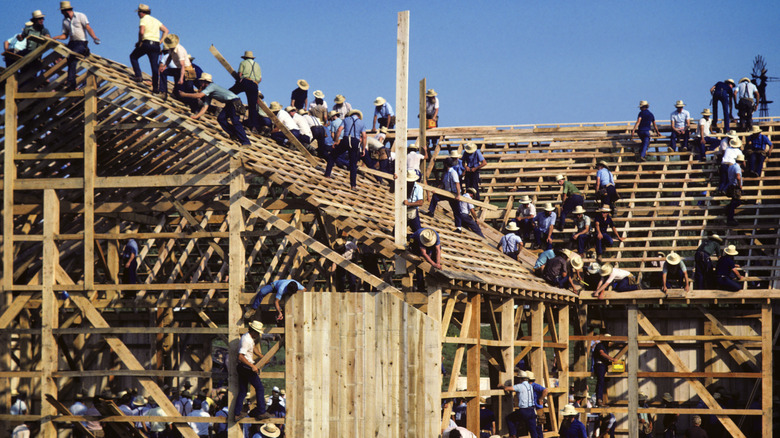
Traditional barn raising in American Amish and Mennonite communities worked something like this: A farmer in need of a barn would spend whatever time and resources were necessary to prepare for his barn raising. Once everything was prepared, he scheduled the big day. All but a very few highly skilled laborers were unpaid, and women and children provided food for all the families involved. It was a social event, lasting a day or two. The tradition was often extended to other critical farm tasks that would be impossible for a single family, like harvesting.
These days, barn raisings are mostly just a metaphor ... but a metaphor for what? They're sometimes compared to open-source development projects, crowdfunding, and volunteerism — all of which miss the point that the cooperative effort isn't optional, isn't political or philosophical, and isn't trivial. It's a way to give people what they need and, later, get what you need in return without friction. The spirit of the barn raising has no use for homeowners' associations and their rules about planting flower beds and building privacy fences because the entire neighborhood is inside the fence.
If not a barn, then what?
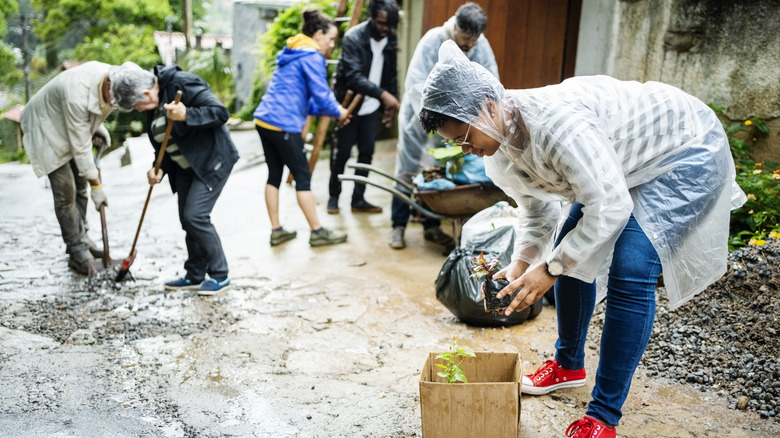
So how do we apply this principle of helping out neighbors? A good place to start is attending meetings. In a small town, this might be city council meetings; in a suburban neighborhood, it might be HOA meetings. Listen for needs, and if you don't hear any, ask if anyone knows of any. If someone has recently been confined to a wheelchair, do they need help building a ramp? If a family is having schedule struggles, can someone help watch their kids while the adults pound the pavement? If someone has two feet of water standing on their property, does anyone have a tractor with which to dig a French drain? And what about a scholarship fund that, by 2026, pays a substantial portion of graduating high schoolers' college tuition? All of these are real needs that arose in my community; the French drain was my own. And there are many more where that came from ... some mundane, and some positively heartbreaking.
And think about everything your HOA polices: landscaping quirks, failure to hide outdoor trash can eyesores, Christmas lights on Valentine's Day. HOAs have even been known to ban bird feeders, and you might be fined for having a $125,000 RV in your driveway because some dingbat decided it's unsightly. Meanwhile, nobody bats an official eye at a Kia EV4, and hideous contrived variety in architectural details is fine so long as a committee of accountants and schoolteachers approved the color scheme. Couldn't some of your community's time and resources be better spent?
It's cooperation, not charity

We often misunderstand the very idea of charity by seeing it as an obligation of the community to the individual. But, in truth, the community arises from the obligation, not the other way around. This is a social contract; it's nothing new, but this one is better than most. Reciprocity prevents work — the currency of this contract — from ever being considered charity. It's just help when help is needed, as any responsible person should provide.
Because helping those in need is simply part of being a member of the community, there's no nobility or status assigned to participation. It's just what you do and what everybody who wants to participate in the community does. Participation in barn raisings was expected of every able-bodied member of the community, and it was the only way to get the work done in most small communities. The social pressure from a church body, tribal leader, or small government is so intense that it's not even felt by anyone except those who refuse it and, subsequently, move away. Obligation, by definition, is not optional.
Bringing it all home
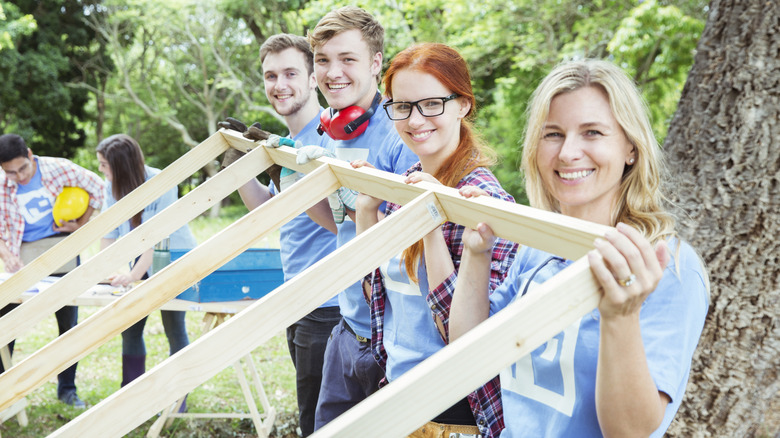
The real point here isn't about farms and barns, of course, but about understanding how much like farmers we are. We're mired in unprofitable businesses (as evidenced by consumer debt levels), partly bailed out by tax breaks and tax credits, and even that isn't working. The farms foreclose, and the suburbanites enter bankruptcy or have their $100,000 pickup trucks repossessed.
I've seen a barn raising of sorts first-hand when my father had a bunch of friends and family over to build his workshop in one afternoon, decades ago. It still stands solid to this day, haunted by a man who never got his 1968 El Camino fully restored. And my mother tells me the very land it sits on was once cleared by a group of my father's friends.
I've also seen barn raisings in spirit when neighbors in my small town have banded together to act like neighbors. Some people do this kind of thing almost every day of their lives. It's a small group of men trying to diagnose the ailments of a farm truck who end up rebuilding the engine before they're aware of how much time has passed. It's taking in a child when his remaining parent can no longer cope. If the wealthiest and poorest members of my community asked for my help, I hope I'd meet the obligation. And when spring comes and water still occasionally stands on the old orchard, uncomfortably close to my home's foundation, I'd expect both of those folks to show up with a shovel, a good story, and (I hope) a casserole.