

Skip Ordinary Painted Accent Walls: Joanna Gaines' Gorgeous Alternative

Accent walls were a thing—until they weren't. And now they're back again? If you Google this trend right now, you'll find that interior designers are split on this feature, but those who are currently pro-accent wall seem to agree on one aspect: The accent wall that's just painted a different color is out. Pros and homeowners alike are now gravitating toward focal walls that present more visual interest in the form of pattern, texture, or depth. And an element that offers all three is one that interior designer and former HGTV personality Joanna Gaines has frequently implemented in projects as an alternative to the ordinary painted wall. No, we're not talking about shiplap, but beadboard.
Unlike trim and molding, which are individual components that you need to arrange into a design, beadboard is paneling that has its own built-in pattern of vertical planks separated by skinnier ridges (beads) or grooves. From a distance, it resembles an architectural rendition of a pinstripe pattern. The pattern is only on the face of the panel while the back is smooth for ease of installation on walls, ceilings, and soffits. Today, you can find beadboard made of select wood species, plywood, MDF, PVC, and vinyl. They're typically unfinished and paintable to allow customization. For anyone wondering, beadboard isn't the same as wainscoting, which is not a panel style. Rather, wainscoting is a design feature in which you clad the lower half of walls using beadboard or other paneling, trim, and molding.
How to get the Gaines look in your home
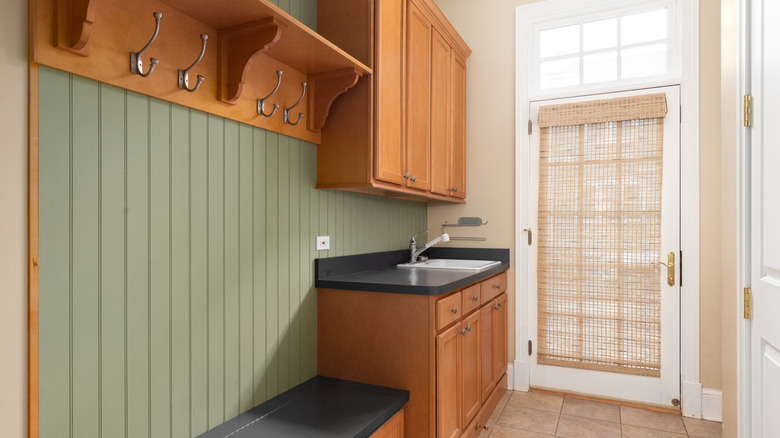
In an episode of Magnolia Network's "First Time Fixer," a series produced by Chip and Joanna Gaines, the homeowner subjects— who had zero renovation experience— took a page from the couple's book by installing and painting a beadboard wall. It's proof that you, too, can channel the Gaineses and DIY this gorgeous alternative to the basic painted accent wall.
First, you'll need to decide on where to install it. Popular locations include laundry rooms, mudrooms, foyers, dining rooms, and bathrooms. (In recent years, beadboard has made a huge comeback as part of wainscoting in dining rooms and bathrooms.) Once you choose, take precise measurements of the wall to ensure you purchase enough product. Shop online or at your local home improvement store for beadboard that you like, taking into consideration the material as well as installation type. But make certain that you're buying the right kind for the location. For instance, it's safer to go with vinyl or PVC for bathrooms and other spaces that encounter moisture and water.
Prep the wall by removing wall plates, baseboard, shelves, and crown molding. You'll be cutting holes to accommodate the wall plates, but the everything else will be mounted on top of the paneling. Using a table, circular, jig, or hand saw, cut the panels to size, including cuts to go around wall outlets. Install the beadboard per the product instructions. Tongue-and-groove and non-tongue-and-groove panels install differently. Paint the beadboard in a color of your choice before mounting back on any wall plates, molding, and shelves you removed.