

Move Over, Traditional Porcelain: The Durable, Crack-Resistant Dinnerware Option
We may receive a commission on purchases made from links.
Ask the average consumer what some of the most durable dinnerware is made of and you'll likely hear the usual: porcelain, stoneware, melamine, and so forth. But you'll rarely hear someone utter "Vitrelle." And yet, most people have probably used a Vitrelle dinnerware piece at one point in their lives without knowing it—and perhaps even dropped it without incident.
Vitrelle products can be mistaken for a type of fine chinaware, but instead of clay, it's made of three thermally bonded glass layers. Corning Glass Works—yes, the same Corning Glass Works that gave us the original PYREX— developed it in the 1940s for television screens, but in 1970 began using it to produce ultrathin and lightweight dinnerware under the name Corelle. Despite that delicate appearance, Vitrelle can actually rival other dinnerware materials in durability. By combining three layers to balance compressive with tensile stresses, the material supposedly has a higher likelihood to resist cracks, chips, and breakage than porcelain and ceramic when accidentally dropped on a hard floor. Search YouTube for videos demonstrating this, as well as showing side-by-side tests with porcelain, and you might be convinced that this is the dinnerware for you.
Should you choose Corelle Vitrelle over porcelain?
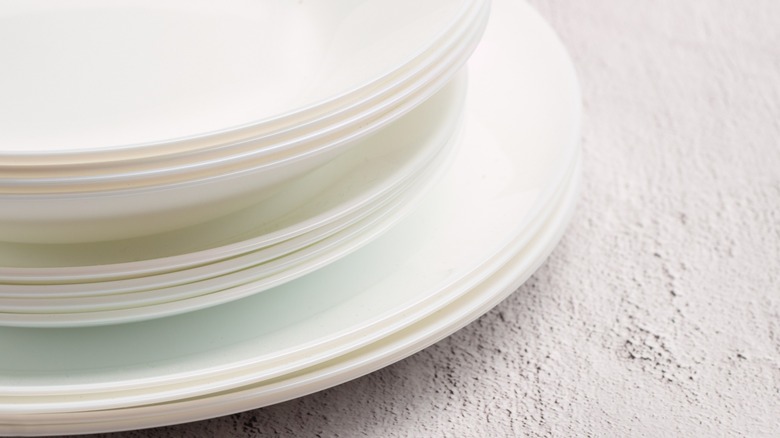
It really depends on your needs and how seriously you take online reviews, both good and bad. But here are the main reasons why or why not to choose Vitrelle. In addition to its surprising durability, an advantage of Vitrelle dinnerware is its super-thin profile. When stacked, the 2 to 3 mm-thick plates and bowls occupy nearly half the space that stacked porcelain items take, making it especially attractive to those with limited cabinet space . (Though if you're lacking kitchen storage, consider different ways of organizing your kitchen cabinetry.) Vitrelle products are lighter weight than clay-based porcelain, ceramic, and stoneware, but comparable to melamine, making it easier to handle, wash, serve, and carry than most other types of dinnerware. Vitrelle pieces are conveniently microwave- and dishwasher-safe, putting it ahead of melamine, which can't be microwaved. And for those interested, Vitrelle is made from up to 80% pre-consumer recycled glass and also made in the USA. One important thing to know is that select Corelle products are stoneware, not Vitrelle. For instance, all Corelle cups and mugs are stoneware due to the glass lamination process not accommodating cup shapes. So with those pieces, you're not getting the benefits of Vitrelle.
The biggest complaint about Vitrelle is that it isn't 100% unbreakable or shatter- and crack-proof. However, Corelle doesn't claim it is, only saying that Vitrelle is "resistant." Corelle also states on its website that all glass can break. There are posters across Reddit and Facebook that claim that their Vitrelle items shattered or broke, some from drops and others without even being touched (e.g. "exploded" while sitting in the sink). You'll also see some YouTube videos demonstrating the drop-test fails. While there's no official explanation for either of these scenarios, online theorists speculate that thermal shock or micro-fractures created by repeated drops are to blame. So, do what you will with this knowledge, but keep in mind that authentic Vitrelle products are positively reviewed for the most part—such as this 18-piece Corelle Vitrelle set, which currently has a 4.7-star rating on Amazon from more than 23k reviews—making it a potentially great alternative to porcelain.