

A Simple Way To Remove A Tree Stump Without Chemicals Or Heavy-Duty Equipment
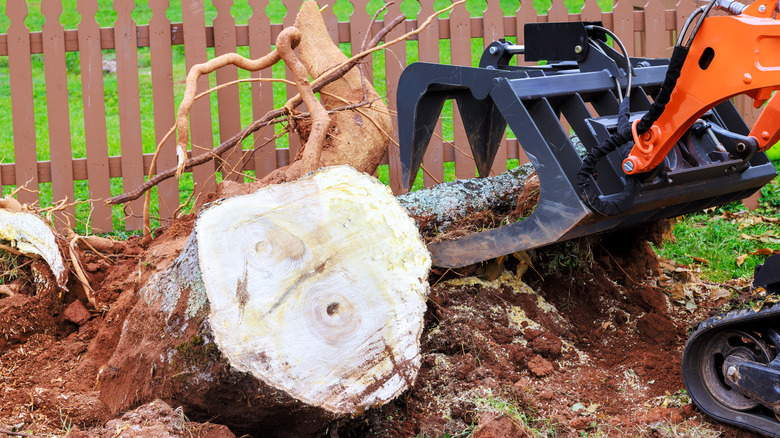
If you're hoping that tree stump in your yard would just rot and disappear, we've got some bad news for you. It'll earn squatter's rights and feature in your family photos sooner than it decays. Yes, removing it is a pain, but leave it there any longer, and it'll become a part of the landscaping. If that doesn't go with your aesthetics, then it's time you took some steps to remove it. Sure, you should think twice before pulling that tree stump out of the ground, but not when you can do it cost-efficiently using the tools you have at home. Just grab a spade to clear out the soil around the structure and use a chainsaw to cut through its roots. What a relief, right?
Having a leftover stump in your yard isn't just an eyesore hurting your curb appeal; it's a mower obstacle, a tripping hazard for kids and pets, it attracts pests, and it's a nagging reminder of yard work you haven't finished. Renting a stump grinder or calling in a pro to remove it can run you a few hundred dollars. And sure, chemical stump killers might sound like a good idea until you start a vegetable garden. It's also a bad option if you have kids and pets running amok. Not to mention that these chemicals can contaminate the groundwater; they can seep into the ground by rain or otherwise. And if those are the excuses you've been giving for procrastinating doing it, set aside a weekend, create a playlist, and grab the listed tools. There's just one caveat to this: You should have experience and be comfortable working with tools, or this project can go sideways quickly.
The stump size plays an important role when removing a stump by hand
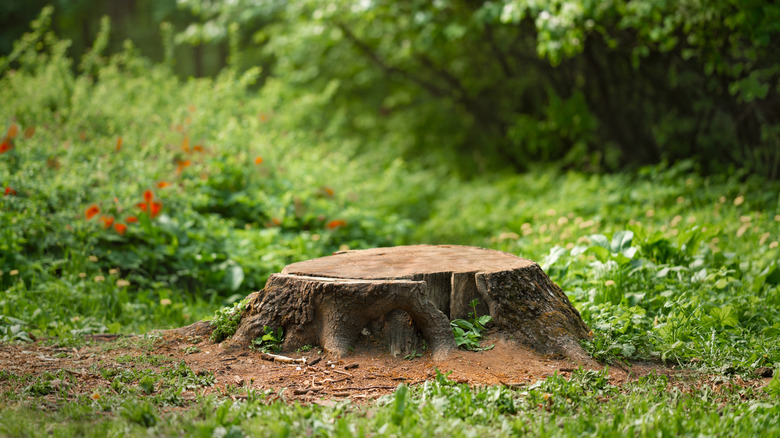
It doesn't matter if you have a shovel, pickaxe, or a mattock; if the trunk was part of a big tree, then this is not a one-person job. But if it was a small or medium-sized tree and the trunk was cut low, you might be able to access its root system. Moreover, pay attention to the stump size since it'll determine how easy or challenging manual removal would be.
To elaborate, your work would become easier if the remaining stump is roughly 1.2 meters (or 4 feet) tall. This height is ideal as you can grip it to pull out the trunk once you have prepared the ground around it. Pulling out the stump would become much harder if the stump is any shorter than that. So, bring out your tape measure to get a good read on the eyesore in your yard. Also, it'd be easier if your tree was cut recently since it'll be comparatively solid, hence easier to grip during removal. For older trees, fungi can break down the wood. As such, it might break apart during removal, increasing your workload.
Dig around the stump, cut its roots, then pry it out
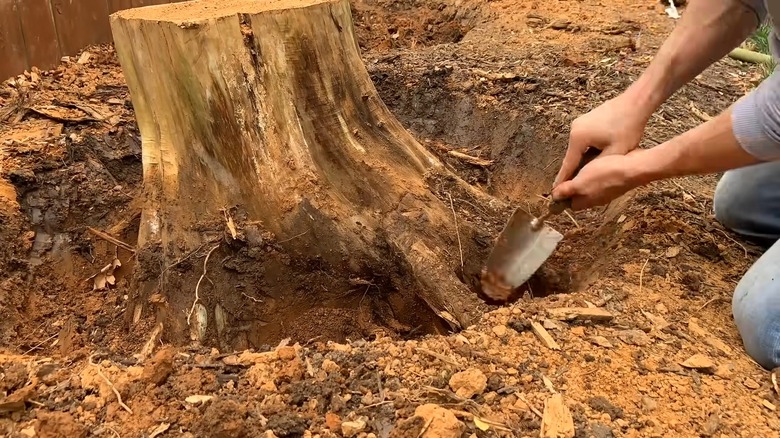
When you're ready to take action, wear heavy-duty boots, rubber gloves, and protective eye and ear gear while working on the stump. Afterward, start digging a narrow ditch using a mattock or pickaxe around the stump and remove the soil. Clear out about 8 to 12 inches from the edge of the trunk to bring the hidden roots into focus. If your tree was bigger, you'll have to dig a wider circle to reach the root system.
Now, focus on roots holding the stump in place, a.k.a. the anchors. They're usually more chunky than smaller, thinner ones and are, resultantly, more difficult to eliminate. Doing this will help narrow your perimeter, as you can just work on cutting them using a chainsaw instead of working on the entire root system. Keep removing the soil around the roots by hand (a hand shovel will come in handy) so that you don't end up trying to cut a stone or rock.
Cut the visible anchor roots with loppers, a small saw, or a mattock. And instead of hacking through the roots, be strategic — make two cuts a few inches apart and remove the part in between. This creates space around the stump and roots, making it easier to loosen and remove the leftover trunk. When you're done, try shaking the loose stump (get a snatch block when dealing with a heavy trunk) to identify residual anchor roots and focus your energies accordingly. If you find a root that is still holding the stump in the ground, remove it as well. Once enough roots are pulled, pry out the stump carefully.