

How To Help Stop Grass From Clumping On Your Mower (Hint: It's Not WD-40)
We may receive a commission on purchases made from links.
When I operated a gardening and landscaping company with my wife during the 1980s and 90s, it was my job to make sure our two lawnmowers were ready to go when we arrived at a job site. They were both gas rotary mowers, and the job of course entailed lawnmower maintenance and tune-up tasks for the engine, changing the oil, topping off the fuel, and keeping the blade sharp. But it was just as important to control grass buildup on the deck and blade, thus ensuring the mower would cut cleanly without overworking. The technique I found most effective was simply to clean off the grass cuttings after every use.
Sometimes I would grab a cheap kitchen staple like PAM and spray the blade and undercarriage to prevent grass from sticking and make removal easier, but that extra step usually wasn't strictly necessary. Even if you spray PAM or some other lubricant on the deck, it gets covered by the natural juices that fly around as the blade is shearing off grass. The result is a green coating that covers the lubricant.
A lubricant — like cooking spray or WD-40 — can make removing this coating easier, but it was just as easy if I made a habit of cleaning the mower deck after every use. Besides, regular cleaning gave me the chance to dig grass out from crevices behind the blade before it had a chance to build up and affect mower performance.
Techniques for cleaning and preventing grass buildup
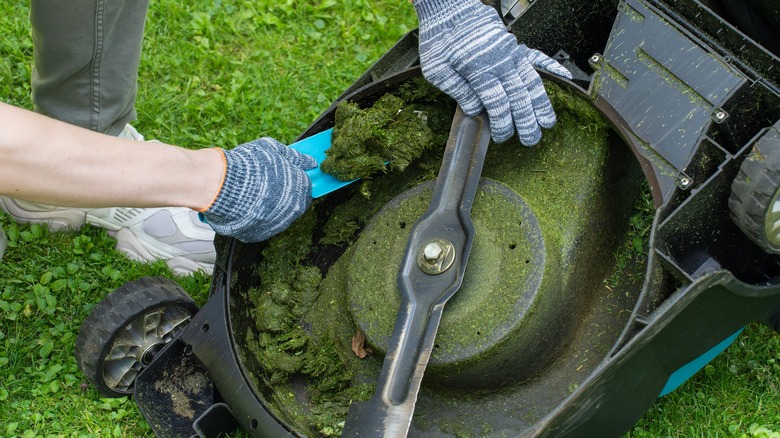
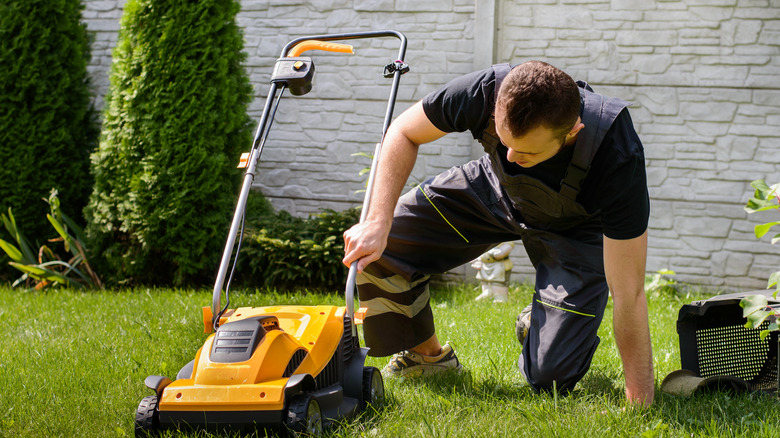
You can clean a lawnmower by turning it on its side (with the carburetor facing up), or you can turn it all the way over onto its back. Either way, you have to prevent fuel from flowing into parts of the motor where it shouldn't be, or onto the ground. I would usually operate the mower until it ran out of gas, but if there wasn't time for that, I'd empty the tank with an inexpensive plastic hand pump, like this Zufecy Hand Siphon Pump (safe for most fluids), and replace the gas when I finished.
The technique I used for cleaning wasn't particularly high-tech; I'd simply scrape off grass with a putty knife, making sure to reach the knife behind the blade to get grass lodged in the spindle. Then I'd remove the green film from the deck and the blade with a scrub brush. Occasionally, after a big job, I'd hose down the mower with a garden hose. Modern lawn mowers have cleaning ports to which you can attach the hose, which makes the task easier and increases efficiency.
In my opinion, there are three other integral ways to prevent grass buildup without having to lubricate the deck and blade. The first is to avoid letting your lawn grow too high, the second is to mow only when the grass is dry, and the third is to keep the blades sharp so they cut grass cleanly rather than shredding it.