

Leave Bench Grinders Behind: A Cheaper Alternative For Removing Rust From Metal Fast
We may receive a commission on purchases made from links.
When it comes to metal tools and fixtures, chances are at some point you'll want to know how to remove rust. There are plenty of ways to do it, some more effective than others. A bench grinder, for example, is a great tool for this task. There's a lot you can do with a bench grinder, including removing rust and corrosion. However, bench grinders are quite expensive: Prices range from $50 to over $500, with wire wheel attachments running $15 to $30 each. If you don't already have one, you may be better off finding another way to get rid of that rust, especially if you're just dealing with a tool or part here and there. One clever hack that uses the same principle as the spinning wheels of a bench grinder is to attach a wire brush to a drill or impact driver. As with the bench grinder, the smaller steel wire brush rotates quickly, creating friction that physically scrapes away rust and oxidation.
Wire wheels and so-called cup and end brushes are easy to use and come in a variety of shapes and sizes, allowing you to choose what works best for a given project. This setup doesn't have as much power as a bench grinder (particularly if you're using a cordless drill, which tends to offer less torque and fewer RPMs than a corded version), but it still does the job, especially when the rust is only on the surface. What's more, the drill attachment makes your grinder portable and perfect for working in tight corners or around features in the yard, kitchen, or garden that can't be moved to the workshop. The best part? Picking up a wire wheel attachment for your drill will only put you back around $5 or $6 per attachment.
How to use a wire wheel attachment to remove rust
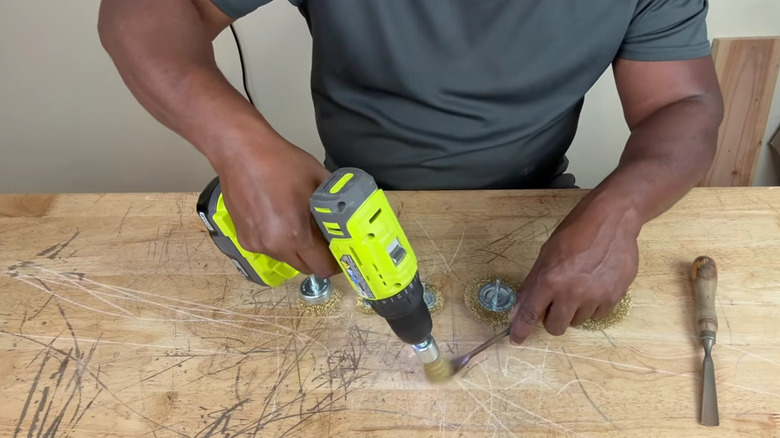
When choosing a wire brush attachment to remove rust, look for higher-quality versions, as users say you get what you pay for. One well-reviewed option — 4.3 stars out of 5 with over 360 reviews — is the 4-piece Avanti Pro removal set for about $19. It gives you several size and shape options to work with. You will also need a drill or impact driver to attach your wheel to. For this project, protective eye wear is a must.
While we are talking safety, check the safety rating on your wire wheel. These attachments are labeled with a maximum RPM — usually 4,500 RPM. Both cordless drills and most corded versions feature maximum RPMs that run well below that of the attachment thresholds. Then choose the right size of wheel for the job — a 1-inch cup wheel works best for tight spaces and small hand tools. A 4-inch wire wheel, in contrast, is best suited for larger, broader surfaces. You can also opt among steel, brass, or brass-coated carbon steel bristles, depending on your needs.
If everything is good there, it is time to install the attachment: All you need to do is insert the brush directly into the chuck of your drill and tighten it down. Then you can go over the surface of the metal you are trying to remove rust from with the wire wheel, using light pressure. This will take a few minutes on a small tool. If you are still having problems getting all the rust off, try applying a liquid rust removing product or a mixture of baking soda and vinegar and letting it soak for a bit to help dissolve the rust.