

The Storage Essential Ancient Greeks Couldn't Live Without
If there's one thing that's held true through the ages, it's that people have always had the need for storage. These days, people are constantly looking for solutions for organizing pantry items, knick-knacks, and linens, going so far to upcycle scrap wood into countertop storage trays. In ancient times, the Greeks and other cultures across the Mediterranean used large vessels called pithoi (in the plural, and pithos, in the singular) to hold — well, pretty much anything.
Pithoi were large, often measuring over 3 feet in height, with some being as tall or taller than the average person. They were also wide, with some models measuring 2 or 3 feet in diameter at the top. The storage jars were typically wider at the top than at the base.
Unlike other forms of ancient Greek pottery, pithoi weren't ornate. Since they were often designed more for function than form, the jars usually weren't elaborately decorated. Archeological digs have uncovered some pithoi that may have been more for decoration than storage, though. For example, in the 1960s, archeologists dug up a pithos on the island of Mykonos that features an elaborate relief carving of a scene from the Trojan War.
Uses for pithoi
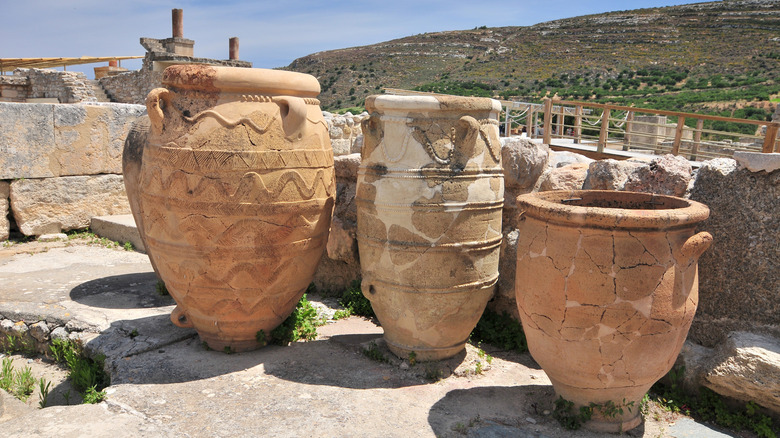
Given their large size, the ancient Greeks used pithoi to store large volumes of food items, such as grain, oil, and flour, and preserved items, like dried fruit or fish. Several have been found in what are believed to be the storerooms of ancient palaces, such as the palace at Knossos of ancient Crete. Since the vessels were made of clay and watertight, they also occasionally stored liquids, like wine or water, or were used as an ancient cistern water system — the Greeks placed pithoi in their basements to collect rainwater.
Outside of food and water storage, pithoi had a few more uses. Like chytra, a kitchen essential the ancient Greeks couldn't live without that resembles a cooking pot, pithoi had ritual uses, too. They may have been used to hold offerings during religious ceremonies. Occasionally, the vessels served as coffins or were used to hold grave goods during funeral ceremonies. The large jars may have also acted as shipping containers or packaging for transporting other ceramic pieces.
Since pithoi were large and made of clay, they were heavy, even when empty. Some had looped handles on two sides, which were large enough to thread a rope or pole through. Several people could then move a pithos together, lifting the pole or rope. Varying in size and usage, the pithos could be seen as our version of the plastic storage box.