

The Unusual Vintage Pyrex Mug That's A Rare Thrift Find Worth Hunting For
We may receive a commission on purchases made from links.
Nothing makes you beeline to the kitchen aisle at the thrift store like the thought of scoring some vintage Pyrex. Any enthusiast knows that certain colors and limited releases are highly sought after, with collectors willing to pay considerably more for those pieces. Condition matters; there's an important difference between damage and a manufacturing error. Chips and scratches lower a piece's value, but an unusual misprint could make it worth more. Enter the mystery of the Pyrex Cross-Stitch mug.
The Pyrex Cross-Stitch mug is anything but ordinary and could be hiding in plain sight among the clutter of preloved mugs. Adorned with rows of small red or blue Xs that look like an embroidered cross-stitched design, the white, milk glass mug is many collectors' white whale. According to certain Pyrex resources, the pattern appears so infrequently that its origins remain uncertain. It's been widely theorized that the design was some sort of specialty or promotional item, not a part of a standard release.
That's why this specific mug is so coveted; it's the mystery that makes it desirable. There isn't an accurate set price either, because so few have surfaced through the years. But some social media users have shared screenshots of past listings that have sold for the price of a monthly car payment. And while the term "rare" is totally overused in online reselling, the Cross-Stitch mug belongs on any list of vintage Pyrex items you should never overlook.
How to identify and care for a Cross-Stitch Pyrex mug
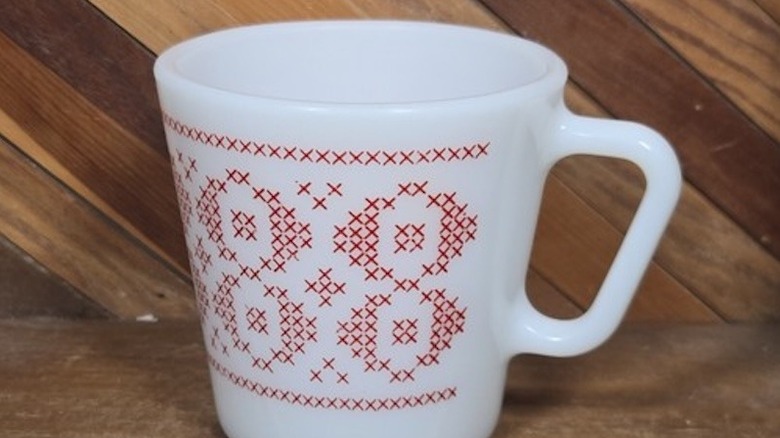
If you're trying to identify authentic vintage Pyrex, the pattern, shape, and backstamp should be able to give you some clues. Look for an opaque-white body with a diagonal-style handle and rows of tiny red or blue Xs. If you zoom out, the stitches form circular or figure-eight motifs between matching bands near the top and bottom. Known examples of the series are embossed "Pyrex 1410 10 Oz." underneath and do not have reheat-safety wording (so keep it out of the microwave), which could indicate an earlier production date. The pattern was also used on Pyrex 1416 cereal bowls, so look for coordinating pieces. Where there's one, there's most likely another — keep your eyes peeled.
Don't rely solely on a seller calling this relic "rare," as most of the time that's just a popular buzzword to get clicks. Always compare the design and backstamp with documented examples, and take a look at the piece under a bright light, which will show you any hairline cracks. As another rule of thumb when thrifting Pyrex, there's a big difference between PYREX and Pyrex. Pieces stamped with the lowercase logo generally come from newer production and tend to be less valuable to collectors than older pieces bearing the uppercase mark.
If you find this diamond in the rough and decide to bring one home, whatever you do, don't run it through the dishwasher. Always hand-wash a vintage find with lukewarm water and mild dish soap, avoiding steel wool or anything abrasive to preserve its pattern. Dry it carefully and put that bad boy on display to treat it as a collectible rather than an everyday coffee cup.