

Put Down The WD-40: There's A Better Way To Fix A Sticky Door
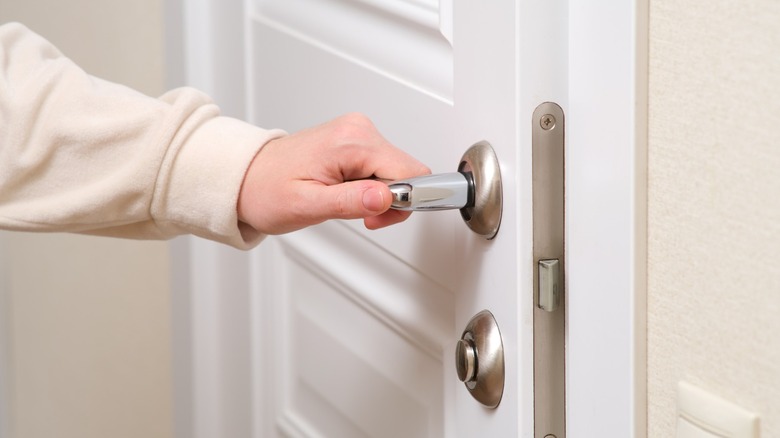
When a door gets sticky and hard to open or close because of corroded hinges, the go-to solution for many is to use WD-40 to remove the rust and loosen the hinges. But doors stick for reasons other than rusty hinges, and WD-40 doesn't always help. For instance, if you're dealing with a door that rubs against the frame and is subsequently tough to open or close entirely, making the edge slick with WD-40 (or any kind of lubricant for that matter) won't do much to keep it operating smoothly for the long term. Instead, you may be able to fix a sticking door with a more permanent solution by sanding down the edge of the slab.
In general, you can tell if sanding will make your door easier to close by noting if the edge makes contact with the jamb when you close it. Solid wood doors and, to a lesser extent, hollow-core doors are able to absorb moisture. The slab will then expand as a whole and often end up squeezing against the door jamb. You may experience this more often in the summer and other high-humidity periods.
By sanding off a bit of the sticking door edge, you'll maintain just enough of a gap to let the door open and close smoothly. Before you pull out the sandpaper, though, check the hinges as an initial point of attack. You can sometimes fix a door sticking at the top of the jamb by adjusting the hinge knuckles or tightening the screws going into the door slab or the frame. If the hinges look good and need no adjustment, grab your sanding equipment to shave off the excess wood on the slab.
Sanding the edge of a wood door
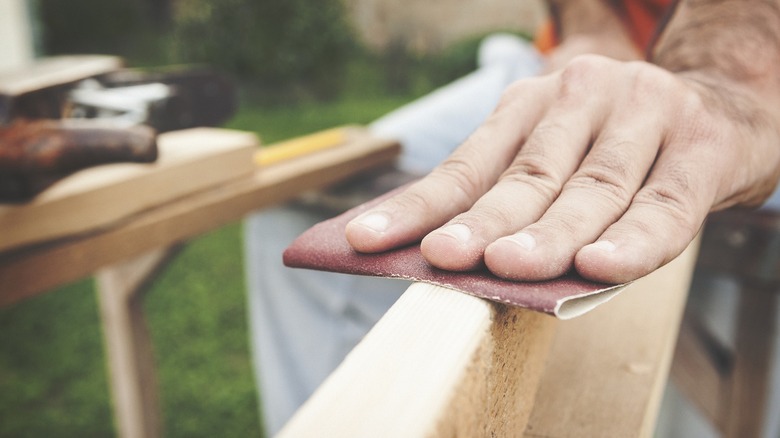
Sanding the edge of a door doesn't have to be a big project, but sometimes it is. If the edge of the door is finished, it's often easier to strip the paint than it is to sand it off, and that's a simpler and less messy job if you take down the door. On the other hand, if the door has only a light coat of finish (or no finish at all) and you can see where the wood contacts the jamb, you might be able to sand down that spot while the door is still hanging.
Sanding a wood door is usually a job for an orbital sander, but if the door is hardwood, or you have to sand a lot off, a belt sander is faster. Start with a coarse grit to remove more wood more quickly, and finish with finer grits to create a smoother surface for refinishing. In extreme cases, when you have to remove a really significant amount of wood, you will save a lot of time by using a rasp or a hand planer. If you have to resort to either of these tools, you'll definitely want to take the door down, stand it on edge and brace it securely, so you can work more easily. These tools leave marks, so after you're done with them, you'll still need to sand the door edge to smooth the wood.
The last step is to apply a new coat of paint or finish matching the rest of the door. And this isn't just for looks. The finish helps protect the wood from moisture and prevent swelling, which would just make the door stick all over again.