

Forget Traditional Birdhouses: Upcycle An Old Milk Carton With An Easy DIY

We may receive a commission on purchases made from links.
Setting up a birdhouse in your yard is an easy way to invite cavity nesters, such as eastern bluebirds, house wrens, woodpeckers, black-capped chickadees, certain owls, nuthatches, and tree swallows. Besides turning your otherwise static outdoors into a lively space, they'll keep the pest population in check, help with flower pollination (if you maintain a garden), and gorge on weeds. However, if you don't wish to hang the same traditional design you keep seeing in your neighbors' grounds, upcycle an old milk carton to attract birds into your yard with this modern birdhouse DIY.
With this colorful DIY birdhouse, you can minimize your household's waste generation and gain a new birdhouse for free. Win-win! Plus, it's a great craft to try with your kids. It won't just allow you to reduce their screen time — it will also unlock their creative potential. Bonus advantage: there's no right or wrong way to DIY a bird-attracting feature out of a milk carton. As such, you don't need a set list of supplies, except the basics, like a milk carton, a sharp X-Acto Knife, a clear sealer (you don't need anything fancy; Mod Podge will work) to protect it against the elements, and some heavy-duty twine or jute rope to hang the structure from.
Decorative elements, including paint, napkins, tissue paper squares, craft sticks, twigs, washi tape, pipe cleaners, and adhesive craft foam, can be used at your discretion. Just don't forget to rinse out your milk carton with a soapy water solution to make the birdhouse safe for small avians to nest in. Many social media DIYers repurpose broken paintbrushes or twigs into perches. However, try not to build a perch, as the birds resting inside can become an easy target for larger birds and other garden visitors, including squirrels.
How to DIY a birdhouse using an old milk carton
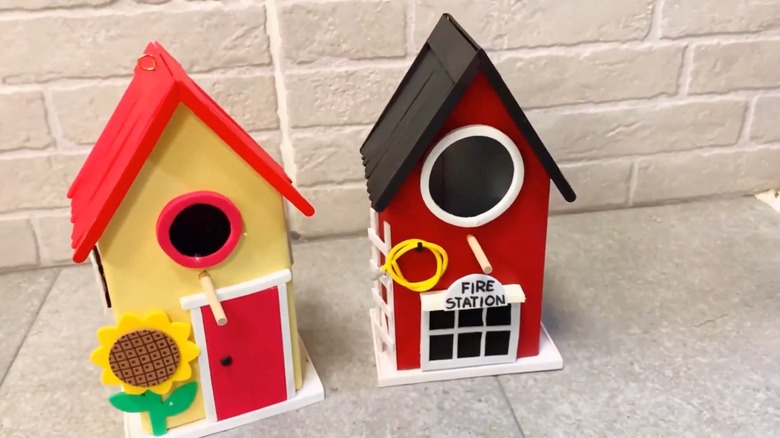
While your milk carton dries, decide your birdhouse's design. Do you want the entrance to be circular? Or, would you rather give your tiny little friends an arched door to move through? A rectangular or square opening will look good, too. Then, determine the species you'd like to see more of in your yard, as that will inform what size hole should be in your birdhouse. For instance, eastern bluebirds and tree swallows can make do with a 1.5-inch window. But chickadees and house wrens don't need an opening bigger than 1 to 1.25 inches. In case this seems like too much work, a standard circular hole with a diameter of 1.25 inches will suffice.
@amanda.stevens13 This is one of my favorite kinds of activities: 💸 free ♻️ recycled 🎨 creative 🌿 gets kids outside All you need is: 🥛 empty milk carton ✂️ scissors 🎨 paint 🪢 string 🦅 birdseed (optional) My favorite activities are the ones that remind kids that creativity doesn't have to come from a store—- it can start with something headed to the recycling bin! Save this idea for a rainy day or summer craft! 🫶🏼 #recycledcrafts #kidscrafts #naturecraft #summeractivities #creativekids
Now, use a pencil to draw your door before cutting it open with a utility knife. Also, punch two holes in the roof to loop the twine through. Moreover, poke a few holes in the bottom to let rainwater drain through easily. Line the bottom with moss and put in a few small pebbles to add a little weight to your birdhouse. To hide its recycled origins, sand it prior to embellishing it. Although this step is optional, a glossy surface is generally not the easiest to hide with paint and you'll end up using three or more coats at the priming stage alone. Alternatively, it'll be easier to glue napkins — decorative or basic white — or tape to a matte base.
Make a thatched roof by gluing craft sticks on top of a leftover piece of cardboard. Add finishing touches with painted twigs, colorful beads, self-adhesive foam sheets, cardboard cutouts, and stickers. Finally, seal your birdhouse and hang it away from features predators can take advantage of, like trees and fences.