

Skip WD-40: There's Another Way To Keep Your Hose Connections From Seizing
We may receive a commission on purchases made from links.
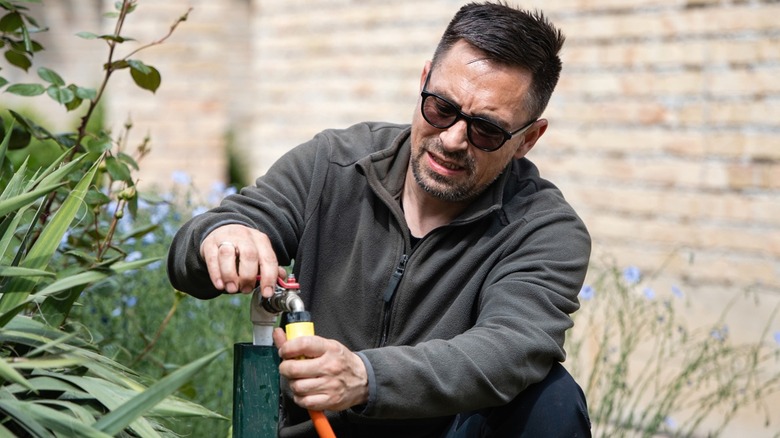
Any gardening veteran will be familiar with the experience of tidying away garden hoses at the end of the summer only to discover that they have mysteriously fused to their spigots. Seizing is often caused by galvanic corrosion when two metals are in contact and connected by an electrolyte, such as water, that fuses them together. While this situation may seem like yet another on a long list of surprising uses for WD-40, the go-to concoction for all kinds of sticky problems, there's actually a better option to maintain your hose connections and prevent issues: plumber's grease.
Also known as silicone grease, plumber's grease is specifically engineered to guard against moisture, friction, and corrosion in plumbing systems, making it the perfect protective measure against seizing hose connections. If you have a tube of plumber's grease like KEZE Silicone Grease, you can coat the threaded surfaces to shield them from wear and ensure a tight seal while maintaining movement in the connection. Plus, it's nontoxic, so it won't contaminate any water going into the garden. You could, of course, use the WD-40 trick for your garden hose in a pinch, but that is actually best used for penetrating and helping to loosen an already seized hose attachment. Silicone plumber's grease, on the other hand, is a longer-lasting true lubricant that will better protect the parts, reduce leaking, and create a barrier between the threading that keeps the hose easy to remove.
How to apply plumber's grease to your hose connections
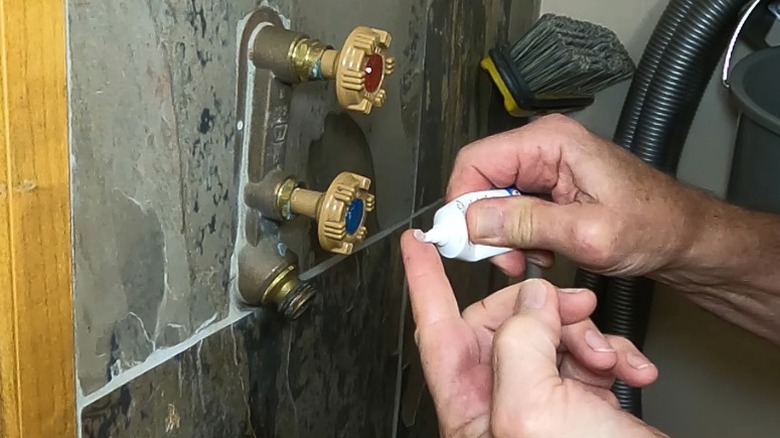
It's important to note that not all types of plumber's grease are created equal. There are two main types of plumber's grease: silicone oil-based and petroleum-based. Each is designed for different jobs. For a hose, you'll want to use a silicone-based grease, which is compatible with rubbers and plastics and best suited to fixtures like faucet valves and O-rings.
At the start of the summer season, when you're setting up your garden hydration system or backyard water park, you'll want to apply your plumber's grease as a prophylactic against hose seizing. Of course, if it's already seized, you'll have to remove your stuck garden hose with a pair of pliers. Once you have the hose disconnected from the bib, clean and dry all the surfaces you intend to coat to ensure no dirt or moisture will block the lubricant. Then, apply a small amount of the grease (about a pea-sized amount or smaller) to the respective contact points until everything is covered in a thin but thorough layer. You can use either your fingers, a cotton swab, or a paint brush for this application, but remember to wipe off any excess grease once you've joined the fixtures. Apply a layer of plumber's grease to your garden hose and faucet threads once or twice a year or whenever you start to notice your hose is becoming tough to disconnect.