

The WD-40 Trick You Need Before Using Your Garden Hose This Season

We may receive a commission on purchases made from links.
Does anything work harder in your yard than a garden hose? Whether you're still trying to figure out how often you should water seedlings to ensure happy and healthy growth, or your lawn is a shimmering emerald carpet thanks to your precise watering schedule, a garden hose is often an unsung hero when it comes to landscaping maintenance. Unfortunately, it's also one of those items that sits outside all season long, getting exposed to rain, sun, heat, and dirt that can turn it into a leaky mess. The couplings on each end are the most vulnerable spots, since the metal can easily rust or corrode. Luckily, it takes only a few seconds to quickly spray your water spigot and couplings with a little WD-40, the trick you need before using your garden hose this season.
WD-40's name sums up exactly what the formula does: water displacement. Originally created by aerospace chemists in 1953 (who nailed the perfect solution on their 40th attempt), its popularity has grown for automotive and household use over the years. There are dozens of surprising uses for WD-40, but spraying it on the ends of your garden hose makes perfect sense once you understand exactly how the product works. In a company blog post about the science behind the spray, WD-40 experts explained that it combines solvents and reactants that break down rust, lubricants that provide slickness between stuck parts, and additives that keep buildup from coming back.
Spray WD-40 on your garden hose, spray nozzles, and spigots
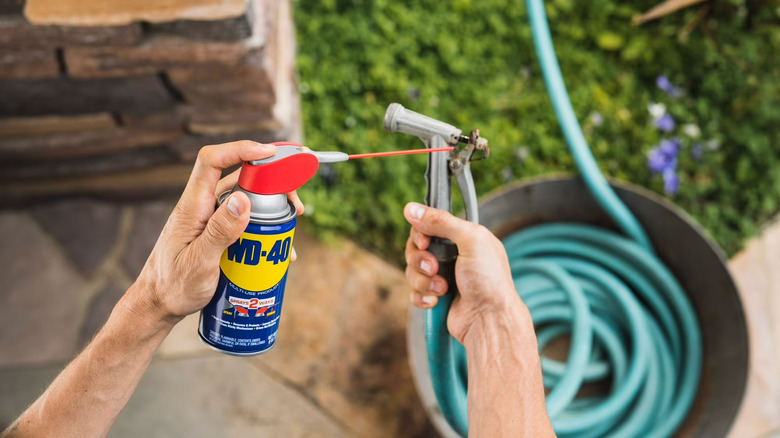
If you've ever struggled to remove a garden hose nozzle or detach the end of your hose from a spigot on the side of a house, you've experienced the exact problems using WD-40 on your garden hose can prevent. Essentially, the combination of dirt, water, and time create a rusty bond between the ends of your hose and whatever they're attached to. That means you'll need to use even more force than usual to loosen the fittings, which can strip threads and damage fixtures. Trying to accomplish the task with grungy gardening gloves or wet hands can make the process even harder.
To avoid the hassle altogether, simply spray your spigots, both ends of your garden hose, and the fittings on your spray nozzles with a little WD-40 before connecting them. By taking just a few seconds to make sure they're lightly coated in the classic water displacing formula before screwing them together, you'll all but eliminate the possibility of rust and corrosion building up as you use your hose all season. This tiny, preventative step can make disconnecting hoses to winterize your faucets, one of the worst fall home maintenance tasks, practically effortless.
It's a cheap fix, too. A small can of WD-40 multi-purpose lubricant spray costs under $6 at Walmart or your local home improvement store. Because it's not a caustic solvent, it's safe on synthetic rubber hoses (wipe away any excess), and you won't need to use much: Just a few quick squirts should do the trick!