

The Rare Vintage Pyrex Set You'd Be Thrilled To Find — And It's Not A Casserole Dish
We may receive a commission on purchases made from links.
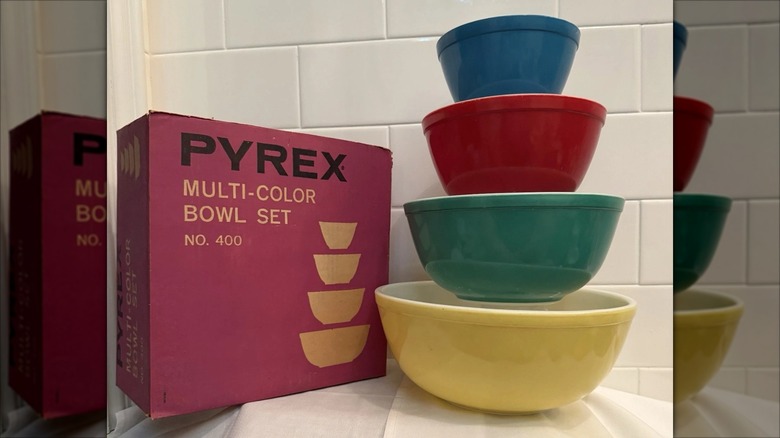
Some Pyrex fans devote their collections to the nearly impossible to track down, seeking out rare prototypes like the Barcode pattern or the limited production run promotional items. For other collectors, the thrill is in the nostalgia. They remember various Pyrex dishes adorning the kitchen counters or dining room tables of their youth. And they want that back. So while the four-piece Primary Colors mixing bowl set isn't as rare as say, a Lucky in Love casserole or an unmarked, vintage New Mexico dish, it's still in demand among plenty of Pyrex fans.
Nostalgia aside, there are a few other reasons why people seek out the Primary Colors set. The four bowls, which come in yellow, green, red, and blue, were the first Pyrex bowls to feature color on top of the opal-milk-white glass. There are also two forms of the bowls. The oldest form, dating from before 1950, has a more pronounced base on the underside. The older bowls also don't include the model numbers on the bottom. Bowls produced after 1950 have a flatter base, similar to that of any other Pyrex mixing bowl. They also include the model number on the backstamp.
When the Primary Colors mixing bowl set first hit the scene, it retailed for a jaw-dropping price of $2.50. Today, you're likely to see a price with the decimal point moved two spaces to the right — a complete set of bowls can sell for $250 or more, depending on condition.
Go back to basics with Pyrex primary colors
In the 1940s and '50s, millions of Pyrex mixing bowls were produced and sold. Given that Pyrex opalware was originally made for use by soldiers, who needed dishware that was virtually unbreakable, many of those bowls have survived to this day. Not all of them are still in good condition, though, and their overall condition affects their value, not to mention how attractive they'll look sitting on your shelf.
Should you come across either a full Primary Colors mixing bowl set in the wild or a lonely bowl or two, inspect it closely. Ideally, it'll still be shiny and vividly colored. It's sometimes the case that Pyrex bowls have lost their luster due to something called "dishwasher damage." Older dishwasher detergents used phosphate, which stripped the bright color off of opalware, leaving bowls with a faded, sometimes hazy appearance. Dishwasher damage is easy to spot, as the bowls look like ghost versions of their former selves. Other signs of damage include scratches on the bowl's interior and chips along the edge of the bowl.
Also worth noting is that Pyrex produced plenty of solid-colored bowls over the years. So, you may come across a blue mixing bowl that's part of another pattern, such as the Horizon Blue pattern, from 1969, rather than the Primary Colors set, or a yellow bowl that belongs with the Daisy pattern. The bowl's size will help you determine if it's Primary Colors or not — the blue bowl is the smallest, 1.5 pints, and the yellow the largest, 4 quarts.