

The Evolution Of Washing Machines Throughout History

According to the most recent American Time Use Survey, the average person spends over 62 hours each year doing laundry. We admittedly have it way easier than our ancestors, who relied on primitive washboards, hand rinsing, wringing, and hanging clothes out to dry. Instead of searching on TikTok for washing machine hacks that make laundry less of a chore, people relied on communal washhouses or gathered at local rivers and streams to clean their clothes. While there's still something charming about a clothesline full of linens billowing in the breeze, early laundering methods involved tremendously difficult and time-consuming physical work.
As a result, inventors began to explore various ways to improve the process through mechanization. In 1691, British inventor John Tyzacke was awarded the first known patent in the "washing and wringing machines" category. Less than a century later, per The Librarians, German inventor Jacob Christian Schäffer confidently wrote in his 1767 washing machine pamphlet, "I think my work here is done... We can rightfully describe the new invention as a convenient, efficient, and lucrative machine in every way." Could he have imagined his humble wooden tub would become an origin story for the entire washing machine industry?
Thirty years later, the first "clothes washing" patent was issued to American inventor Nathaniel Briggs. Although there's no definitive record of how his device worked, laundering was an arduous affair at the time. It could be so cumbersome that it would often take place on a monthly basis or, in some cases, even less frequently. It makes sense, then, that industrious types would continue to put their own spin on washing machines in the centuries ahead.
The first washing machines were powered by hand
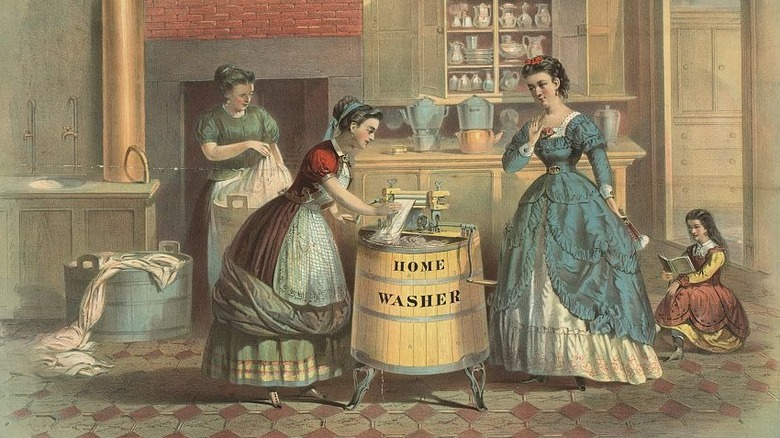
The evolution of washing machines throughout history was a long process involving plenty of trial and error. Early versions were clever yet crude, and the earliest patents for washing devices typically included wooden tubs and paddles that were manually powered through hand-cranking. Inventor James King was awarded the first American patent for a hand-powered washing machine with a drum in 1851, although evidence suggests the original rotary washing machine was conceived several decades earlier by Henry Sidgier, a Brit who registered his invention in 1782. Both men recognized that soaking and gently agitating soiled fabrics instead of aggressively scrubbing them against rocks or boards prevented damage to clothes caused by friction. The designs contained rudimentary versions of the perforated cylinders found in many household washing machines today.
Until the late 1800s, most of these washing machine advancements were intended for commercial use in washhouses. Many of the patented ideas were never actually produced or sold. But in 1874, the washing machine was reimagined for everyday homes by William Blackstone, who built one as a birthday gift for his wife. Its compact size made his invention practical for homemakers, who were thrilled to leave the arduous task of scrubbing clothes against a washboard behind them. Although many families would continue to use large tubs, laundry bats, washboards, and manual wringers for decades to come, Blackstone's birthday gift is widely considered to be the true birth of the residential washing machine industry.
Despite these advancements, washing machines remained a largely manual affair throughout the 1800s. However, when Americans began embracing electricity, the dirty work of domestic life entered another exciting cycle.
Electricity completely changed washing machines in the early 1900s
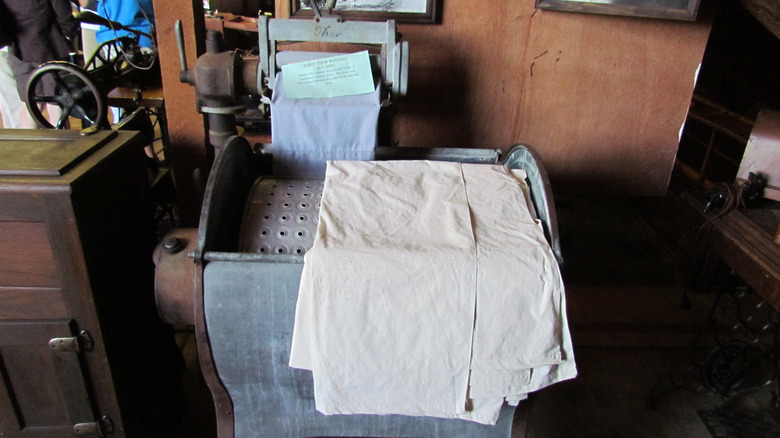
Electricity completely transformed the washing machine industry in the early 1900s. Along with changing how inventors approached the design process, the emergence of electricity also revolutionized the way people thought about household chores. In 1908, Alva J. Fisher introduced the first electric washing machine. The "Thor" consisted of a simple metal drum and an agitator that kept the clothes inside from bunching up. It was powered by a Westinghouse motor that moved the drum, and featured a clutch that allowed the agitator to switch directions, along with an emergency stop rod. Around the same time, Dr. Otto Rohm invented what can be described as the first real laundry detergent (although his enzymatic formulas were very different from the products added to washing machine loads today).
Of course, it took longer for newly emerging power grids to reach rural areas. But Iowa farm boy F.L. Maytag remained undeterred, developing a multi-motor gasoline engine washer marketed specifically to rural homemakers. By 1919, the company discovered how to cast aluminum washer tubs that were lighter, more durable, and far less prone to leaking than traditional wooden tubs.
These washing machine advancements were extraordinary for their time, but doing the laundry was still a major ordeal. Electric- and gasoline-powered machines did take the hard manual work of scrubbing out of the equation. But they still had to be manually filled and drained. Gas models were loud and produced smelly fumes, while electric ones were prone to short-circuiting when exposed to dripping water. Plus, wet laundry still had to be wrung out, either by hand or with machines that could easily catch fingers and hair. Fortunately, major advancements in automation changed washing machines for good.
Mid-century advancements in automation reduced manual laundry tasks
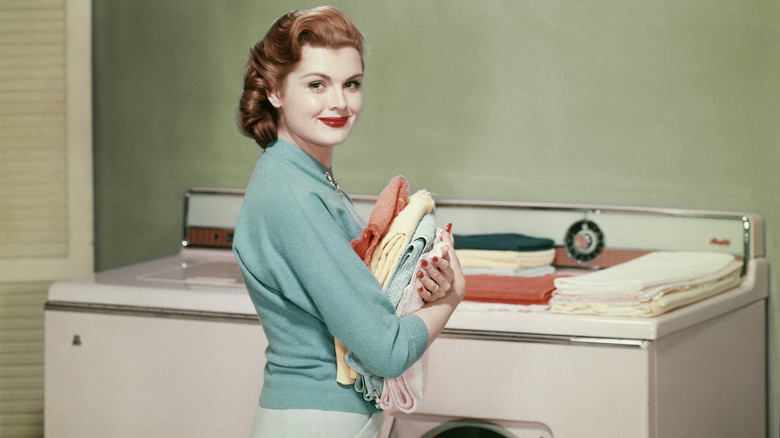
Laundry made one of its biggest leaps forward when Bendix Home Appliances introduced the first automatic front-loading washing machine in 1937. Headlined as "a thrilling announcement to every woman" in advertisements placed in The Saturday Evening Post, the company promised consumers "new leisure, freedom from toil, new economy and far cleaner clothes." Within just a few years, Bendix had sold over 330,000 washing machines to households that were all too happy to hand off the filling, agitating, draining, rinsing, and spinning to the powerful devices.
Kenmore, Maytag, and Westinghouse would soon follow with their own washing machine advancements. Automatic timers were introduced in 1941, but production shifted dramatically the same year when the United States entered World War II. Rationing and metal shortages meant Americans who hadn't yet invested in an automatic washing machine would have to wait until war production drew to a close and companies reconverted their factories to meet booming consumer demand.
In 1948, the United States Department of Agriculture produced a pamphlet designed to help answer the burning question on many minds: "Shall I buy an automatic washer?" Things to consider when buying a washing machine remain the same today: how much time and energy you want to save, the capacity your family requires, and what other features might come in handy. A number of new choices arrived in the 1950s. Along with the introduction of washer-dryer combos from GE, Bendix, AMC, Philco, and other companies, consumers had a plethora of washing machine colors to choose from, including powder blue, seafoam green, and pastel pink.
1990s washing machine regulations led to energy efficiency

The colors may have changed to avocado green and harvest gold in the 1970s, but washing machines wouldn't really see their next major evolution for another decade. According to Our World in Data, over 70% of American households had a washing machine by 1975. Water usage skyrocketed during this same era, drawing the attention of lawmakers and the plumbing industry.
Once automated washing machines became commonplace, manufacturers shifted from touting their time-saving benefits to focusing on water and energy conservation improvements. This may have been to entice households to replace their original machines with the newest models, but it was also prompted by new legislative requirements. The Department of Energy enacted energy conservation requirements for consumer clothes washers in 1988. In 1992, the Energy Policy Act established minimum efficiency standards for washing machines. These regulations forced major design changes that continue to impact consumers today.
While few would want to go back to using a washboard to clean their dirty laundry, consumers weren't entirely sold on the push toward energy-efficient everything – the first wave of energy-efficient washing machines simply didn't work as well as earlier versions, often scoring poorly in cleaning performance tests. And despite the long-term utility savings they offer, front-loading washers are often filled with mold and mildew.
Washing machines are getting smarter every day
Today's washing machines aren't just about outsourcing one of America's least favorite chores. App-enabled smart washers are about connectivity and control. Automatic detergent dispensers offer optimization and conservation. Manufacturers continue responding to legislative and consumer demand for lowered water and energy consumption with features like load sensing and adaptive cycles that our ancestors couldn't have possibly imagined. Irons have been replaced by steam features. And that precarious task of filling a leaky wooden tub with boiling water for those really soiled clothes? Special sanitizing and allergen cycles handle it with the push of a button.
As technology advances, so does the potential for problems. While some people are thrilled with the latest and greatest washing machines, others have engaged in widespread class-action lawsuits concerning defective products that major companies are unwilling to fix. With tariffs increasing the cost of this laundry room essential, consumers may shift their attention from technological advancements to manufacturer reputation and warranty promises — which is no surprise when you consider how long a washing machine really lasts.
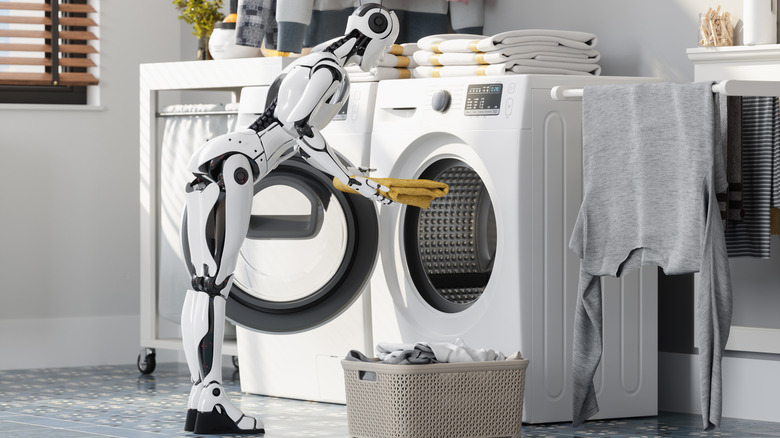
Of course, others are already embracing the idea of never doing the laundry again. Modern startups are raising billions to develop robots that will handle washing, drying, and folding autonomously. AI-assisted cycles, hyper-efficient models, and advancements in UV sanitation and self-cleaning modes are on the horizon as well.