

Put Down The WD-40: How To Prevent Your Lawn Mower Deck From Rusting
We may receive a commission on purchases made from links.
Our lawn mowers, especially the decks, go through a lot. These bare metal pieces have to deal with humidity on a regular basis during spring and summer months. And if you leave your lawn mower out in the rain or don't wait for the grass to dry before powering it on, the wet condition plus trapped grass will further worsen conditions. Add in a dirty mower to the mix and the accumulated dirt and dust will hinder air circulation. Combined together, all of these factors will cause your deck to develop rust.
This will eventually hamper the structural integrity of your equipment, lead to unsightly holes, and minimize its efficiency, forcing you to buy a new lawn mower earlier than you'd anticipated. So, to extend your machine's life, you need to prevent its deck from rusting. While you might want to try the WD-40 trick before mowing your lawn, there's another product that can help: Rust-Oleum Power and Equipment Spray Paint.
This works because the sprayed-on paint will protect the underlying metal surface (in this case, your lawn mower's deck) from oxygen and moisture, keeping rust away. Plus, it'll beautify it without much effort on your part. Moreover, if you choose a can after careful consideration, you might even be able to match it to your equipment's body color for a cohesive appearance. The pocket-pinch won't be too bad, either. That being said, you'll have to set aside a little time for this project since you must clean the deck first before painting it. So, grab a dedicated scraper, like MoJack's Heavy-Duty Stainless Steel model, a non-metallic brush, and a garden hose (if your machine runs on gas or features a wash port). Don't forget to don a pair of protective gloves and goggles before you start.
Clean your lawn mower deck before using Rust-Oleum spray paint
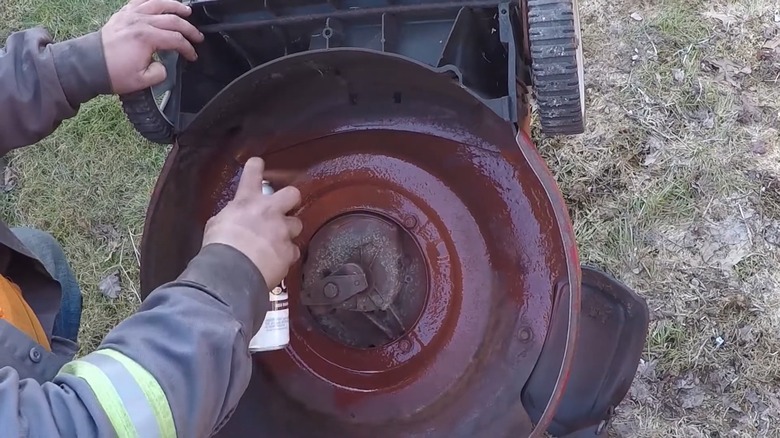
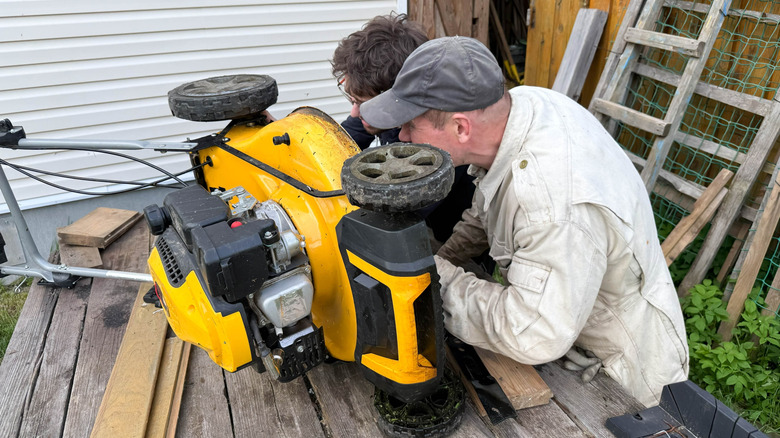
If you've recently used the machine, unplug it and let it cool. Then, take out its battery (if it's battery-powered) and tilt it slowly so the deck is clearly visible. Now, get your scraper to pluck out the stuck grass, built-up grime, and other debris. When it's sufficiently clean, spray a little water with a hose and scrub the underside using a gentle detergent and a stiff brush for a sparkling finish. In case you have a battery-powered mower, skip this step. In both cases, leave the deck alone for a few minutes so it can dry completely.
While you're waiting, determine what parts (think wheels and blades) you can safely remove and use old newspapers to cover the rest (the engine is a good example). Though cumbersome, this step is vital since dried paint might hinder those component's performance. Once done, get sandpaper to prep the surface for paint and forcefully eliminate tiny rust flakes. Wipe it down again and let it dry thoroughly prior to applying a coat of rust-preventing primer, such as the one from Rust-Oleum, to the exposed metal. After it cures, shake the can of paint and spray it evenly on the prepped surface.
However, keep in mind that paint isn't a permanent solution to rust. Your lawn mower's deck can still oxidize when it starts chipping. Also, this method won't be of much use on parts that have already started corroding. In such circumstances, you'll need a specialized formula, like the Rust-Oleum Rust Reformer Black Spray Paint to salvage your equipment before it's too late.