

The Lawn Task To Do In September To Keep It Weed-Free

We may receive a commission on purchases made from links.
It's undeniable that our lawns undergo a raging battle during the dog days of summer. All that intense sunlight, heat, and humidity is enough to crisp the best of grasses. Sadly, even when temperatures start to cool down with the approaching fall, there's little respite. Several broadleaf weeds, including dandelions, white clover, henbit, ground ivy, black medic, horseweed, chickweed, thistle, plantain, and bindweed, begin germinating in this cool weather. While they may mask themselves as tiny, benign seedlings in your turfgrass, come spring, they put out explosive growth that is harder to manage.
Given that, you must undertake a lawn task in September: spraying it down with weed control treatments. Now, there are several reasons why you should do this. For starters, weeds are better tackled as seedlings, as they're yet to form deep roots. Moreover, they're easy to eradicate now that they're still small rather than later when they will have established thick mats and hamper spring care tasks.
Most importantly, fall treatments are particularly more effective. Fall-germinating weeds begin transporting resources into their underground structures, like roots, tubers, or stolons, to ensure successful overwintering. Herbicides applied in September similarly translocate into their roots, effectively weakening or killing the weeds and preventing self-seeding or spread. This also works out well for your ornamentals. Since their growth slows down during autumn, they take less damage from any accidental chemical or vapor drift, compared to spring applications when they're actively growing. Besides, at cooler temperatures, you can go in with a higher dose if the weed pressure is high.
Spray your lawn for weeds during September
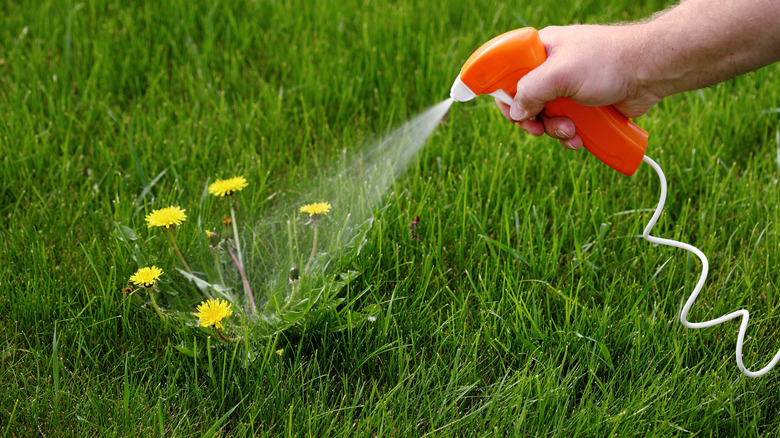
Before you set about spraying common lawn weeds, be sure to identify them. In September, they'll be actively growing and show up as rosetted specimens or seedlings. According to Michigan State University, apps like PictureThis may offer reliable results, though you can also compare these weeds to pictures available on extension websites or online. Based on this, choose a selective systemic treatment, like Ortho's WeedClear Lawn Weed Killer or BioAdvanced's Season Long Weed Control For Lawn, that specifically targets these weeds and is safe for your turf type. Active ingredients approved for residential use usually include 2,4-D, dicamba, MCPP, triclopyr, clopyralid, sulfentrazone, and MCPA. Note that if you notice lots of summer annuals, like crabgrass or purslane, know that fall treatments are ineffective on them. That's because they'll die after exposure to frosts and will have already set seed. So, you can deal with them next year.
Keep the treatment targeted by spot-treating the problematic areas, as opposed to broadcasting the herbicide. Remember, you must follow the instructions on the label for maximum safety. That being said, to ensure the spray sticks to plant foliage, it's important to time your applications when no rainfall is forecasted, at least for a day. Since September is also when many homeowners reseed or overseed their lawns, you may have to take extra precautions. While guidelines may vary, the general rule is to wait until new grass has been trimmed a couple of times before treating it chemically. If you were additionally hoping to fertilize your lawn, look for granular products that combine fertilizer and post-emergent herbicide, though targeted liquid treatments usually provide better results.