

The Beautiful Vintage Pyrex Color You'd Be Thrilled To Find At The Thrift Store
We may receive a commission on purchases made from links.
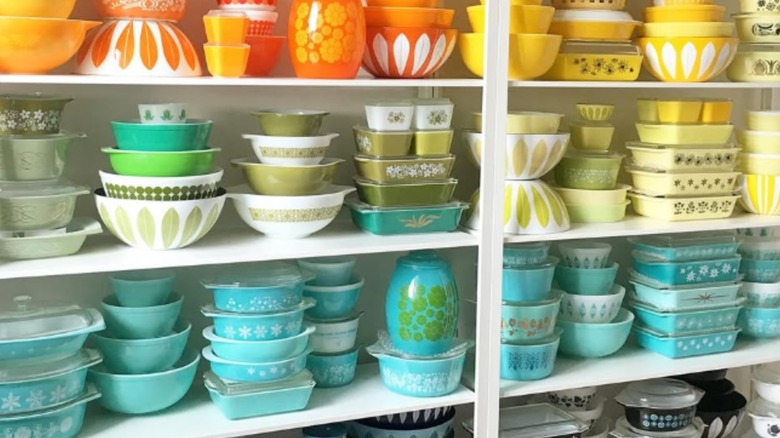
Your typical Pyrex collector is after the opalware pieces, from unmarked, rare vintage pieces in one-off patterns to the brand's iconic designs, like Butterprint in unique colorways, to dishes and bowls in a specific color, like pink or turquoise. But what happens once you've maxed out your collection of opalware Pyrex? The answer is simple — you start going for the clear glass or the colorful clear glass.
That's right, Pyrex produced dishware like pie plates, casserole dishes, loaf pans, and mixing bowls in a translucent, colorful glass. The jewel-like pieces had jewel-like names to match, like amethyst, cranberry, peacock, and, perhaps the most sparkling and attractive of them all, cobalt blue. Marketed under the "Pyrex Originals" line, the colorful transparent cookware dates from the 1980's and 1990's, after Pyrex discontinued production on all its opalware products (in 1986).
If you've already got a shelf or two full of colorful vintage Pyrex dishes, and are looking to add something a little different, cobalt blue Pyrex Originals can be the way to go. The deep blue hue will look particularly attractive next to the rare blossom-pink daisy Pyrex casserole dish or alongside one of the rare vintage Barcode-pattern prototypes. But first, you need to know what pieces to look for and how to identify cobalt blue Pyrex.
How to identify cobalt blue Pyrex
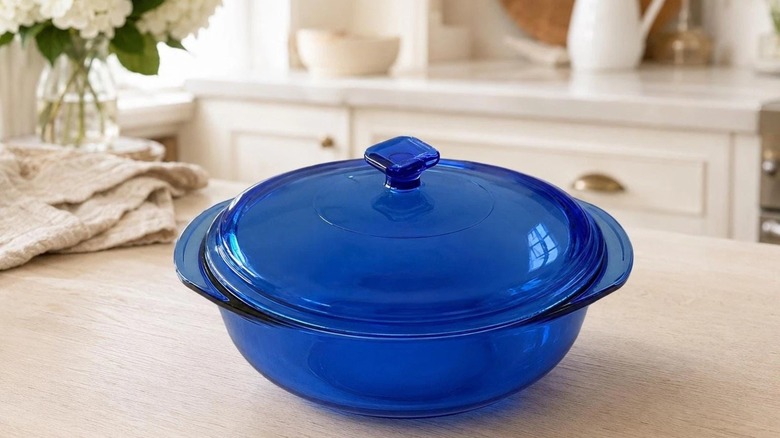
The first sign that you're holding a vintage cobalt blue Pyrex dish is the color. While other colors in the Pyrex Originals line look a little muted, like pale spring green and faded cranberry, cobalt blue Pyrex is a deep, brilliant blue. The next way to identify the dish is by flipping it over.
Based on company records, cobalt blue Pyrex Originals were released in 1999. By this point, Corning had started using a lowercase "pyrex" logo, rather than the all-caps "PYREX" logo used on earlier dishware, meaning a cobalt blue Pyrex dish will have the logo in lowercase letters on its underside. The backstamp should also have the model number of the piece, "MADE IN THE USA," and use instructions, like "NO BROILER" impressed into the glass.
As for the pieces — the 1999 promotional material shows pictures of a square baking dish, rectangular baking dishes, a pie plate, a loaf pan, and bowls. In addition, there was also a covered, round casserole dish. Given that cobalt blue Pyrex is newer than opalware, some of which dates to the 1940s, its prices are generally lower. A casserole dish may set you back $25, rather than $150, and a mixing bowl set could be yours for around $50, rather than $250.