

Smart Grills Are Everything That's Wrong With The World

If you have managed to miss it, smart grills are all the rage, and they promise to do for your backyard cookout what autonomous cars have done for driving — ruin it entirely. Let's see if this story sounds familiar: We've taken an activity in which one could take pride, stripped it of any need for skill or knowledge, and reduced this iconic bit of American competence to staring in puzzlement at another disposable electronic device while you wait for tech support to tell you to try turning it off and back on again. We did it with Wi-Fi-enabled kitchen appliances, self-driving cars, and robotic lawn mowers; now they're coming for your grill.
Grilling is very nearly sacred where I'm from, and the idea that smart grills make cooking more efficient would have been considered a downside in my youth when we still valued social interaction. But efficiency isn't the only reason to ditch the high-end smart tech. Smart grills encourage you to offshore your personal competence and increase your reliance on your phone. In exchange, you generally get more expensive, poorer quality grills that don't work without electrical power. You also get an epic number of new points of failure for a device that previously had exactly one: Skill issues. Now, your grilling can be derailed by a failed touchscreen, sensor, controller, mobile app, or buggy firmware. Your burger depends more on your grill's Wi-Fi compatibility, the knowledge and skill of support staff, and the scant availability of parts.
Smart grills allow a social disaster

The role of conversation and camaraderie in the experience of grilling food is not a revelation. Grilling is often an inherently social experience, with some equating the grill to a backyard water cooler. The society of grilling is as far from a perfunctory personal interaction as a good steak is from water. It's a place where you stand and make yourself available not only to converse with but also to serve your family and friends in what might be the most fundamental way possible — by feeding them.
As Rodney Scott, a South Carolina restaurateur who famously turned down his own reality TV show to keep doing his analog thing told Eater: "Name one time you were standing by a grill and someone didn't ask you a question." The social aspect of grilling is a ritual, and this is why efficiency is less important. Time is supposed to be spent, not saved, on family and friends. With features like remote temperature monitoring, alerts, and app-enabled controls letting you manage your cookout from anywhere, smart grills no longer necessitate that traditional element of the ever-present grillmaster that is so essential to summer gatherings. Letting your grill do the thinking and the work is like going to a concert where the singer is lip-syncing to a backing track at double speed; there's practically no reason to go, and you don't even get to spend much time commiserating with your fellow concert-goers.
It's a competence disaster
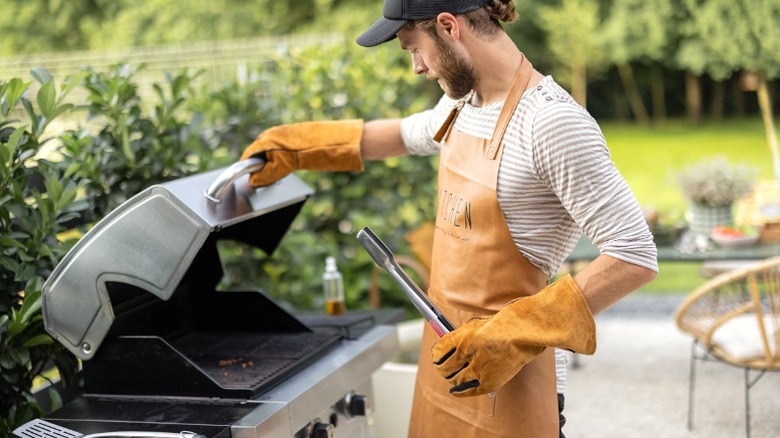
My father was a great cook, though he tried his best to avoid it most of the time. But on vacation, he could play his PK grill like a fiddle and make the best steak you ever tasted ... better than any 5-star chef and, more importantly, better than the guy in the next campsite. I've tried for years, mostly with cheaper grills, to master it his way, and I haven't come close. But if I were to buy a smart grill tomorrow that did all the thinking and produced a steak as good as dad's, I wouldn't eat it, because he would probably return from the grave to seek fiery but temperature-controlled vengeance upon me.
When he grilled, dad held a folded paper towel to adjust hot vents and, mostly, taste test hot food. If it didn't taste good, you would never find out, because he would find out first. If the friendly oneupmanship stops being centered on competence and instead becomes a matter of app features and sensors (read: price), you've reduced a great social tradition to boorishness and materialism.
Technology is not my issue — my issue is the usurpation of the human domain by devices that learn from humans and filter all the joy, skill, and actualization from the process. This, doubtless, sounds like fear, and a way to preserve my values at the expense of the values of younger, more digital-friendly generations. Listen, I'm no caveman. I spent years as a developer and can see when the digital future is better. What I have a hard time with is dismissing the cost of not learning all that my parents and grandparents might have taught me about the traditional ways of doing things.
And don't forget planned obsolescence

I've never trashed a stove. The modern stove will usually last 13 to 15 years, but my current one is around 75 years old, and that might spell the difference. But the fact that I have not, myself, ever had a stove problem that couldn't be easily repaired tells me that I haven't yet bought one plagued with the scourge of planned obsolescence, wherein manufacturers engineer flaws right into their products to maximize profit (and consumer chagrin).
Grills, however, live harsh and relatively short lives, since they're often exposed to the weather and extreme temperatures. How would you go about shortening the life of something that only lasts 5 to 15 years? One possible answer is by making them die just like all the indoor appliances die — at the hand of their own electronics. Since smart grill electronics likely have a shorter lifespan than dumb grills and smart features may stop receiving updates and support after a few years, the circuit board time bomb inside your grill, taking measurements and sending text messages, has another purpose ... improving the manufacturer's bottom line. The genius is that, at the non-luxury end of the grill spectrum, smart grills also cost about twice as much as dumb grills.
Grilling on the cloud
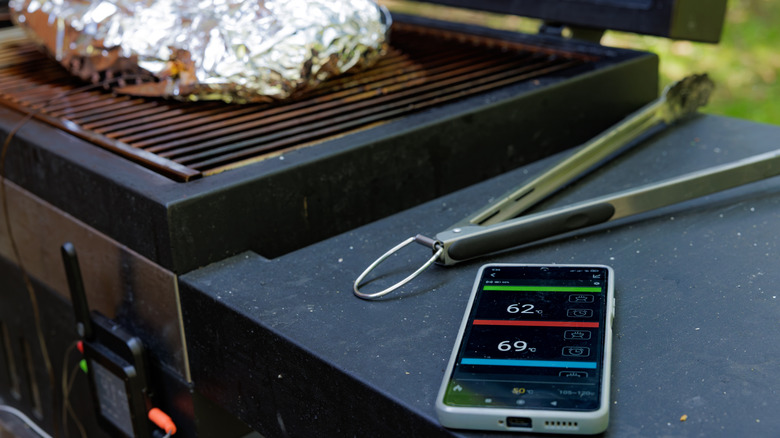
Then, there's the cloud. YouTuber Jeff Geerling released a video called "I won't connect my dishwasher to your stupid cloud" in which he takes issue with the non-physical buttons, the boot-up time, and the fact that a bunch of features are only available for his dishwasher via a mobile app ... which requires an account and cloud access. "I don't ever want to have to create an account for a dishwasher," Geerling said. "It seems stupid for a dishwasher ... I don't need Internet on my dishwasher." He goes on a bit, opining the inevitability of a cloud service either being discontinued and bricking your device or starting to incur a subscription fee. Both of these things happen all the time, and a Wi-Fi-enabled grill will be just as susceptible to it as any other smart appliance.
It's possible that you could throw some charcoal briquettes in there and try to use your grill anyway. For my part, I'd do that on day one rather than wait for the manufacturer to decide I haven't spent enough lately to matter. There's a reason that the big advantages of modern kitchen technology aren't usually smart features. Fortunately, your smart grill probably won't last long enough to experience its cloud obsolescence.
Where I'm wrong about smart grills (and why I'm still right)

Needless to say, not everyone agrees with me, and many hold legitimate points of view. For starters, assuming they work correctly, smokers are a bit of a different beast than grills ... and one for which smart technology might occasionally make sense for pros and long-cookers. Smart features can benefit a cook whose nights will otherwise be consumed with tending a fire (though I'd still rather have an old freezer converted into a smoker than a high-end, state-of-the-art machine doing all of my work for me).
And there are points of view I can acknowledge without pretending they make much sense. The tech bro argument goes something like this: It's not a zero-sum game. Accuracy and reminders will improve your grill game and leave you free to focus on other meal or dish improvements, which may make the overall cookout and eating experience better.
With all that said, my point remains: Stop salivating over the thought of buying a smart grill, because the returns rarely appear as expected. I wired my home to be as smart as possible, with a dedicated network, DC power cable run in four voltages, dozens of sensors talking to microcontrollers, and dozens of microcontrollers talking to a rack-mounted enterprise server. That was almost five years ago ... and I never turned it on. I became suspicious of my own obsession, then of the mess's very utility, and then of the kinds of things I talk about above — I talked myself into not wanting it. And in fact, I haven't missed it, and I suspect my life is richer for it.