

Queen Anne's Lace Vs. Poison Hemlock: How To Easily Tell The Difference
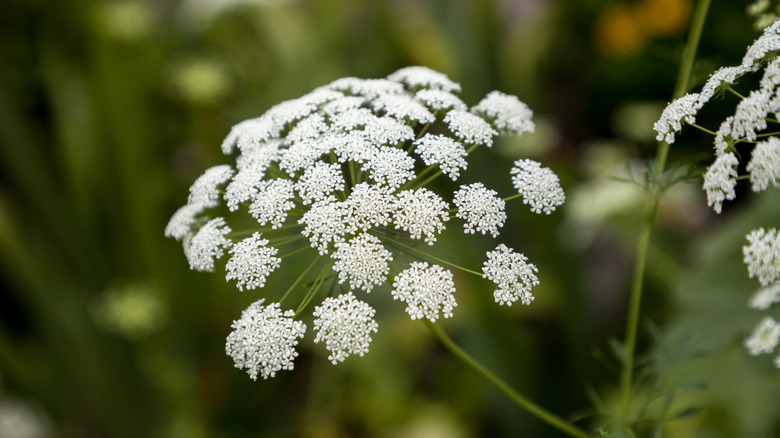
One is deadly, even in the smallest amounts. The other may give you a rash, if you have sensitive skin. Both are invasive in North America and grow wild in almost every state. Most importantly, for you and your loved ones, the two plants — poison hemlock (Conium maculatum) and Queen Anne's lace (Daucus carota) — look similar. But, there are some tell-tale differences that can help you determine whether you're looking at one of the most toxic plants in the country or one that's merely an irritant.
The main differences between Queen Anne's lace and poison hemlock are their height, their flowers, their stem, and when they are in bloom. Poison hemlock is the bigger of the two, growing between 6 to 10 feet tall. Queen Anne's lace usually maxes out around 3 feet in height. Both plants are in the same family (Apiaceae), along with common edibles like carrots and parsley. So if you come across a plant with fern-like leaves, but it's towering over you as opposed to below you, stay away, as it's most likely poison hemlock.
Another notable difference between Queen Anne's lace and poison hemlock is when they bloom. Poison hemlock typically blooms earlier in the season than Queen Anne's lace, late spring rather than mid-summer. By the time Queen Anne's lace's flowers are in bloom, poison hemlock will be going to seed. Finally, the appearance of the stems and flowers are different. Queen Anne's lace has fuzzy, solid-green stems and a single, compound flower. Poison hemlock has smooth stems with purple blotches and clusters of tiny white flowers.
What to do about Queen Anne's lace and poison hemlock
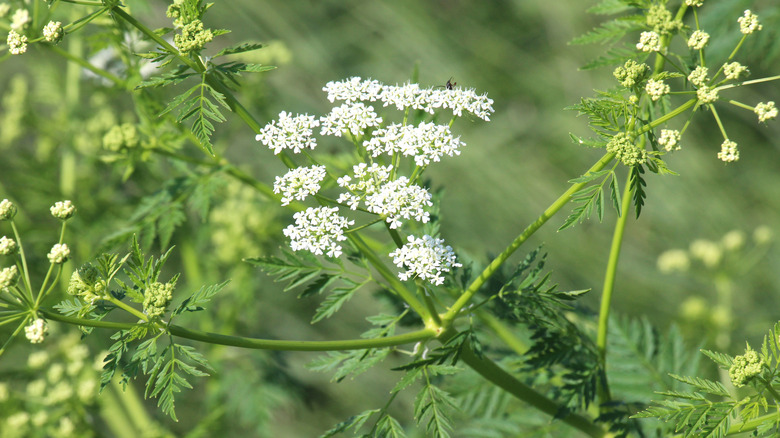
Both Queen Anne's lace and poison hemlock are considered invasive or noxious weeds, because of the damage they can cause to humans, other animals, and a region's native plants. You certainly don't want to be planting either one in your garden, and you'll want to take action to control either plant if you spot them in your yard. Since it's deadly, you'll need to be extra cautious when managing poison hemlock. Wear protective gear, such as gloves and goggles, and consider wearing a mask, as the sap of poison hemlock can be dangerous if inhaled.
If you have just a small area of poison hemlock or Queen Anne's lace in your yard, mechanical removal (hand-pulling) may be the most appropriate way to get rid of it. After removing the weeds, overseed the lawn to minimize the chance that the plant will return. A potentially more effective removal option, particularly for poison hemlock, is to use a selective post-emergent herbicide that's known to kill poison hemlock but not damage grass. Apply the herbicide in the early spring, before the poison hemlock flowers, following the instructions on the packaging.
Since it's so poisonous, be extra cautious about how you dispose of any poison hemlock you remove from your yard. You can't burn it because it can release toxins when burned. To reduce the chance of the seeds spreading, it may be best not to compost either Queen Anne's lace or poison hemlock, but to dispose of them in the trash.