

Skip The Table Saw: Cut Wood With A Simpler DIY Solution

We may receive a commission on purchases made from links.
Small, but mighty. The reason every DIYer should carry — but not over-rely on — a Dremel-style rotary tool is encapsulated in that short sentence. It's a handheld device that, outfitted with the proper blade, can do the work of much larger, more cumbersome tools, such as reciprocating saws and, yes, even table saws. But small rotary tools have limitations.
Rotary tools are commonly used for DIY tasks such as removing grout from tile, sharpening blades, and deburring cuts made by other means (to a pipe, for example). Different blades serve different purposes. Blades and cutoff wheels are often used for cutting bolts, and it's even possible to cut aluminum with a Dremel reinforced cutoff wheel. Spiral bits are used for making cutouts in flat materials, such as mortises and bores for door locks. You can even cut plexiglass with a Dremel. But a toothed saw blade, or Dremel's EZ544 cutting wheel (which is designed for wood and laminate), makes quick work of cutting through plywood cabinets, sheathing, underlayment, and trim.
What these circular saw-like blades do best is shallow, fairly straight cuts. In addition to cutouts in sheet goods, they're great for modeling, crafts, and rough shaping for carving processes (such as making knife handles, for example). With care, they can also be used for some reasonably complex joinery. When you're dealing with shallow, straight cuts, this makes rotary tool saw blades a good replacement for a number of power and hand tools, though not so much for saws, such as jigsaws and scrollsaws, used for curved cuts, or precise, straight cuts that require a fence, such as a track saw.
Bits and accessories for cutting wood
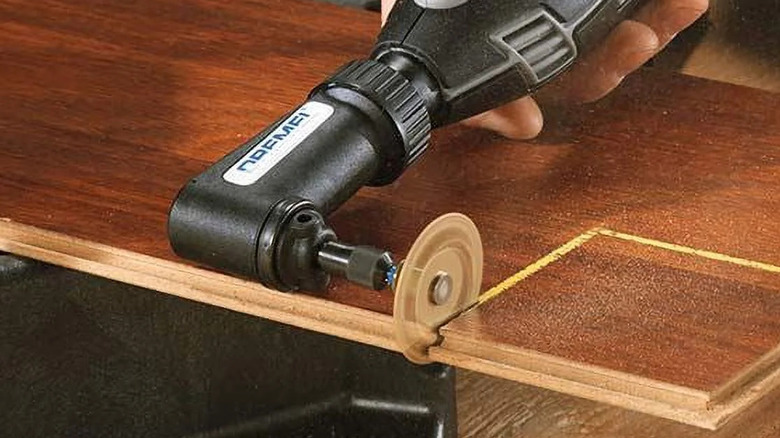
Dremel's rotary tools give you a few ways to cut wood effectively. It's not always in the form of a saw blade, such as the 546 rip/crosscut toothed blade or the EZ544 (which is actually a sort of hybrid cutting and abrasive wheel). The blades are coated on both sides with tungsten carbide grit (often used in drill bits for metal and saw blades for ceramic tile) and feature cutouts of the sort you see in many saw blades for noise reduction, heat dissipation, and accommodating blade expansion. The EZ544 is a 1.5-inch blade that attaches to a rotary tool via Dremel's EZ Lock system, which makes blade changes fast and creates a positive connection so you don't have to rely on the friction of a super-tight blade to make sure the blade turns at the same rate as the mandrel. (There is also a version of the blade, the Dremel 543, that relies on a standard friction mandrel.)
Most of the wood-cutting attachments Dremel makes are for straight bits, like you'd use in a zipsaw or a router. The one attachment designed for a saw blade is the Mini Saw Attachment (Dremel #670), which is basically a cover for the 546 toothed blade that holds it straight vertically when cutting. The Mini Saw Attachment is limited to cutting ¼-inch plywood. There are a few other general-purpose attachments that might be useful with saw blades in general, like the Flex Shaft Attachment and Right Angle Attachment.
Limitations of the rotary tool
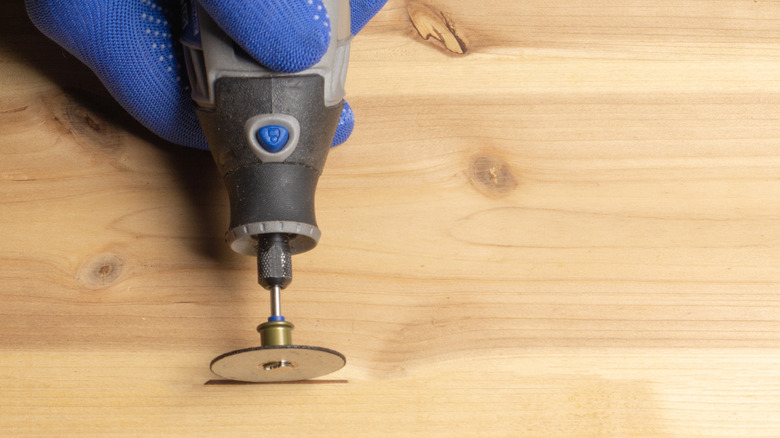
In general, rotary saw blades are limited by the size of the tool. It's impossible for a 1.5-inch diameter blade to cut more than ¾ of an inch deep, of course, but, in reality, the depth is more limited than that. While the Flex Shaft Attachment and Right Angle Attachment might improve this to some extent, the bulk of the rotary tool itself causes the blade to enter at an angle anywhere the tool is thicker than 1.5 inches. A fix for this problem is built into the Mini Saw Attachment, but it still only cuts to a max depth of ¼ inch. Additionally, because the tools are handheld and don't make any provision for any sort of fence, rotary tool blades are most suited for freehand operations.
Rotary tool wood-cutting blades are best at replacing not power saws, but handheld tools such as keyhole saws and tile nippers, which are used to make freehand cuts in larger pieces of material, including cutting holes in the back or sides of cabinets for plumbing or wiring, or fitting tile around an obstruction. However, rotary tool saws are great at some onerous chores, such as fitting wood flooring around a doorway. This can be done a number of ways, and most recommend an oscillating tool with a wood-cutting blade, but they're noisy and prone to dulling expensive blades at an unsustainable pace. It's often done by professionals freehand on a benchtop table saw, which is inconvenient because of its size. A Dremel saw blade makes short work of this kind of thing — and you can carry it around in your pocket.