

Swap Metal Files For A Powerful Tool That Sharpens Lawn Mower Blades Faster
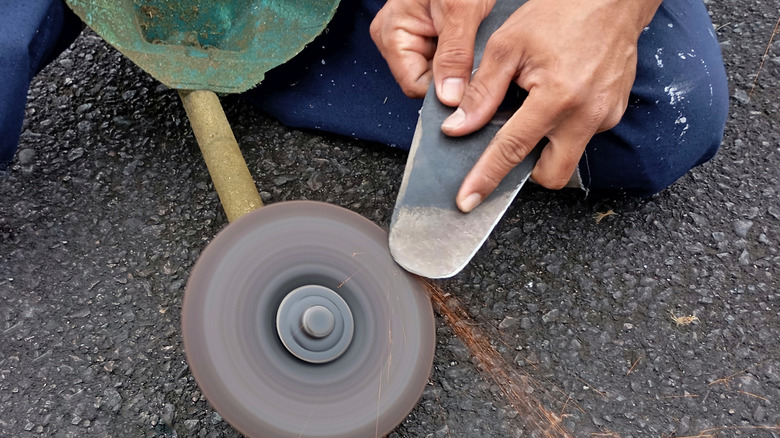
Anyone with a complement of metal files and the instinct to sharpen a lawn mower blade with one probably has an easier tool for getting the job done, and it's often an angle grinder. But if you have one handy, it's worth considering a tool that's similar in principle to an angle grinder, but radically different in specifics: the pneumatic die grinder, which can make quick work of putting a cutting edge back on a worn mower blade.
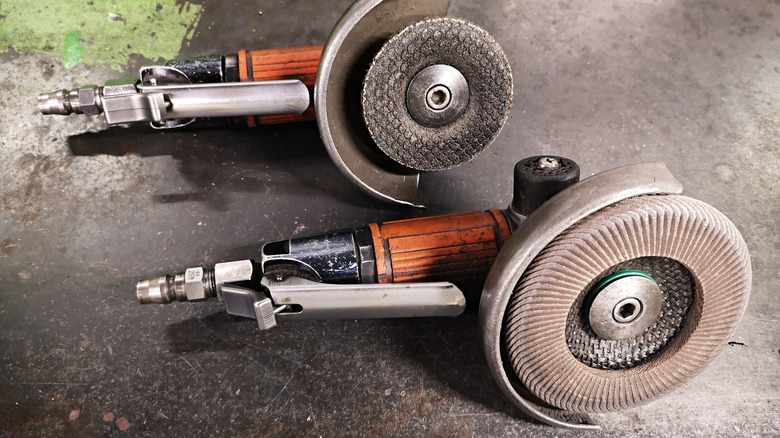
Pneumatic grinders are, by definition, driven by compressed air. You might already have a compressor for an air nailer, but whether it will work for a grinder depends on the grinder's pressure and airflow needs, so you need to look into how to size and select an air compressor. Die grinders come in straight and right-angle varieties, and a right-angle model is what you'll likely use for sharpening a mower blade. They have, by tradition if not necessity, a longish on/off switch running roughly parallel to the tool itself, near its base. These grinders are primarily used for shaping metal — that is, by grinding some of it off. This often involves cutting, smoothing cuts, or removing excess material from welded joints.
Since pneumatic grinders, wrenches, and the like are mostly used for metal fabrication and automotive repair, they're not always a fixture in the average millennial's garage, except perhaps when they've been inherited. But they're at least as effective as angle grinders and, as we'll explain below, there are valid reasons to prefer a pneumatic die grinder to an electric or battery-powered angle grinder, and many other methods of blade sharpening.
How to sharpen blades with a die grinder
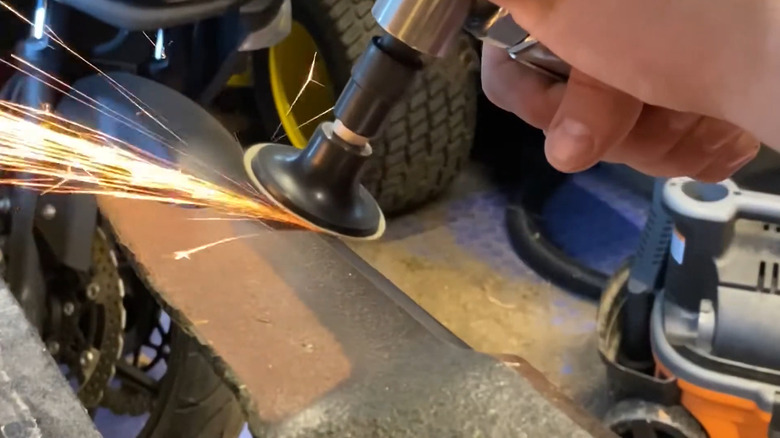
Sharpening your lawn mower blades with a die grinder starts out much like sharpening it by any other method. This means safely removing the blade and securing it in a position so that you can easily apply the business end of the die grinder to it, usually by clamping it flat in a bench vise.
You will need to attach something to your die grinder to do the actual grinding, and for a task like blade sharpening, that usually means a sanding disc. This is attached to a rubber backing pad, often with a twist-lock arbor, which is fitted to the die grinder. Unlike many other sharpening methods, there really aren't any accessories or jigs that help you achieve the correct angle for mower sharpening, usually around 30 degrees. It might be possible to adapt one of the many DIY angle grinder jig designs, but the die grinder's hose adds a layer of complexity that we can't endorse. So you're essentially left with freehand sharpening, and this is a fairly common way to get the work done, for both DIYers and lawn care professionals alike.
Failing to balance the blade after sharpening is one of the biggest mistakes people make when sharpening lawn mower blades. Use a blade balancer to make sure your blade is still balanced, since the vibrations from an uneven blade cause wear and tear to your mower, its engine, and its powertrain. If the blade tilts noticeably toward one side or the other, use the grinder to gradually remove additional material from the heavier, lower side until the blade is balanced.
The pros and cons of die grinders, and pneumatic tools in general
Even if you don't own pneumatic tools, you've probably seen — or heard — them in auto repair shops, perhaps in the form of air wrenches used to remove wheels from cars. It's an undeniably old-school way of doing things, and that isn't all bad — or all good. Pneumatic tools can be lightweight because they're unencumbered by batteries or electric motors. They are simple and durable, and can run more or less continuously without overheating (there is no heat-generating electrical resistance to contend with). They don't have motors that will burn out, batteries to recharge, or electricity of any kind to shock you. Or battery prices to shock you, for that matter.
But pneumatic tools are increasingly sequestered in commercial and industrial use for some pretty valid reasons. You must own and know how to use an air compressor, and buying a decent compressor erases the advantage of not buying batteries and a charger, though you probably should have a good compressor anyway. And while compressors have improved, they're still quite loud. To the compressor, you must attach a hose, and hoses are neither cheap nor user-friendly things. The less expensive they are, the less pleasant they can be to wrestle with. Any hose can become a tripping hazard, while a cold, coiled plastic air hose is one, even though you'll never get the thing unfurled so you can use it in the first place. And while there are some pneumatic tools that haven't yet been adequately replaced by battery-operated alternatives — sandblasting, automotive paint, and wet cutting come to mind — none of them can sharpen mower blades.