

There's No Need For Metal Files: Here's An Easier Way To Sharpen Knives
We may receive a commission on purchases made from links.
Sharpening dull knives doesn't have to be a tedious task that requires a metal file. Instead, try a rolling knife sharpener to make the process safer and easier. It simplifies traditional knife sharpening methods since it doesn't require you to hold the knife directly, thus reducing the effort and manual precision that is necessary for metal files and most sharpening tools. Due to its dual-sided magnetic block, a rolling knife sharpener also takes the guesswork out of achieving the proper sharpening angle for different types of blades. Not to mention, it can sharpen a knife in minutes or less, making it possible to have ready-to-use cutlery available as soon as you need it or at a moment's notice.
A rolling knife sharpener is a two-piece system that is made up of an angled holder and a plated cylinder. The holder features a fixed 20-degree angle on one end that replicates the durability of Western knives and a 15-degree angle on the other for the precision-focused sharpness that you'd find with Japanese cutlery. Meanwhile, the cylinder does all the hard work by rolling along the knife's edge, either sharpening the dull blade with a diamond grinding disc or honing it with a steel or ceramic disc, depending on which side you use. These knife sharpeners typically range in price from $119 to $400 from the top brands like HORL, Tumbler, and Work Sharp, but well-reviewed options on Amazon can be as low as $40, such as the AIERLIAN Knife Sharpener Tool.
How to use a rolling knife sharpener
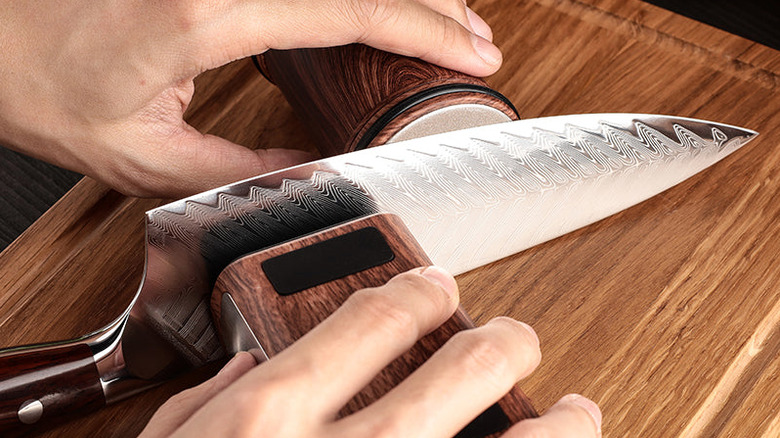
If you're new to sharpening your own knives or don't sharpen them as often as you should, then a rolling knife sharpener would be helpful to have on hand. Thanks to an almost intuitive design, the most important factor you need to know is how sharp you'd like the knife to be. Place the sharpener on a flat and stable surface and use light pressure, since the grinding disc is abrasive enough without the added force. From there, roll the grinding disc against the 20-degree or 15-degree side of the knife block for consistent sharpening. If you're sharpening a tall knife, such as a cleaver, it's recommended that you set the roller on a cutting board (with the holder set lower on the counter) for extra height to reach the blade.
You can use a rolling sharpener on a variety of knives for indoor and outdoor use, such as paring knives, utility knives, and smooth-edge hunting knives. Do note that ceramic knives are not compatible with this type of sharpener, since ceramic is non-magnetic and won't stick to the holder. Scissors and knives with serrated edges, like bread knives, should also not be sharpened with a rolling knife sharpener, as it risks ruining the teeth of the knife and damaging the sharpening disc. Luckily, these knives don't need sharpening anyway.