

The Thrift Store Find I Used To Create A Rustic Bathroom Vanity With A Clever DIY
We may receive a commission on purchases made from links.
Welcome to The Thrifted Fix, where Hunker writers turn pre-loved thrift store finds into the ultimate solutions for everyday home problems. Consider this your weekly reminder: A little vision and DIY ingenuity can fix any space!
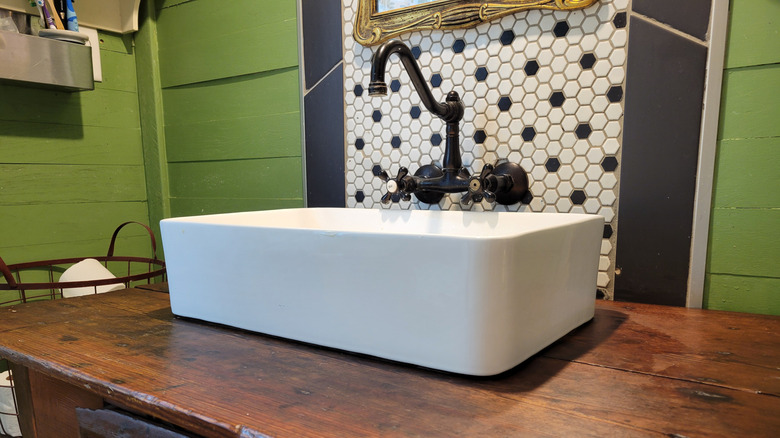
Our bathroom looks like a room from a farmhouse we once rented, one where you could see through the walls. It's well-insulated and watertight, but it does have a rustic vibe that's carried much further than most spaces would. In place of drywall, there's walnut flooring blanks. There's a century-old, 7-foot-tall door. And there's an antique biscuit table under a mirror with a vessel bathroom sink — a style with peculiarities aplenty — on it. That biscuit table was an epic thrift store find, and it remains one of my favorite parts of our entire home.
We have all the modern conveniences in our bathroom, including a water closet and a tub that could accommodate a diving board — but we didn't want a modern vanity. I usually find them very dull ... the ones I can afford anyway, which tend to look too monumental, too polished, and/or too cabinet-y for a room that's rustic down to its bones. My wife had been on the lookout for a biscuit table for years, for no particular reason other than they are a cool-looking bit of our history. But when she finally found a rather homely representative of its breed in the back corner of a thrift store, we decided it was the perfect primitive platform for our bathroom sink. It would be easy to modify thanks to its thoroughgoing woodenness and would leave no one with the mistaken impression that sterility in any sense was our goal.
The perfect table for a bathroom vessel sink
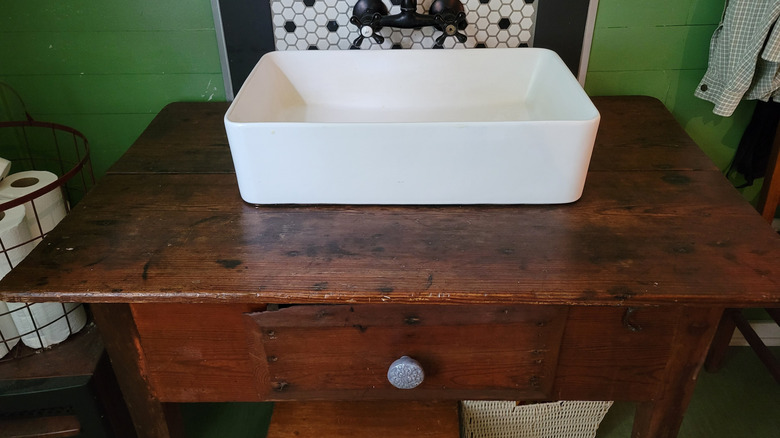
Even a moderately decrepit biscuit table, a relic of 19th-century American kitchens, can handle a sink. Most are designed not only to hold a huge (and heavy) slab of stone on top but also to withstand a merciless beating every time someone made biscuits. Some are also fitted with a hinged lid. Of course, the biscuit table as a household staple eventually died out, and our particular find lost its stone slab somewhere along the way — the sort of thing that can happen over the course of a century and a half. But ours was clearly sturdy ... rough sawn, assembled with dowels rather than nails or screws, obviously made with hand tools. It would not only have to hold up the sink but also teenagers perched in conversation or leaning to dye their hair and younger kids seated along the edges for toothbrushing instruction and various sink-related adventures.
Speaking of smallish people, you also have to consider height. Vanities are traditionally 30 to 32 inches high, with more modernized bathroom vanities standing closer to 34 to 36 inches tall. The vessel sink complicates this, usually adding too much height, so I was aiming for 36 inches at the sink's rim. The biscuit table is 28 inches tall and our sink added 5 ½ inches ... a bit short of the "comfort height" goal. I chalked it up as a service to the kiddos and moved on (though the open area underneath also gave me the perfect place to tuck a step stool). But one nice aspect of using this kind of table is that the height can be decreased easily enough with a saw or increased with risers or adjustable feet, if necessary.
Lumps in the gravy: Struggles modifying my biscuit table
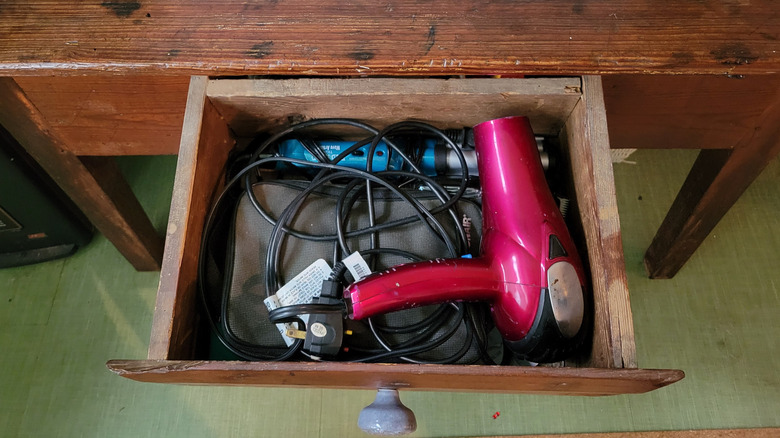
The thing about fitting a vessel sink to something not designed for a sink is that you have to cut holes for the drain (and sometimes a faucet or water lines) where there's something in the way. Typically, that entails drilling an access point and properly using a jigsaw to cut the hole for the plumbing coming from the vessel sink. It's often only the tabletop that you have to worry about, but in my case, it was also a drawer, front and center. So, I simply shortened the drawer by moving the bottom and back in so that its back stopped short of the drain. I left the sides, since they weren't in my way, allowing the drawer to pull out fully in the manner of full-extension drawer slides. This worked fine.
There were a few areas where I fell short and some where I simply got lucky. I got lucky with the vertical placement of the faucet, not having fully accounted for the extra height taken up by a vessel sink that's on top of, rather than in, a vanity. And I failed to seal the wood properly with a good slathering of spar urethane (a flexible waterproof sealer), which is a mistake in a household with splash-obsessed 3- and 8-year-olds. The table does get an occasional slathering of Howard Feed-N-Wax, a great product but one that just isn't meant to handle the water park-like atmosphere of a family bathroom. I apparently also didn't leave enough room for countertop storage, so I wound up using another thrift store find to fix my toothbrush clutter. But on the whole, it was a great success, and exactly as fitting for our rustic bathroom as it needed to be.