

Who Pays For Cracked Sidewalk Repairs? Here's What To Know
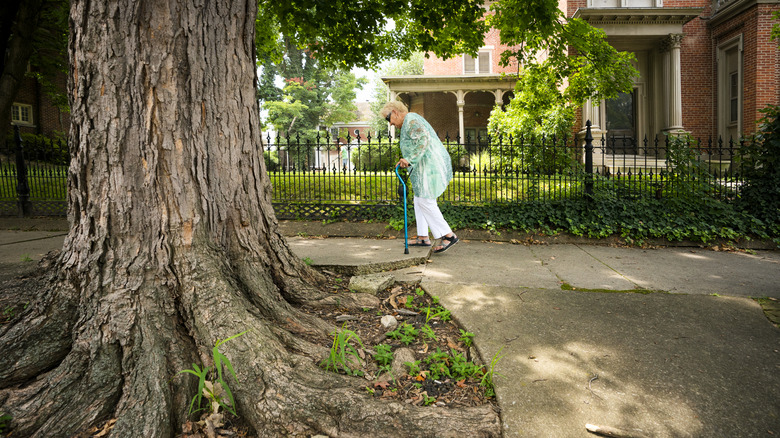
Cracked sidewalks are a hassle. Not only can they be dangerous tripping hazards, but the condition of a neighbor's property can be a factor that affects your home's value. But if you are waiting for your local transportation or public works department to fix your sidewalk, you may be surprised to learn that that cracked strip of concrete in front of your house may be your responsibility to repair.
Whether you need to pay for a sidewalk repair depends on where you live and the specific regulations that apply to your property and neighborhood. Most local codes require that the owner of the property adjacent to a strip of sidewalk maintain it. This extends not only to repairs but to ongoing maintenance, such as keeping it free of snow and ice. This is because your property ownership often includes the area where the sidewalk is located. When your lot was developed, your local jurisdiction likely required an easement or right-of-way for a public sidewalk. An easement grants access, not ownership. You still own the land beneath the sidewalk, which means you are usually on the hook to maintain it.
If your development is private and maintained through an HOA, then your HOA fees may cover maintenance, but not always. You should check with your homeowner's association or read the rules governing your property to find out who is responsible for sidewalk repair or replacement. Some cities have special districts where they maintain the sidewalks. So the answer to the question of who pays to fix a cracked sidewalk is: It depends.
How do I know which local rules apply?

Finding out whether the cracked concrete in front of your house is your problem or the city's takes a little digging. The local planning department will have answers to what regulations apply to your property. Some jurisdictions, such as Fairfax County, Virginia, provide interactive online maps to show which sidewalks are their responsibility and which are the homeowner's.
If an online map isn't available, and you aren't sure where your lot ownership ends, check with your local assessor's office to determine your home's property lines. They will have a record that not only shows what you own, but also the location of public easements. It is important to know this because if someone trips and falls on your cracked sidewalk, you can be liable for it. In addition, some cities regularly inspect sidewalks and may ticket you for required repairs.
While some concrete cracks are a breeze to fix, other sidewalk repairs can get expensive. Some jurisdictions have funding or programs to help you pay for repairs. Olympia, Washington, and Denver, Colorado, have undertaken wholesale sidewalk repair projects funded by special local fees, even if owners are legally responsible for maintenance. Bath, Maine, has a community-wide sidewalk repair program to ensure safe passageways for all users, and Austin, Texas, has a plan to address and fund sidewalk repairs in specific neighborhoods.