

Dump Boring Blinds: A Better Way To Cover Windows & Block UV Light

Canadian interior designer Courtney Ungaro (@courtneyungarodesign on TikTok) knows what she likes, and she knows how to prove a point. One thing she doesn't like is when blinds are used as window coverings — well, most of them. She does like sheer fabric (often available as solar shades, distinct from solid roller shades), but only if it's black. And she came to TikTok intent on proving this is the right decision. Her proof? She holds up black and white sheer fabric swatches with the same 5% open weave and shows how it's far easier to see through a black mesh than a white one.
It's a classic case of "show, don't just tell." Ungaro goes on to tell her audience that windows naturally look black when viewed from the outside during the day, and she contends that using white sheer fabric interrupts this effect and leaves passers-by with the impression that you've hung a sheet in your window. Ungaro is, needless to say, not a fan.
The sheet business is subjective and unprovable, but she clearly proves her point about seeing through black mesh. Ungaro also tells her viewers that sheer fabric offers substantial UV protection, which is true, though proving it requires a little more in the way of investigation. It's an important issue, too, since a surprising amount of ultraviolet (UV) light causes skin damage and the deterioration of furnishings, fabrics, and building materials. And since some of this light makes its way through standard windows, it's important to know how much one's window coverings help.
Black mesh absorbs light, while white mesh reflects it
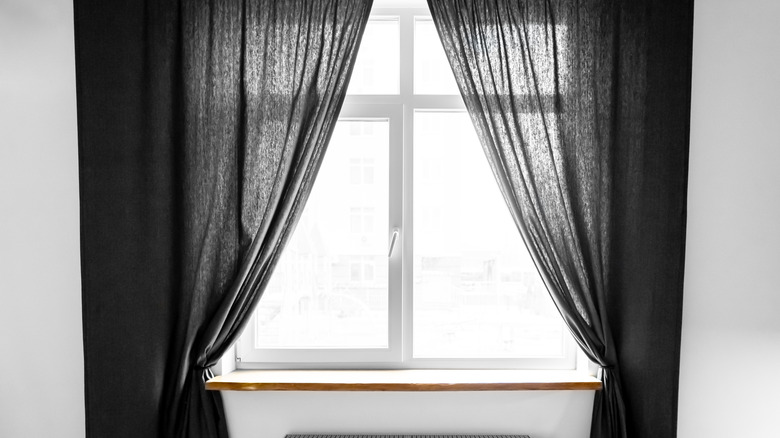
You might wonder why we can see so much better through black mesh than white mesh that's just as open. The effect is not subtle, and those who keep chickens and other critters in metal mesh enclosures have long been commenting on the phenomenon. It is clearly and demonstrably easier to see into those enclosures if the mesh is painted black rather than left silver, gray, or white. And this is true even for very open wire designs.
The reason turns out to be fairly simple: White (and gray, and metallic colors) reflect light, while black and very dark grays like charcoal absorb it. For this reason, as you might have noticed, window screens tend to be manufactured in the darker colors. White fibers bounce light back into the room, creating a glow for your eyes to focus on. When looking through a black screen, that light isn't present to interfere with your view.
@courtneyungarodesign Everyone disagrees at first but then they always come around! #blinds #designtok #designtips #homedecorideas #homestyling
The one drawback, as Ungaro points out, is that black sheers don't provide much in the way of nighttime privacy, since they essentially become transparent from the outside as well. So black sheer fabric alone might not work for every window. (There are, incidentally, window treatments that allow you to see out but not inside.) But, as a starting point, it's a great way to eliminate light and keep your view. Double-roller blinds that include both sheer and blackout fabrics are a more versatile way to cover windows than heavy curtains or traditional blinds.
How sheer fabric helps with UV radiation
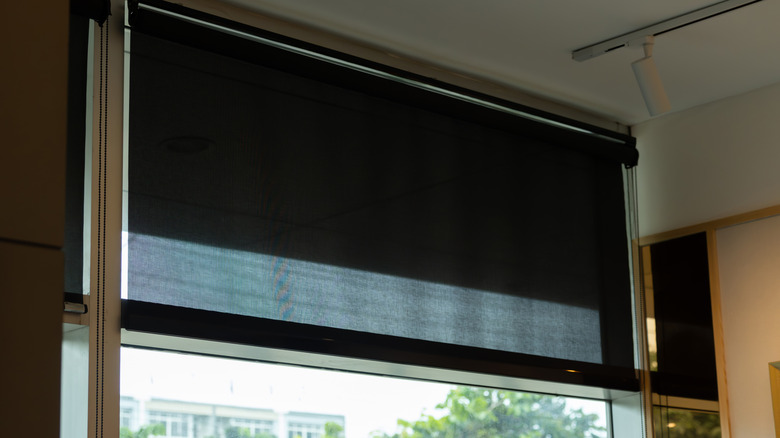
To understand how much black sheers help with UV protection, it helps to understand a few things up front. First, UV light comes in several varieties, including UVA and UVB. UVB light is responsible for skin damage like sunburns, while UVA light contributes to more long-term damage, as well as to the fading of fabrics, flooring, and other materials. The good news is that even the most basic glass blocks practically all UVB radiation — the bad news is that it only eliminates about 25.7% of UVA light.
In the real world, fabric is a great way to block UV radiation, but its effectiveness is limited by its color, thickness, weave density, fiber type, and finishing process (and other factors for clothing). This is all summed up in a fabric's Ultraviolet Protection Factor (UPF), roughly analagous to the Sun Protection Factor (SPF) of sunblock. A UPF of 50 means that only 2% of UVA and UVB radiation can penetrate a fabric and is considered excellent protection. Just thinking in terms of a black fabric's weave density, it turns out that a 5% open sheer design is quite effective. Since glass is shouldering a lot of the burden, the fabric only has to eliminate about 5% of the light to ensure that less than 2% of UVA/UVB light passes through.
Note that several factors cause the fading of fabrics and flooring, and together, they have more impact than UV light. To fully protect your interior materials and finishes, your window coverings must also address factors like heat and visible light.