

What Do Blue Utility Flags Mean?
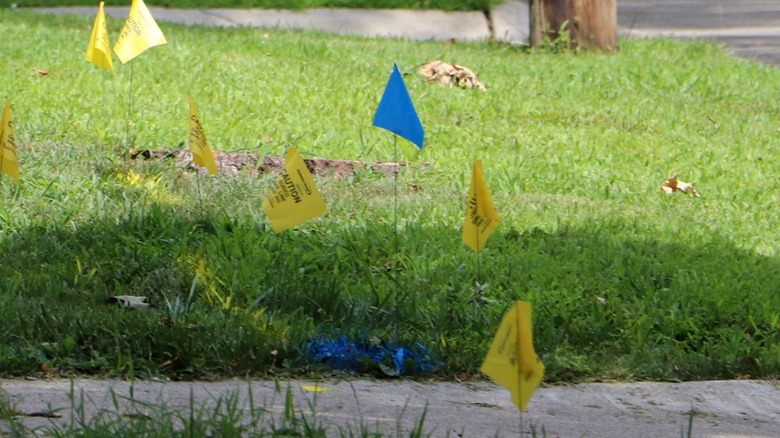
Any project that involves significant digging into the ground requires utility location in advance. Doing so helps to prevent possible damage to underground lines that might be costly (and even dangerous). Examples include gas, cable, and electric lines, to name a few. With this in mind, you may be most familiar with brightly-colored red, orange, and yellow utility flags that symbolize volatile lines. These aren't the only colors utility locators use, though. Aside from green utility flags, as well as white and purple ones, blue flags are also used for certain markings. Blue utility flags indicate the presence of potable (drinking) water lines, and it's important they stay in place during any construction process to prevent possible damage.
While you might have come across unexpected utility markings on driveways, it's also commonplace to see these painted lines and accompanying flags in the ground before a home project. Like other utility marking and flag colors, the color blue for drinking water follows the national standard as set forth by the American Public Works Association (APWA). These types of water lines not only supply drinking water, but they can also connect to fire hydrants. Purple paint and flags, on the other hand, indicate the presence of non-potable water often used for irrigation. The locator determines exactly where the water lines are underground, and then will likely paint blue markings that run along the surface. This helps to prevent accidental water line breaks while digging into the ground. At the same time, the locator will also likely place blue utility flags on top of the blue painted markings to increase visibility.
Blue utility flags can protect water lines, with some caveats

Blue utility flags for drinking water lines are certainly critical tools to help protect potentially expensive damage that can incur from haphazardly digging in the ground. Yet, there are also some limitations to using these ground markers. Utility flags cannot indicate how deep the utility lines are located beneath the ground, so either you or your contractor will still need to exercise caution when digging in the area. Some private locating companies might utilize different tools to help estimate the depth of the lines, but these are exceptions, and not the rule.
Whether you're planning a large-scale yard project, are constructing a new home, or are simply planting new trees, it's always important to obtain utility location, the process of finding underground lines. Your first thought may be to call 811. Despite this essential (and free) service, 811 can only come out to locate and mark public utility lines. Water lines that run between your home and the water meter must be located by a private utility line locating company instead. Once they identify the lines, they will still mark the areas in blue, as per APWA guidelines. If any utility flags or matching paint markings are erroneously removed, you must call a locator again to replace them. As such, you may want to keep curious pets and young children away from the area. Always turn off the main water supply valve and call a plumber if you accidentally hit a private water line on your property while digging underground.