

The Vintage Dishware Brand With An Iconic Mid-Century Pattern That's Highly Valuable

Attention vintage dishware enthusiasts: There is an iconic mid-century option you should keep your eyes peeled for. It has a unique pattern that perfectly captures the atomic vibe of the era ... and if you can score it for cheap while secondhand shopping, even better. While it's not one of the most iconic kitchen products of all time, this pattern is still highly valuable to collectors! It's the Starburst line from Franciscan Ceramics. This line was exclusively produced from 1954 to 1957, so there is extremely limited stock out there. Items from the Starburst collection are so valuable because they are rare! That is, if you plan to resell, you can often get back way more than what you paid.
If you seek out Starburst intentionally, you'll find that vendors who already know what they have on their hands routinely sell sets for more than $2,000 a pop. Even pieces sold on their own can seem expensive, like $75 for a gravy boat or a few mugs for $40. If you can take the time to piece together a collection, you do have the potential to save, but even $5 and $8 bits can add up quickly. The ideal place to find Starburst ceramics is at an estate sale or thrift shop. Often, ceramics in these contexts are priced to sell by people who would simply want to move merchandise. So, this line is one of the valuable vintage kitchen items you should never skip.
Identifying authentic Franciscan Ceramics Starburst dishware in the wild
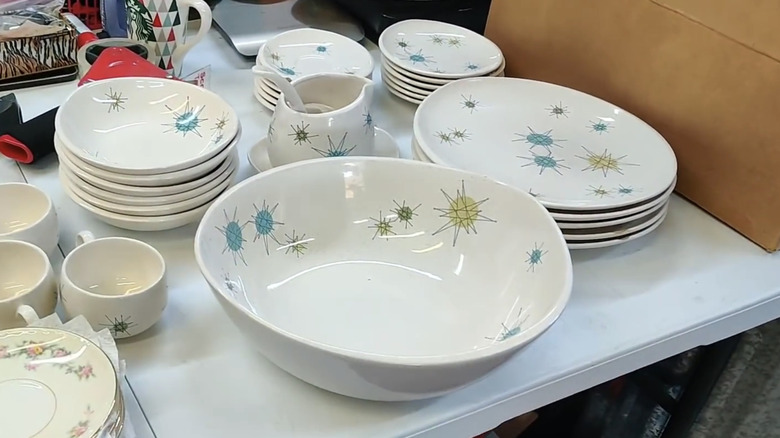
The Starburst line from Franciscan Ceramics looks like it belongs in an episode of "The Jetsons." The base of the line is a creamy white, flecked with baby blue and olive stars. The spiky, asymmetrical shape of these stars leans on the science-forward design of the post-war era. In fact, other brands made pieces that also leaned into the atomic trend, like the Corningware dish you'd be excited to see at the thrift store. "At that time, there was a lot of focus on the atom because of what was happening with the nuclear arms race — especially the atomic bomb," historian Alessandra Wood told Architectural Digest. "It was something that was really scary for people, but seeing the symbol of the atom was a way for people to start to feel more comfortable with the nuclear world." Having a piece of this collection from the late 1950s is like owning a little piece of history — making them all the more valuable.
Once you've spotted atomic stars on dishware, pick up the piece to check its authenticity. The Starburst wasn't hand-painted. So, when you run your fingers over the decals, they should feel smooth. If they are raised, it's probably a different brand or an imitation. Next, flip over the piece. There should be a Franciscan stamp on the bottom. There are different versions of the stamp out there. Some are blue; some are brown. However, both also say Gladding, McBean & Co (an original producer) and "Made in California."