

What Is An Orange Electrical Outlet Used For?
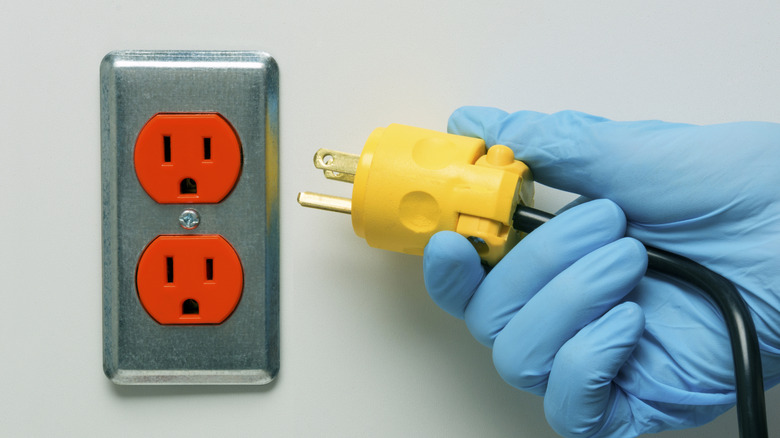
If you've ever seen an orange electrical outlet, you're not alone in wondering what they're used for. While most outlets are a classic white, the orange versions do have a special purpose. And no, they are not typically just a fun decorating option for people who like bright colors. Instead, their job is to keep special equipment operating safely and effectively. In this Hunker exclusive, we spoke to Carl Murawski, a licensed electrician and host of a popular YouTube channel that offers blue collar wisdom, to understand exactly how these orange outlets work. "They are uncommon in typical homes," he says. "What people often call an 'orange outlet' is usually an isolated-ground receptacle, although the important identifier is actually the orange triangle on the face of the receptacle — not necessarily the color of the entire device." So in some cases, they might even be white — but still set apart by these special markings. That's the key thing to spot. Similarly, Murawski notes that there are orange outlets that were installed for color coding, without being isolated-ground receptacles.
"These receptacles are more commonly found in commercial buildings, healthcare facilities, laboratories, recording facilities and other locations where electrical interference may affect specialized equipment," Murawski continues. That said, there are a few cases where they might still pop up residentially, too. "A home might have one because it previously contained a recording studio, specialized computer equipment, medical equipment or another system whose manufacturer or designer called for an isolated ground." But it's also okay to use orange outlets for other purposes that aren't on this list. It won't cause them any harm if you do.
How do these orange isolated-ground receptacles work?
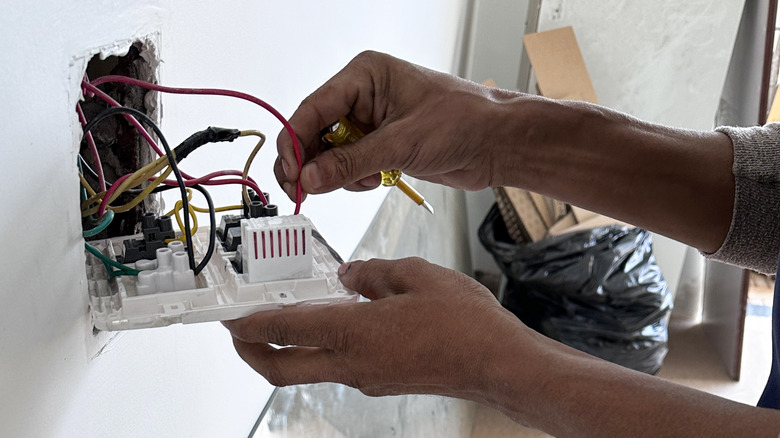
The reason these orange outlets (or white outlets with the orange triangles!) exist where they do is to eliminate any electrical noise for a specific purpose. "An isolated-ground receptacle is designed so that its grounding contact is electrically isolated from the receptacle's metal mounting strap," Carl Murawski tells Hunker exclusively. "A separate insulated equipment-grounding conductor is then run with the circuit conductors back to the proper grounding point." This means that the wires at this outlet are isolated from other wires in the building. There is only one connection highway: straight to the grounding point. "When the entire circuit is designed and installed correctly, this arrangement may help reduce electromagnetic interference reaching certain sensitive equipment," Murawski continues.
Isolating specialized equipment in this way has its benefits. It means that in hospitals, things like ultrasound or EKG (electrocardiogram) machines can run without any interference. In recording studios, there shouldn't be any buzzing or humming in the background of the clips thanks to the orange outlets. While orange outlets are beneficial in these situations, there are limits. "It does not create completely 'clean power,' regulate voltage or provide additional surge protection," Murawski clarifies. This is why you don't see these orange outlets in residential buildings as much. As you review your homeowner's guide to kitchen outlets, you'll notice that your countertop TV or fridge don't really need any of these benefits.
If you don't already have an isolated-ground receptacle, should you get one?

Let's say you do plan to install a home recording studio. After researching techniques for soundproofing walls, should you also hire an electrician for an isolated-ground receptacle or two? Carl Murawski isn't so sure. "For the average homeowner, an isolated-ground receptacle should not be the first response to computer problems, audio hum or other electrical interference," he says in an exclusive chat with Hunker. This is because "simply replacing a normal receptacle with an isolated-ground model will not provide any benefit unless the grounding conductor and the rest of the circuit are installed for that purpose."
That said, if you decide the electrical problems you are experiencing are too big to ignore, there is a safe way to do things. "A homeowner experiencing recurring interference should have a licensed electrician examine the grounding and bonding system, circuit loading and wiring arrangement," Murawski advises. Never attempt to wire your own house or complete similar electrical work on your own; this is not a DIY job. The electrician can assess whether there is a simpler fix than installing a separate entity. "In many homes, correcting an existing wiring problem, using a properly designed dedicated circuit, adding appropriate surge protection or addressing a ground loop at the connected equipment will be more useful than installing an isolated-ground receptacle." However, should this not be the case, you'll need to have the isolated-ground receptacle professionally installed for it to work safely and effectively.