

Step Aside, Quartz Countertops: This Attractive Alternative Is Cheaper & More Versatile
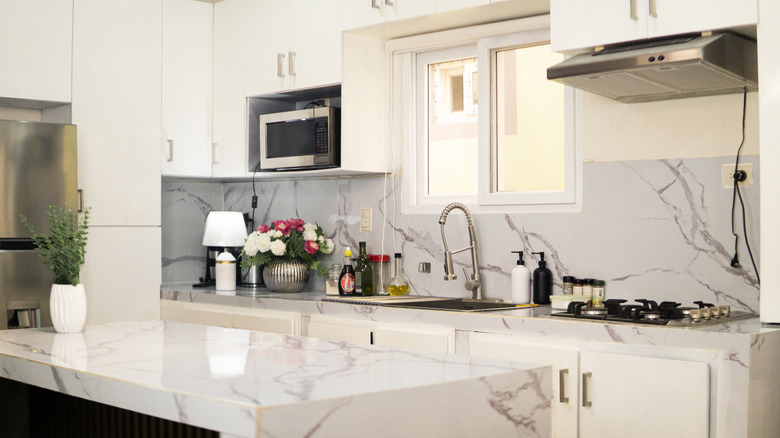
Quartz is undeniably the most popular kind of countertop in 2026, primarily thanks to its sleek look and simple maintenance. But if you're hoping to save a little cash on your next counter installation — and choose a material that can fit a variety of counter shapes and sizes — then you might want to look at a near-identical alternative. Corian is a solid surface (or synthetic) countertop that can provide your kitchen with a similar look to quartz.
Made with a mix of minerals and resin, Corian counters typically offer much more flexibility than their quartz counterparts. Professionals can use heat to flex and bend the material, so you can achieve the shape of your dreams — whether you're aiming for a curvy or round design or an integrated sink. It's easy to find a seamless slab of Corian for your counters, but even when a seam is needed, it's barely noticeable. This makes the material especially useful for kitchen elements that require invisible seams, like islands or backsplashes. Compared to quartz, which is inflexible and has slightly visible seams, Corian definitely takes the lead for unique design. If you're feeling brave, you can even DIY solid surface countertops.
Corian also offers a lower price point than quartz. The former typically ranges from $40 to $100 per square foot. Quartz, on the other hand, can reach as much as $150 per square foot. While you'll achieve minimal savings on the low end of both materials, the more expensive ranges could net you a large discount when using Corian.
The downsides of Corian countertops
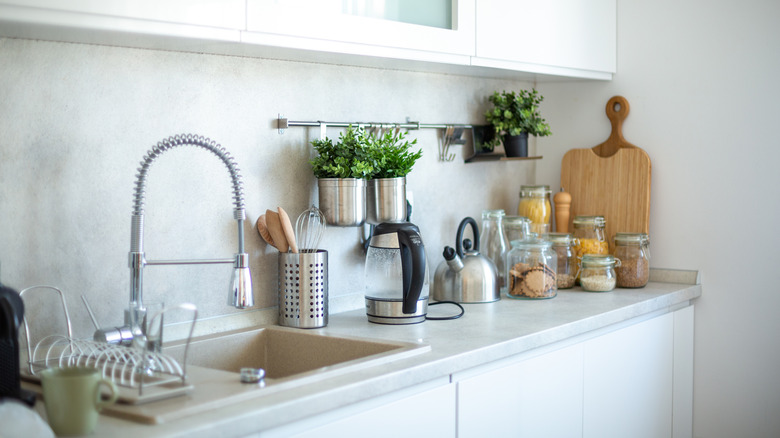
As with any countertop, Corian has its downsides. Corian is extremely soft compared to quartz, which means it will acquire scratches quite quickly. (Thankfully, this is an easy fix — Corian responds well to buffing, as long as you don't mind the extra maintenance.) It also chips easily. Overall, these issues contribute to its lower durability; while quartz can last for up to 50 years, you'll get 20 years at most out of your Corian counters.
Sadly, the same flexibility that makes Corian moldable when hot also means that it doesn't respond well to heat in the kitchen. Resting a hot pan on your Corian countertop for just a few seconds will easily scorch it. Quartz, on the other hand, generally has a higher temperature tolerance. In terms of resale value, quartz is naturally the better option. Corian nets a lower overall return on investment than quartz. At the moment, the latter is also seen as a premium material that's highly marketable in home listings. If you're planning on selling your home soon, note that buyers generally respond better to quartz.
At the end of the day, the countertop material you choose should be tailored to your needs, as well as the features you prioritize in your home. Corian is a versatile, affordable counter option that's worth considering. Plus, if you're planning on using it in a space where temperatures and scratches matter less — such as the bathroom — it could match quartz's performance. But if you do end up choosing quartz, here's how to estimate the cost of your new quartz counters.