

It Sat On Everyone's Vanity Generations Ago — Now It's A Thrift Store Decor Gem We'd Be Thrilled To Find
It's a spritz on your inner wrist, a spray on the pulse points of your neck, and your latest décor trend? Perfume bottles have long served as decorative items as well as the means to smelling fabulous. And no perfume bottle is more iconic that an authentic Lalique art glass perfume bottle. French jewelry maker René Lalique was renowned for his unique art nouveau glass, and praised as the "inventor of modern jewelry." He began experimenting with glass designs in the late 1800s, before unveiling his glass perfume bottle designs in 1909. His expertise in artistic design and industrial production make these bottles a dream to find on the thrift store shelf.
Ever at the forefront of fashion, Lalique's art nouveau gave way to art deco. One of the differences between art nouveau and art deco is the move from swooping curves to geometric straight lines and patterns. You'll find his perfume bottles from both eras, and they frequently featured nouveau nature, women, intricate patterns, and curves — along with striking lines and elaborate shapes. Finding a real Lalique perfume bottle isn't impossible, and it's worth the hunt.
Many of these pieces are highly valuable. "The value of a perfume bottle is a function of the rarity and beauty of the bottle itself," Lalique expert Nicholas Dawes told PBS. "If a Lalique bottle once held a rare perfume it doesn't mean it's worth more than a bottle that once held a common perfume." For instance, a rare blackberry tiara-topped bottle from the 1920s was valued at a minimum of $20,000 back in 2008. Many others are worth thousands; a serpent bottle from 1920 is valued at over $6,700, while the Rosace frosted glass bottles from 1912 can fetch over $10,000.
How to spot an authentic Lalique art glass perfume bottle
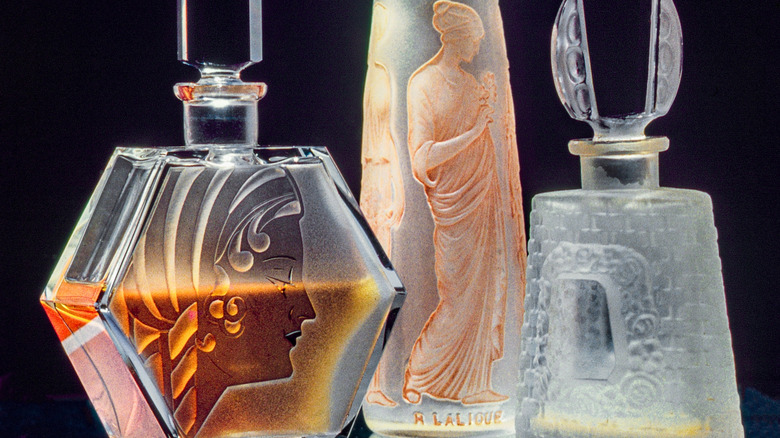
Every beauty has an imitator. Some "real" Laliques that may grace your thrift store shelves are certainly fake. A true Lalique will never have "Made in France" etched in the glass, nor will it have René Lalique's full name. An authentic perfume bottle will have "R. LALIQUE" in the design or on the bottom of the glass. After René Lalique's death in 1945, the signature switched to simply "Lalique France" with no "R" in front.
If you're lucky enough to thrift an antique Lalique from the 1910s or 1920s, or a vintage one from later decades, you may want to sell it or hold onto it, as rare pieces can increase in value. You can also use them as statement pieces for a display cabinet, bookcase, or mantel. (Since these are old, you may need to clean the perfume bottles if the scent itself isn't your style). Think old-school and arrange it on a decorative tray on your dressing table or bathroom counter. Pair it with other art nouveau or art deco antiques like tea sets or hand mirrors, or let it stand on its own as a centerpiece. Mix it in with your china cabinet pieces (study how to arrange a China cabinet to make it pop) and let it shine. Make sure that it's secure and cannot fall to protect your investment (but let's be real — a broken authentic Lalique is still an authentic Lalique!). If all else fails, Lalique as a luxury perfume brand is available today, and its modern bottles pay homage to its 100-year-old glass heritage.