

Skip Vinegar: There's A Smarter Way To Get Rid Ants In Your Yard Without Chemicals
We may receive a commission on purchases made from links.
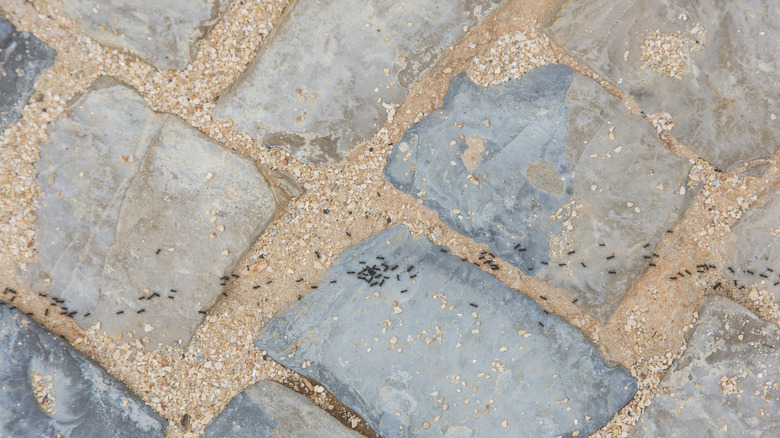
Not all ants are bad for your lawn and garden — in fact, most species are beneficial — but the bad ones can do a lot of damage, and the orange and red ones (fire ants, field ants or harvester ants) can sting you while they're undermining grass roots and smothering the lawn with their nests. When the ants get indoors, they nullify any benefits they bring to the garden by just being a nuisance. You can control indoor ants with vinegar, which has a strong smell that overpowers the pheromones that tell the ants where the food is, but the smell doesn't last long and isn't very effective outdoors. Diatomaceous earth (DE) is a smarter option for outdoor ant control.
DE is the fossilized remains of tiny shelled organisms called diatoms, and although it looks like nothing more than a fine powder to the naked eye, under a microscope, it's a minefield of sharp glass edges. Diatom fossils are too small to do any damage to humans or pets, but they are big enough to do significant damage to insects. When ants walk through DE powder, it lacerates their feet and shells and kills them by dehydration.
Recognizing the danger, ants tend to avoid DE, which makes it a good deterrent. You can make barriers in your house or garden that the ants won't cross, and the best thing is that, at about $25 for a 5-pound bag of something like Harris Diatomaceous Earth at the time of writing, it's as cheap as it is safe.
How to use diatomaceous earth safely
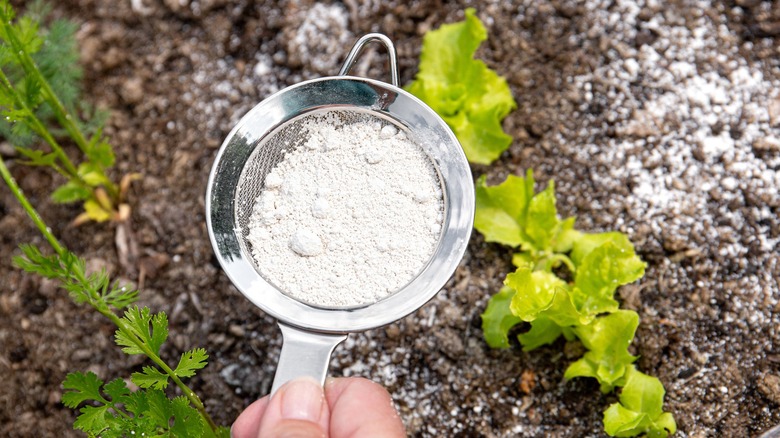
For ant control, you need food-grade — not pool-grade — diatomaceous earth. Food-grade DE is highly purified and safe for animal consumption, whereas pool-grade DE has been fire-treated to turn the silicon dioxide it contains into crystals. This improves its ability to filter pool water, but makes it a respiratory hazard and possibly even carcinogenic. Food-grade DE does not pose such hazards, but it can still be an irritant, so it's best to avoid inhaling it.
You can spread diatomaceous earth freely throughout your lawn or garden to keep ants away, or you can use it in a more controlled way with a duster or spoon to create ant barriers around particular plants or parts of the garden. You can even dust it on leaves or flowers, because besides ants, it will also kill a host of other insects that damage plants, including beetles, weevils, moths, aphids, and leafhoppers. Reapply DE each time rain washes it away and whenever you can no longer see a white, powdery coating.
It's important to keep in mind that DE isn't a perfect ant control tool. The label on Bonide Diatomaceous Earth states that it won't kill some species, and it might not pack the punch you need. That's likely to be the case if you find a fire ant nest in your yard, since it doesn't usually reach the queen. While using insecticide bait that foraging ants can bring back to the colony is usually the most effective method of total ant control, DE is a strong option if you want to keep your strategy chemical-free.