

Why Do Concrete Driveways Sink?
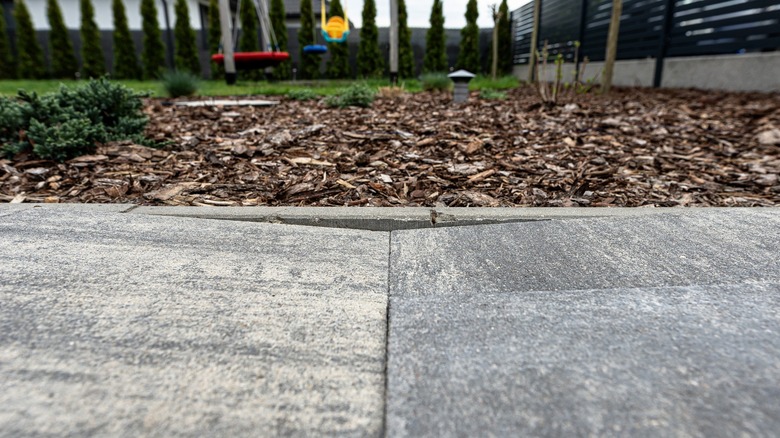
A concrete driveway looks solid, and it is, as long as it has adequate support from what's underneath it. Should soil movements undermine that support, the resulting voids can be so big that even a 4-inch concrete slab can't span them without sinking or cracking. Soil problems are a major reason why concrete driveways sink, but they aren't the only one.
Natural phenomena, such as incursions by tree roots or ground heaving during freeze/thaw cycles in colder climates, can also be responsible. Tree root damage is usually easy to diagnose; for one thing, there's usually a tree right there next to the driveway. Roots push concrete up, so they aren't a direct cause of sinking, but they give that impression by making some parts of the slab appear lower than others. It also matters how you use the driveway. If you habitually drive heavy vehicles on a driveway not designed for them, the concrete is bound to sink and crack.
It goes without saying that the soil under a driveway isn't supposed to settle, and the installing contractor should have assured that it wouldn't by making a 4- to 6-inch sub-base with angular gravel and compacting it with a plate compactor. Continuous use by heavy vehicles calls for an even thicker sub-base — up to 12 inches. If your driveway is sinking because of an inadequate sub-base, you've got a problem, because you basically have to redo the driveway.
Some signs of sinking are more obvious than others
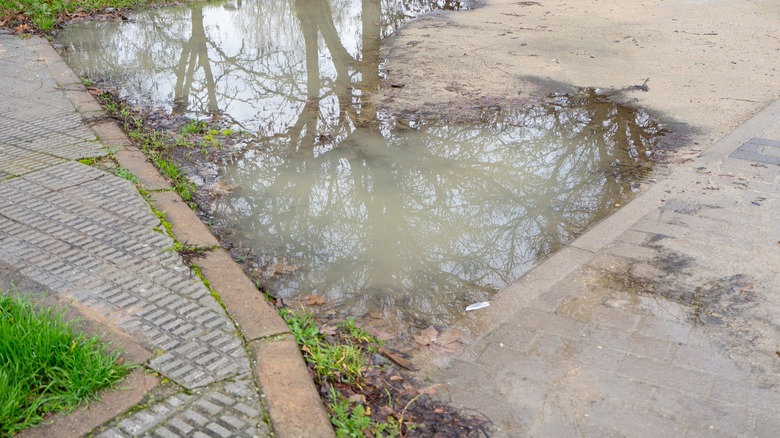
Even if your concrete driveway has an adequate sub-base, it can still be undermined by soil erosion, and that's usually because of a drainage issue. Water pooling near the edges of low-lying parts of the driveway can seep into the ground and emulsify the soil, especially if it's loose and loamy, and instead of a solid footing under the sub-base, you've basically got mud. To fix such a situation, start by installing a drainage system, such as a French drain for the driveway, and then you can decide whether to level the affected part of the slab with polyurethane foam or to demolish and replace it.
Buckling at the joints and pooling water are two obvious signs that your driveway is sinking, but some other signs are more subtle. For example, you may notice one or more concrete driveway cracks, which by themselves aren't indications of anything more serious than degraded concrete, but if they're spreading, the slab is likely undermined. Similarly, slight variations in level at the edges or between expansion joints mean that some part of the slab is either sinking or heaving, and if you don't live in a cold climate where the ground freezes, it's probably sinking.
Fortunately, most causes of sinking don't affect the whole driveway and don't call for such extreme concrete slab repair measures. In some cases, you may have to break up the concrete in parts of the driveway and replace it, but sometimes, you don't even have to do that much, and only need to inject material under the driveway to prop it back up.