

Plant This Overlooked Cover Crop In Late Summer To Prevent Sprouting Weeds

If the summer heat is causing your plants to suffer, opportunistic weeds could present a problem. Weaker plants have trouble competing with weeds, giving them a chance to take root in your garden. Even worse, if some of your plants have completely died and been removed, the empty space left behind is perfect for weeds. Cover crops are a safe and natural weed control option to fill that space. The idea is to plant something that is suited to the environment, grows quickly, can outcompete weeds, and won't interfere with the rest of your garden. You shouldn't overlook buckwheat (Fagopyrum esculentum) — it's a popular cover crop for farms, but you can use it for your own garden as well!
Buckwheat is a great cover crop due to how quickly it grows. It can germinate in a matter of days and is fully grown in just a few weeks. Its broad leaves stop sunlight from reaching the soil, helping to prevent weeds from getting what they need to grow. When planted densely throughout your garden, it can be incredibly effective at preventing weeds. Buckwheat can provide other benefits as well. Its root system is great at breaking up compacted soil and can help reduce erosion, which is good news if you live somewhere with summer storms and tend to lose soil to the wind and rain. If you need a quick and easy cover crop to get your garden through the hottest days of summer until it's time to plant your fall vegetable garden, buckwheat is an excellent choice.
Growing buckwheat as a cover crop
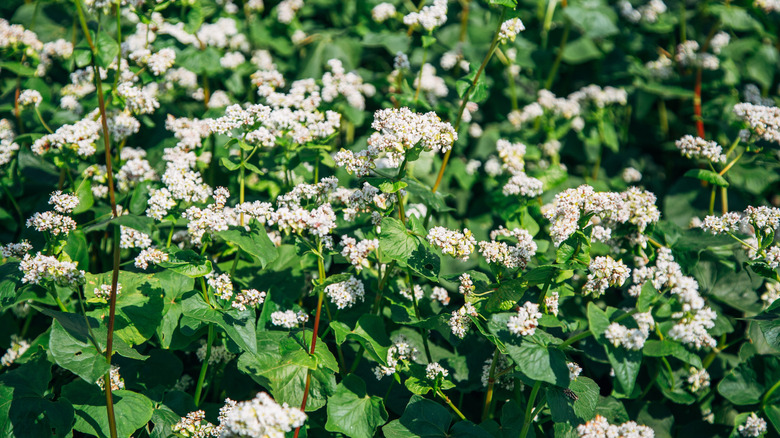
Before you prepare the soil or plant your seeds, make sure you have the right plant. The buckwheat commonly used as a cover crop is Fagopyrum esculentum, or common buckwheat. However, there are other plants that are also called buckwheat. Wild buckwheat (Polygonum convolvulus), also called black bindweed, is a common weed on the west coast. There are also wild buckwheats (Eriogonum spp.), which is a genus of native flowering plants. You may want to grow the native wild buckwheats in your garden as well, but it's important to know which you're getting.
Buckwheat can be seeded throughout the summer, from May to September. It doesn't tolerate the cold well and is only hardy in Zones 6 through 12. Make sure you're planting it at least a few weeks to a month before the chill of fall arrives in your area if you want it to reach maturity. It thrives in full to partial sun, and prefers relatively moist soils. While it can survive some droughts, it tends to wilt in dry, hot weather. You don't need to bury the seeds deeply. Simply loosen the soil and scatter them over the surface, covering them lightly with soil. Water the seeds, and before long you should have plants large enough to smother any sprouting weeds! In a couple of weeks you should see pink or white flowers. Their single-petaled flowers attract pollinators which hunt harmful insects. However, buckwheat can self-seed if the flowers are left too long, so cut down the plants once they've been flowering for roughly a week.