

Forget Cypress: This Tree From Colorado Makes A Beautiful Privacy Fence
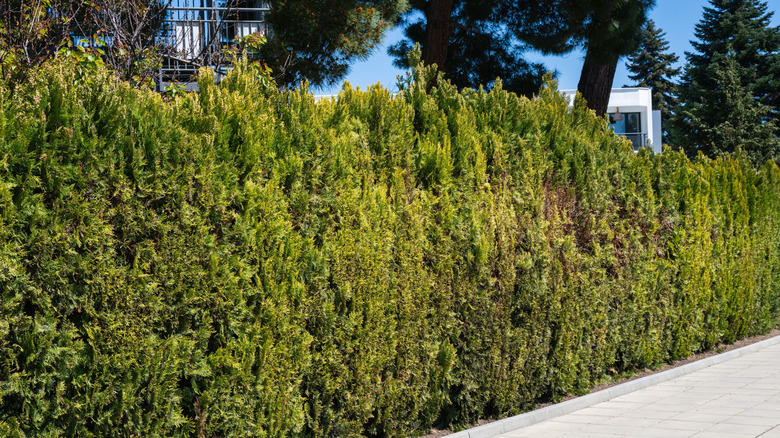
You get along with your neighbors, sure. But you don't want to have to see them every time you're out in your backyard. A plant-based privacy screen can turn your yard into a private oasis, giving you some peace and quiet as you barbecue, garden, or just relax outdoors. While Leyland cypress (X Cupressocyparis leylandii) is a common pick for a privacy fence, its fast growth rate and potentially large size could cause considerable damage to your home and could quickly outgrow the space allotted to it.
If you'd like an evergreen that's more slow-growing but still ideal for privacy, consider the Colorado blue spruce (Picea pungens). The tree's blue-green needles give it a distinctive appearance, and its slow growth rate means you won't have to rush to replace it or worry that it will crowd out other trees or landscaping in your yard. Dwarf versions of the blue spruce, such as JeanGenie Colorado blue spruce (Picea pungens 'Moneva') also exist. The dwarf Colorado blue spruce maxes out at roughly 15 feet high and 8 feet wide, potentially making it an ideal pick for a compact privacy fence.
Planting blue spruce as a privacy fence
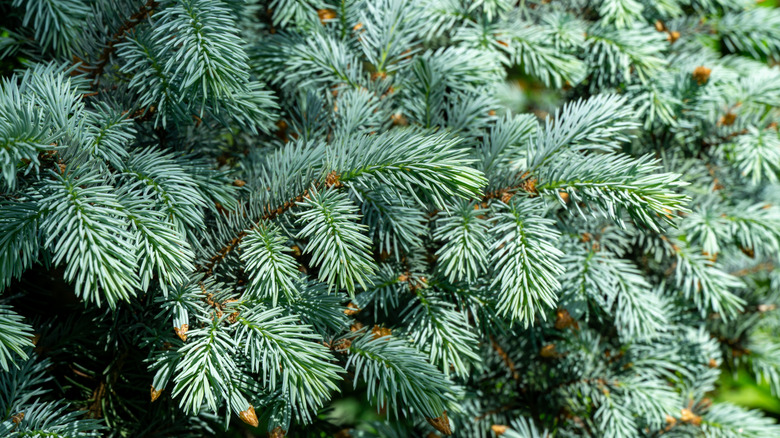
Before you plant Colorado blue spruce in your yard, consider whether you can give it the conditions it needs to thrive. As a native to the Rocky Mountains, the evergreen tree does best in cool, dry conditions. It won't thrive in a hot and humid climate and is only hardy in zones 2 through 7. It also needs well-drained soil, similar to the sandy soil found in its native habitat. If you live in an area that doesn't experience hot and humid summers and that doesn't have clay soil, the blue spruce can be an excellent choice for a privacy fence.
To create a privacy screen with blue spruce, spacing matters. While giving the trees at least 10 feet of space is usually recommended, spacing of 6 to 8 feet allows the trees to overlap, creating a solid privacy fence. Dwarf variants need to be spaced 3 to 6 feet for privacy screening. Blue spruce is susceptible to several diseases, notably rhizosphaera needle cast, which causes the tree's needles to turn brown and fall off. Planting the tree in humid conditions or not giving it enough airflow can increase the chance of it developing needle cast. To keep the tree in good health, you should trim blue spruce to thin its canopy, improving airflow and allowing sunlight to reach all its branches. You may also consider choosing a more disease-resistant variety, such as Fat Albert or Hoopsii. Those two varieties also have a more distinct blue color than others, making them a perfect pick if you want a blue spruce that actually looks blue.