

Ditch Ugly Boxes: Turn A Thrift Store Find Into The Ultimate DIY Storage Solution For Legos
Welcome back to The Thrifted Fix, a weekly column where our writers turn thrift store finds into the ultimate solutions for everyday home problems.
It is safe to say that I have stepped on a few Legos in my time. Most of our collection, which was inherited from family members who didn't have the heart to properly "put them away" for good, arrived fairly organized, often still assembled as spectacular (and spectacularly expensive) sets, complete with instruction booklets. But these soon dissolved into an undifferentiated ocean of plastic bricks, doors, swords, torsos, and curvy vehicle panels that apparently couldn't be approximated with old-school Lego geometry. Thankfully, I found my ultimate Lego storage solution at a thrift store in the form of a $10 end table. (Maybe I should have dropped off the Legos at the thrift store while I was there.)
The idea: Give the kids a contained, Lego-friendly play surface and ample storage. Results are mixed but generally promising, and no drinks have been spilled on it ... yet. This was a homely end table, by my reckoning — a wood top with inset tile — a very '90s sort of thing. The style meshed just fine with our vintage-eclectic-dorm style, though practically everything does (or nothing does ... same thing). I still didn't like it, but that didn't matter, because I built a 25-inch by 25-inch removable top covered with 10-by-10 Lego baseplates glued to a bit of chipboard, giving the toys a place to sit and, hopefully, stay attached.
The utility and engineering of a Lego storage table
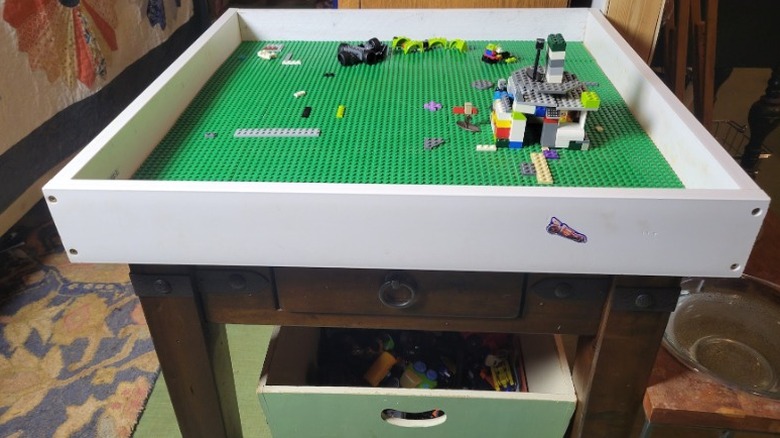
The sides are built of PVC trim on three sides and a piece of 1-by-3 furring on the fourth. The PVC has a dado cut into it to receive the edge of the chipboard so that the sides extend an inch below the tabletop on three sides. This allows it to sit securely in place while still being easy to remove. The sides also form a lip above the baseplates to create a kind of palace curtain wall around the table or, more aptly, a Lego prison perimeter wall.
The table has a drawer for storing maybe a few hundred bricks and is mostly useful for sweeping Lego pieces into when things get a little too chaotic. The drawer is really too small for general Lego storage, but this was just an accident of the table we selected; your setup may vary. I'll probably reallocate it for the various Lego Technic sets and other specialized pieces. A bin underneath the table or something like a nifty thrifted book storage solution could probably hold most of the Lego pieces we still have around ... that is, the ones that haven't been passed on or "put away" for good.
How our Lego table could be and shouldn't be better
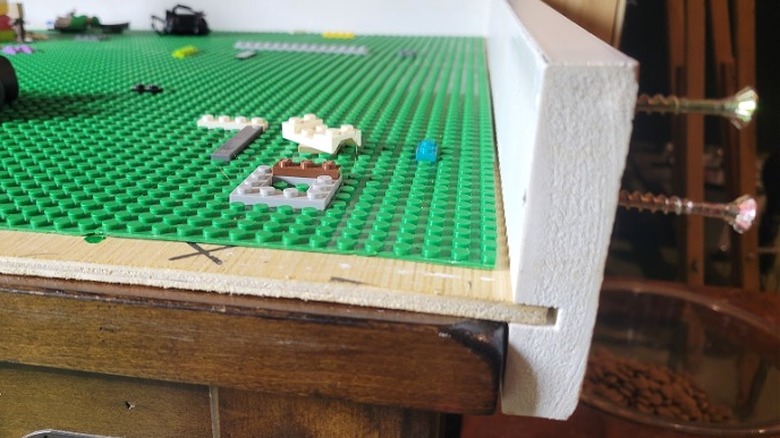
The Lego table is not a panacea in the way that, say, smelting or "putting them away" would be. The baseplates are difficult to clean, requiring an orange oil-based spray, a nylon bristle brush, a microfiber cloth, and a vacuum cleaner to properly de-gunk. You can disinfect Legos themselves, but sanitizing glued-down baseplates might prove challenging. I picked up these off-brand baseplates on Amazon and they don't align perfectly along their edges, as you can see in the above photo. I used Lego bricks to find the spacing when gluing the baseplates down, so there are small gaps between some of them. And the table itself might be too small ... but evidence suggests a table even the size of my living room would be too small.
Another problem, probably irresolvable and certainly not the fault of the table, is that non-Lego pieces tend to find their way into my kids' Lego creations. Hot Wheels cars park in Lego garages, while metal Minecraft Creepers wait at the top of the stairs to blow up mini-figures with conveniently removable heads and limbs. I see this sort of toy syncretism as a benefit. It teaches my kids to make do with the 37,000 toys they already have, and I don't have to buy mini-figurines and little Lego car kits.
It's usually messy. This is not a proper storage shelf, but a place for kids to play with (and drop and try very hard to break) their Legos. An active and fun kids' playroom should be a place for joy and all the unruliness and mess that comes with it, not a space staged for Instagram. That's why we haven't put the Legos away, and maybe never will.