

Your Vintage Cabinet Could Turn Out To Be A Designer Antique Worth Thousands
We may receive a commission on purchases made from links.
There are certain valuable collectible items you should never overlook when shopping at estate sales, but sometimes, the best deals are already inside your home. As any fan of "Antiques Roadshow" will tell you, you tune in to see unsuspecting guests discover their vintage cabinet is actually a designer antique worth thousands. If you have a William and Mary chest of drawers in your home, this could be you. Sometimes also labeled as Early Baroque style, William and Mary furniture was created between 1690 and 1730, named after the British monarchs of the time. It was instrumental in the creation of dovetail joining and is delicate in its design, qualities that make it extremely valuable to modern collectors. At auction, smaller William and Mary chests go for a few thousand dollars, while larger, more specialized pieces (like those with oyster veneering) can go for more than $40,000.
Aside from their monetary value, many ordinary folks already have William and Mary chests in their homes simply because of their beauty. Perhaps they inherited the furniture from family, or purchased it after shopping Facebook Marketplace like a pro ... often from a seller who didn't know what they had on hand. They are easy to style and go with almost everything. "I find they mix into so many interiors — traditional, English, Spanish," designer Nathan Turner told Country Living. "They're great as nightstands, entry pieces, or in a living room with a tray and a bar set up on top of it."
Identifying and pricing your William and Mary chest
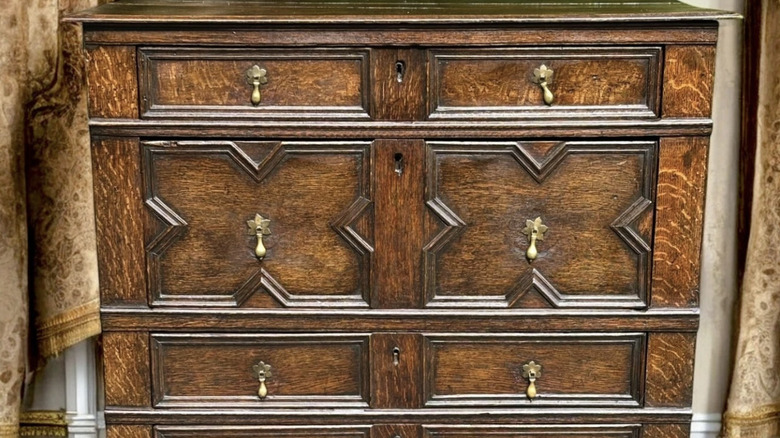
William and Mary chests are so precious because they showcase early American craftsmanship. When colonists first came across the Atlantic, they did not bring their fancy furniture with them. Instead, pieces were built on-shore and, in the early days, were quite plain. As the new colonies found their footing, the quality and detail of the furniture improved. William and Mary chests show a society shifting from survival to comfort. When identifying William and Mary chests, you should note that pieces are typically lifted off the ground, and by thin legs that are at an angle. This motif was repeated across pieces in the style. They also have veneers attached to the front of the chest. These are quite detailed and were meant to showcase luxury. As mentioned, dovetail joints are also a prominent feature of the style.
Hopefully your William and Mary chest hasn't been ruined under layers of paint. If not, contact a local auction house for a quote based on its condition and features. They will also need to confirm that it is an authentic antique piece and not a modern reproduction. However, even pieces with modifications may be worth tens of thousands if they're particularly rare, an example being the line-and-berry inlaid walnut chest, which was listed on Sotheby's with an estimated value of $15,00 to $25,000.
You can also browse resale sites, from eBay to Sotheby's, for listings that seem to match your chest. By comparing similar pieces, you can land on a relative valuation. That said, furniture like this is worth holding onto for a while longer. They make great family heirlooms and are likely to increase in price due to their age, if kept in good condition.