

Your Lawn Mower Blades Don't Need To Be Sharpened As Often As You Think
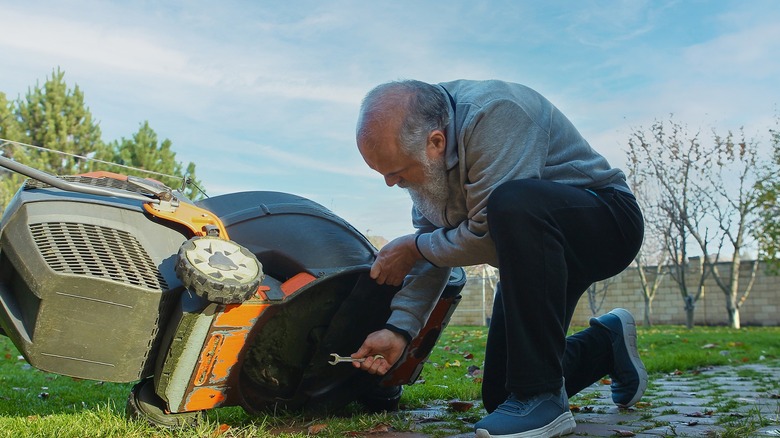
It's a given that your lawn mower needs a sharp blade to cut the grass evenly. Some lawn mower retailers recommend doing it at least once a year, and others twice a year or even more often. While sharpening the blade is not difficult, especially if you do it with a handy blade sharpening tool hiding on Amazon, it's an extra chore. If you have set aside limited time for lawn maintenance, you'll be happy to know that these recommendations are not actually requirements. You don't necessarily have to sharpen your blade every year. For a smaller lawn, you may only need to sharpen the blade every two years or so.
This isn't to say you don't need to maintain a sharp blade ... You do. A dull blade won't cut cleanly, and as a result, your mower will work harder, and so will you — especially if you let the grass grow long and thick. Consider the difference between using sharp scissors to cut paper and using dull ones: The sharp ones make a clean cut while the dull ones simply bend the paper. That's the difference between cutting grass with a sharp blade and doing the job with a dull one, except the force of a dull blade doesn't just bend the grass; it shreds and rips it. Although a mower blade needs to be sharp, it doesn't need to be razor sharp, and you wouldn't want that. A blade that's too sharp wears down quickly and needs to be replaced sooner.
How to know when the blade needs sharpening
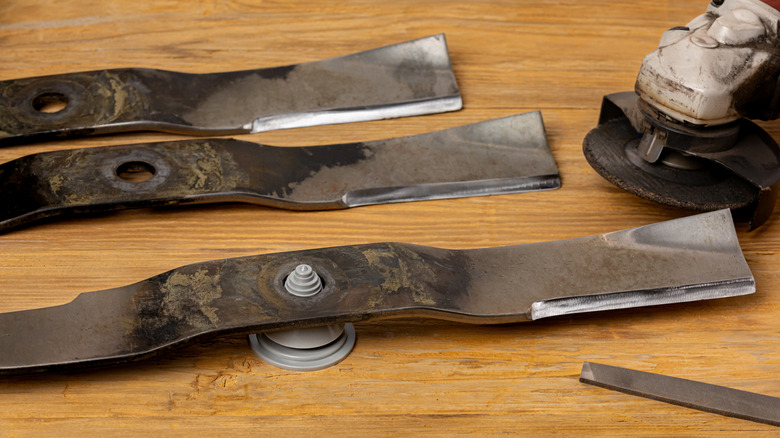
The first indication of a dull mower blade shows up in the lawn itself. Instead of being evenly shorn, the grass will be ragged and have split ends, and because the blade tends to rip the grass right out of the ground, some parts of the lawn may be brown. Besides of the uneven mowing, you'll also notice that the mower tends to bog down in long or wet grass, requires more effort to push, and may even stall out. All of this means it probably takes longer to mow the lawn than usual.
Whether or not you notice any of these effects, you can tell a blade is dull just by inspecting it. It may be nicked or gouged by stones it has run over while mowing, and the edge will be rounded. If you run your finger along it, it will feel more like the edge of a spoon than a butter knife, which is what it should feel like. You may also find dirt collecting on the undercarriage; that's a sign the blade is pulling grass out of the ground rather than cutting it cleanly.
If the blade is bent, or the curved upward part at the end of the blade (the sail) has worn thin, it's time to replace the blade. Otherwise, you should sharpen it, and to sharpen a blade safely, you should remove it and put it in a vise.