

Evict Carpenter Bees From Your Fence Or Deck With An Expert-Recommended DIY Solution
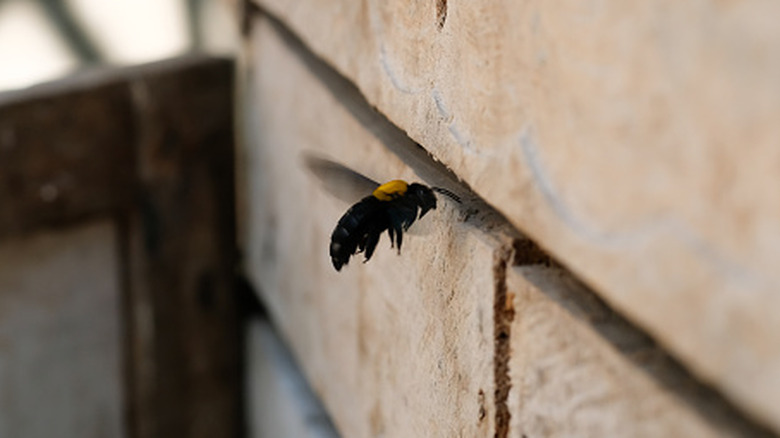
Homeowners' reactions to carpenter bees might seem puzzling at first. While a carpenter bee might occasionally take a run at a person near an active nest in a sort of "dive-bombing" action that's all too familiar to some, they don't generally sting. (The males can't, and the females must be strongly provoked.) They are a solitary species that, unlike social wasps and bees, won't swarm or attack en masse. You might have even created a garden to attract bees. The true danger of the carpenter bee lies in its name: In the right circumstances, they'll blithely demolish wooden structures in and around your home. Fortunately, there are expert-recommended ways of dealing with carpenter bees, including DIY methods like using insecticidal powders and sealing or painting wood.
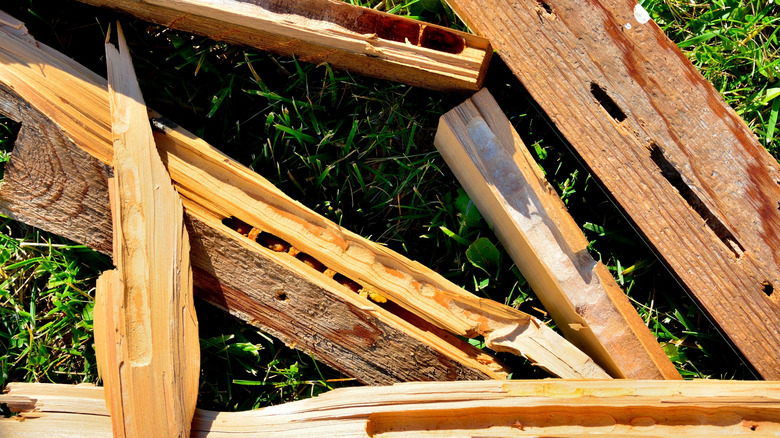
Hunker spoke exclusively with Josh Petro, Operations Manager at Truly Nolen Pest Control in Sarasota, FL, about how to effectively deal with carpenter bees, and he started by elaborating on the risks these otherwise-beneficial insects represent for homeowners. "Carpenter bees can damage wood decks, fences, railings, and similar outdoor structures, although the severity varies," Petro said. While they are, on average, less destructive than termites, Petro explained that the problem with carpenter bees is cumulative. "Multiple nests can weaken small structural members over time." The bees create 10-foot-long "galleries" in untreated wood, often also weakening porches, balconies, and steps. These not only lessen the amount of material present, but are also highways for water ingress and decay. And when multiple generations of bees burrow into a single board, the problem can become dire, causing warping and eventual structural failure.
An expert's recommendation for dealing with carpenter bees
Carpenter bees do their damage in very predictable areas. When Hunker exclusively interviewed pest control expert Josh Petro, he explained that carpenter bees are seeking unpainted softwoods that are appropriate for nesting, so sealing or painting the wood is one easy DIY solution for keeping carpenter bees from drilling into your deck. "Carpenter bees prefer bare wood, weathered wood and woods such as pine, cedar, [and] fir; therefore, filling the holes with wood putty then painting will also help," he said.
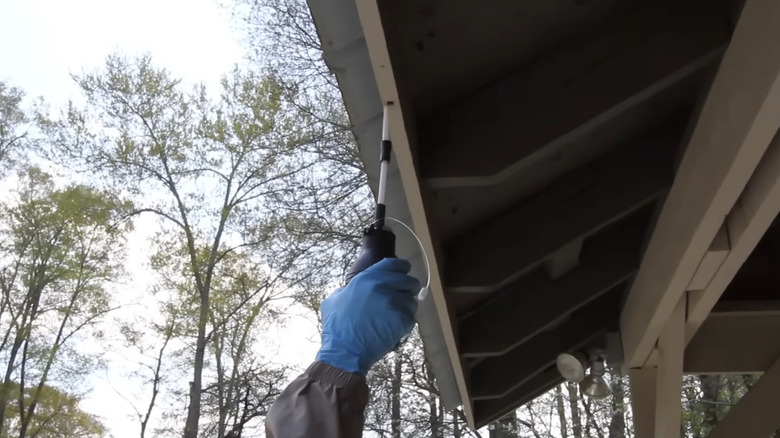
Once you know where to look, you might very well find the telltale evidence of carpenter bees ... nearly round half-inch holes, usually accompanied by a dusting of sawdust and yellow fecal staining. Fortunately, Petro said, "there are solutions homeowners can use to get rid of carpenter bees." He specifically recommended applying insecticidal dusts to carpenter bee galleries. These dusts are usually applied with bellows, bulbs, and specialized applicators, and most often contain the pyrethroid deltamethrin; one common example is Delta Dust. He also recommended using boric acid dust, a less toxic and less expensive alternative to traditional insecticides. A residual insecticide specifically labeled for carpenter bees can also be used around nest entrances, Petro said. These also typically contain pyrethroids like permethrin or pyrethrin-containing dessicants. (Chemical and trade names can be tricky; note that deltamethrin is a pyrethroid, a stronger synthetic version of pyrethrin, which is naturally derived from chrysanthemums. In spite of the similarities in naming and chemical composition, pyrethrins are not pyrethroids, which are generally more toxic.) It's often necessary to reapply residual insecticides about every 30 days.
Not all DIY solutions work, and sometimes you need a pro
Unlike proper pesticide application and painting, which you should do when using untreated lumber outside anyway, there are DIY approaches that are basically ineffective. Josh Petro told Hunker in an exclusive interview that these include the notion of giving your bees an annoying concert. "Playing loud music is unlikely to get rid of carpenter bees," the pest control expert said. Carpenter bees' "hearing" is limited to vibration-sensing organs, and carpenter bees are great at habituating themselves to all but the most irregular, loud vibration-inducing sounds. Most commercial devices don't come close to generating sufficient vibrations. Other products sometimes pitched to DIYers include ultrasonic devices, which are well outside of the "hearing" range of carpenter bees.
"A homeowner should consider calling a professional pest control company for carpenter bees when the infestation is beyond simple prevention measures," Petro said. "Multiple active nests, recurring infestations, for example." These infestations sometimes require precision and knowledge beyond what you might be ready to provide as a DIYer. For example, some deltamethrin-containing residual desiccant insecticides are slow-acting and aren't appropriate for dealing with bees.