

Not Wedgwood: The Antique Dishware Brand To Hunt For At The Thrift Store
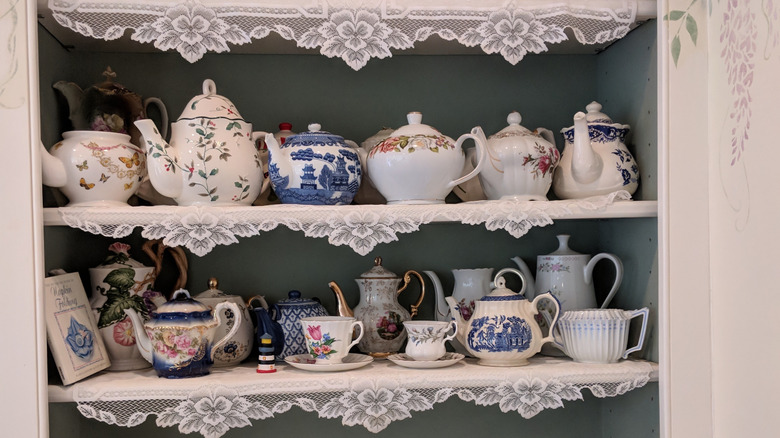
Look, we all love finding a valuable piece of Wedgwood at the thrift store. Not only are these designs gorgeous, but they're just such good quality dishware. However, there's another brand of china you should be checking out that's been under the radar of semi-serious collectors — and it's one of the more historically-significant porcelain brands you'll find. Welcome to the world of Spode.
Josiah Spode I was a potter in 18th century England who pioneered some of the most important inventions in pottery history. Not only was he the first to develop an underglaze print transfer technique, but he also was the first producer of bone china, then called "Stoke China," named after the area where his shop was located. Josiah I died in 1797, but his son, Josiah II, kept the business going by further developing and perfecting Spode products. In 1822, he launched Felspar Porcelain, a derivative of bone china that is considered the granddaddy of all English chinaware made today.
What makes Spode China worth looking out for is its consistently high quality. Antique pieces are valuable and can be worth several hundred to tens of thousands of dollars; for instance, a set of 12 plates, circa, 1820, was listed on 1stdibs for $17,500. Some of Spode's original designs are being produced today, which can make it a little difficult to find those original pieces. You just need to know what to look for. But first, we have to be the bearer of bad news. The chance you'll find an antique dish of Spode China at the thrift store isn't too high, based on availability and the fact that Josiah I didn't sign his pieces. However, your chances of finding something vintage — as in made during the last century — are pretty good.
What to look for to find the most valuable Spode pieces
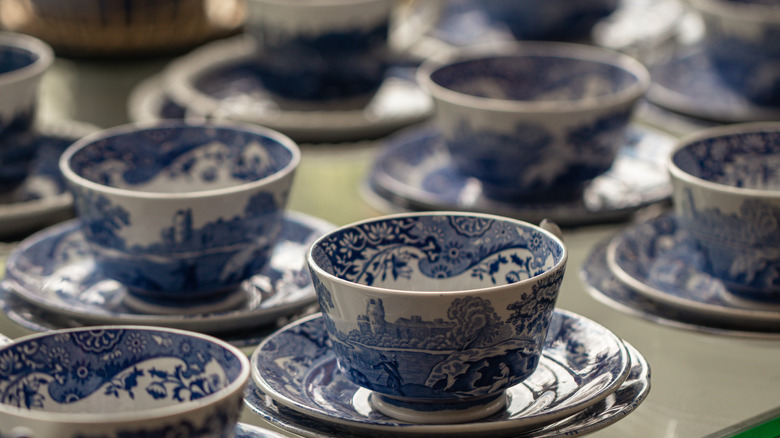
Many of Spode's early designs were printed in blue, so we'd recommend starting there. First, feel the quality of the piece. Bone China is thin yet strong, so you're not looking for something heavy like stoneware or thick ceramics. Next, hold the piece up to light — if it becomes semi-translucent, it's likely you've got a genuine piece of bone china.
After that, turn the piece over and look at the backstamp. The earliest pieces were hand-marked with "Spode" and the pattern number in red, blue, or black ink. However, if you find a backstamp marked "Copeland," don't set it back on the shelf yet. From 1833 to 1847, Spode was known as Copeland and Garrett (its owners at the time). Copeland and Garret backstamps will typically date to that era, while just "Copeland" or "W.T. Copeland" stamps are on pieces dating from 1847 to 1970, and are most likely the vintage pieces you're going to find. Many will also have impressed datemarks that use a letter to designate the month, stacked on top of two numbers that signify its date. So, for example, if you find a piece marked "D 45" that means it was manufactured in December, 1945.
In 1970, the company reverted to the name Spode and so the backstamps needed to be updated again. If you find a piece with a machine-printed "Spode" backstamp, you've got a piece that was made between 1970 and 2009, when the Spode factory closed. These backstamps will also often signify whether or not the piece is dishwasher-safe, which is important because some designs are so delicate they need to be soaked in warm water or washed by hand.