

What Is The 90-Minute Rule For Mixed Concrete?

For almost a century, the way to deal with concrete mix that's been in the truck for 90 minutes or more was simple and almost inflexible: You send the truck and all the concrete back and start over. From 1933 until very recently, this "90-minute rule" was a widely accepted, important industry standard. It was also a royal pain.
The 90–minute rule gave builders a way to keep concrete strong, free from cracking, and easier to work with. Back when the American Society for Testing and Materials (ASTM) formulated the rule, concrete that had begun to set could only be kept workable by adding water, which would compromise the quality of the finished concrete. On the other hand, concrete delivered and poured within the 90-minute timeframe was sure to be workable and optimized for maximum strength when cured.
So long as no water was added, and the temperature of the concrete mix stayed under 90 degrees Fahrenheit, the ASTM rule — which was adopted by the American Concrete Institute (ACI) — allowed the time limit to be extended to 120 minutes. This exception points to one of the major implications of the 90-minute rule: its effect on schedule control. That extra 30 minutes could be critical, because it was a major hurdle for any delivery that took a long time and didn't end at a jobsite with running water — a common enough occurrence on new construction sites. Urban traffic, long suburban and rural hauls, and dozens of everyday slowdowns could ruin an entire batch of concrete before it ever left the truck. Fortunately, the 90-minute rule is on the way out.
The importance of the 90-minute rule
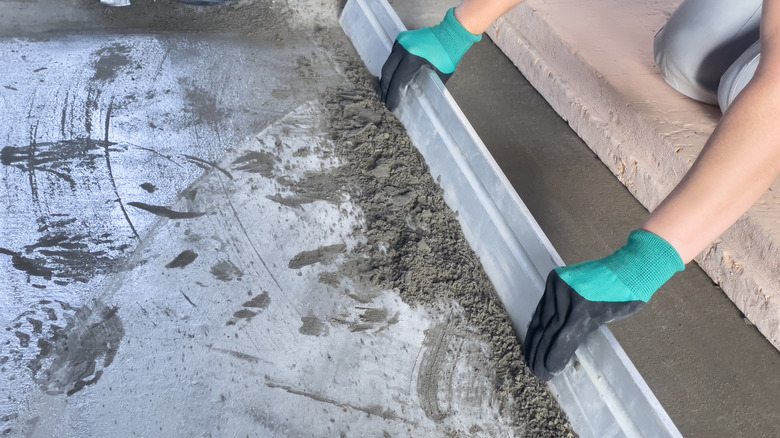
To understand why this is such a major issue, it helps to know the basics of ready-mixed concrete. Think of your concrete project as a cake. Dustier than many and ultimately harder than most, sure, but working wet concrete can remind one of cake batter. When the truck shows up an hour late for your patio pour, and the concrete isn't as workable as it should be, you might be thinking in cake terms. If you want to loosen stiff cake batter, you add liquid (milk, say) to it a little at a time. This works just fine. By the same logic, why not add some water to the concrete mix? So, you grab a hose and, if the driver doesn't start shouting at you to stop, you ruin your concrete.
As the cement in your mix hydrates, the concrete begins to set and becomes difficult, or impossible, to work with. (Check our primer on the difference between cement and concrete to get a handle on both materials.) You can make the mix superficially more workable by adding water, but you are trading workability for quality and strength at that point. Adding more water than strictly required leads to poorer-quality concrete, as excess water evaporates and leaves voids, which weaken the concrete and make it more permeable. The final product also shrinks more and, therefore, cracks more. Worse yet, the finished surface becomes far more prone to flaking or even eroding to dust. Concrete takes a long time to cure, so these problems might not show up immediately, but they will appear with time.
Is the 90-minute rule still valid?
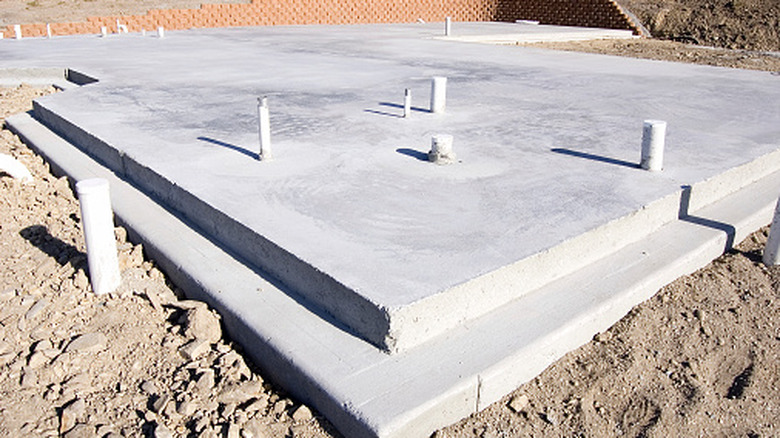
The measure of concrete's flowability and workability is called concrete slump, and fortunately, there are ways to improve slump without adding water to the mix. Ready-mixed concrete is now commonly improved by what the industry calls "admixtures" — chemical additives that enhance the process or the final product in various ways, including maintaining a target slump for longer without additional water. Research shows that these additives — water reducers, stabilizers, plasticizers, set retarders, and others — can greatly extend delivery and placement times for ready-mixed concrete. And that means taking some of the risk out of the hauling process, presumably reducing costs to producers and prices to homeowners.
Admixtures aren't a cure-all, no pun intended. Some concrete mixtures might still require less than 90 minutes for placement and working, and stacking incompatible additives can actually worsen the rate of slump loss. But, on the whole, the industry has outgrown the 90-minute rule. Researchers at the New Jersey Institute of Technology have shown that the new technologies keep freshly mixed concrete viable for as long as 150 minutes, and industry trade groups like the ACI are likely to follow ASTM's lead in amending the old rule. The ASTM last advocated the 90-minute rule in 2020, and subsequent revisions have replaced it with a recommendation that purchasers should set the discharge time limit on a case-by-case basis, in conversation with concrete producers. That conversation would likely touch on factors like the mix composition, design strength, concrete and ambient temperatures, placement method, and the size of the crew (which affects the speed of finishing).