

The Overlooked Solution To Keep Weeds Out Of Gravel Before It's A Problem
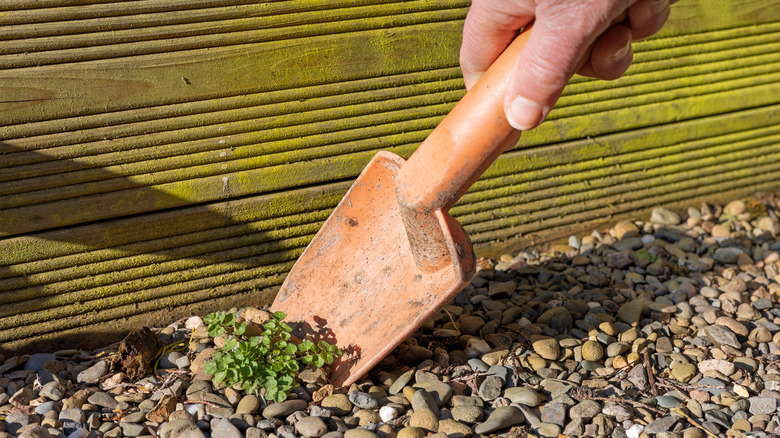
Gravel is a staple feature in landscape architecture. Building gravel paths and driveways can look chic, but their visual impact is easily undercut by the presence of pesky weeds. Once they take root, it can be quite the chore to get rid of them. To really come out on top, you need to keep the weeds out of your gravel before they become a problem. An overlooked solution to accomplish this is to use salt! In this Hunker exclusive, we spoke to Brad Holley, owner of The UnDesign, to understand how salt dehydrates everything it touches, essentially going nuclear to keep weeds out of your gravel once and for all.
Since you don't want to grow anything in your gravel paths, the key is to make it uninhabitable to all plant life. Salt kills everything, meaning nothing will grow. "When salt is worked into the soil, it effectively leeches water away from most of the other sediment and makes it so that plants (all plants) essentially starve and cannot grow at all," says Holley. "It's incredibly effective, you just have to understand that you'll be getting rid of *all* plant life should you decide to use it." That said, eventually, rain and wind might wash away enough of the salt, or push it deep enough into the earth, that plant life can once again thrive. If the elements drain or neutralize the salt in the soil, you'll need to add more, should you ever see any weeds popping up.
Angled gravel can delay weed growth, but won't stop it completely
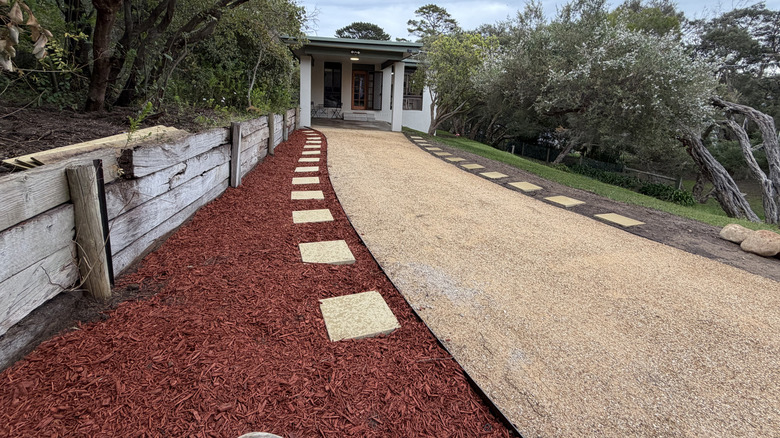
Keeping weeds out of your gravel can be a real uphill battle! Rounded ground cover options create little nooks between their pieces because they can't stack flush. These dark, moist places are a perfect spot for weeds to put down roots. "As storms roll through, and as rain falls, and as dust and debris blow all over the place, those voids in your ground cover slowly get filled up with the same dirt and minerals from your soil," Holley explains exclusively to Hunker. "This sediment may not be a plant buffet, but it's more than enough for weeds to grow in and grow roots from."
This is why folks often turn to angled gravel as a solution. Its bits can fit closer together because they have sharper sides instead of rounded, smooth options. Because of this, the gaps between each stone are smaller, or in some cases, not there at all. However, this doesn't last forever, as weeds will find a way. "It is true that an initially weed-free garden might stay weed-free a little bit longer when using angled, jagged gravel versus rounded ground cover, but the same thing is still going to happen eventually," says Holley. "The very best case (if we're being generous) is that it may potentially make it slightly more challenging for weeds."
Weed barriers, or landscape fabrics, can't choke out plant life when installed under gravel
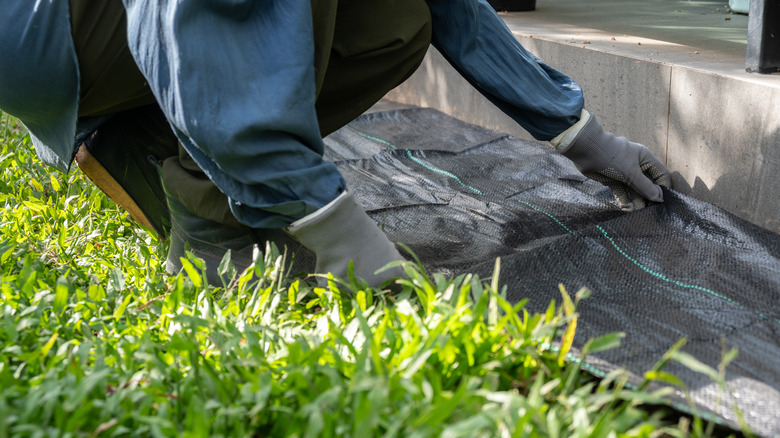
The only way to completely prevent weeds from growing is with chemicals or interventions like salt. Other options are popular, especially because many people don't like using herbicides in their gardens. However, Holley exclusively tells only Hunker that these solutions tend to only delay the inevitable. Unless you kill them, they find a way. "I want to spike out one of the most commonly held beliefs about weed prevention, and that has to do with landscape fabrics, often referred to as 'weed barriers.' In fact, that colloquialism is probably where the misconception gets all of its power," he says. "The idea (and the intention) is that if you cover the soil with a barrier, then anything lying dormant (or spreading) under the surface will be choked out because it can't penetrate the barrier and grow out of the ground."
This is true to an extent, but he warns that, just like with angled gravel, the fabric only works for a season. While at the beginning, it does suppress weed growth, eventually, a little ecosystem forms over it. Dirt and debris collect on top of the fabric, weeds start to put down roots, and then you're back to square one. So instead of wasting all the effort on putting down fabric for it to only later fail, just salt your gravelled areas to save yourself the work and hassle.