

Skip The Sprays: Scare Carpenter Bees Away With An Eco-Friendly Solution
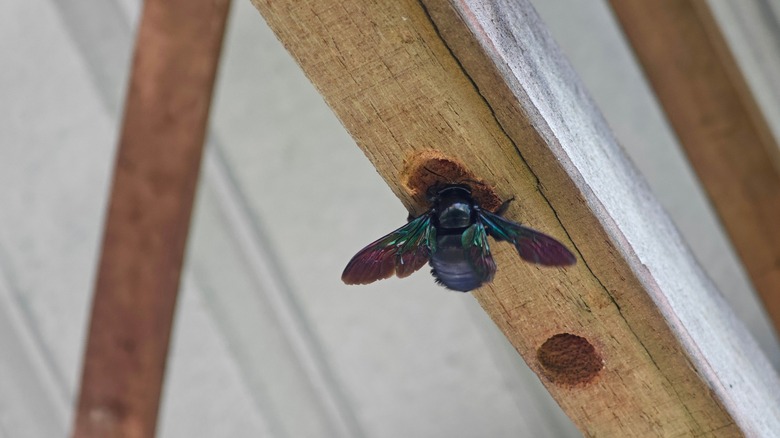
You know you've got a carpenter bee problem when you discover nickel-size, perfectly circular holes in wooden structures on your property. While not as damaging as termites, carpenter bees can definitely cause problems, returning, year after year, to the same nesting holes and boring them a little deeper each time. One way to discourage these busy bees while not harming them — because they are pollinators that benefit your garden — is to deploy a wasp nest. They'll stay away if they think there are wasps around.
That's the thinking anyway, but like many folk remedies, the scientific evidence that this works is thin to nonexistent. It's a harmless, easy method to try, though, and some people claim to have had success with it. If crows feel threatened by scarecrows, and other pests avoid fake owls (at least for a while), the same rationale may apply to carpenter bees. They don't like wasps and won't even enter a trap designed to attract the bees if there are wasps inside. To carpenter bees, a wasp nest their scarecrow.
The easiest type of nest to use as a bee deterrent is a bald-faced hornet nest (hornets are a type of wasp). It's about the size of a football or basketball, and it's made of a paper-like substance, so it's very light. You may find an abandoned one hanging from a tree branch, but if not, you can purchase a look-alike or make one from something as simple as a brown paper bag.
How to deter carpenter bees with a wasp nest
You're in luck if you can find a real bald-faced hornet nest hanging from a tree branch. Besides being more likely to deter bees than a fake nest, it could become a treasured conversation piece. The best time to collect a nest is in early winter, before snow and cold temperatures have destroyed it but after freezing temperatures have killed the colony. To ensure all the hornets are dead, bring the nest into a dry, unheated indoor space and leave it there at least through mid-winter.
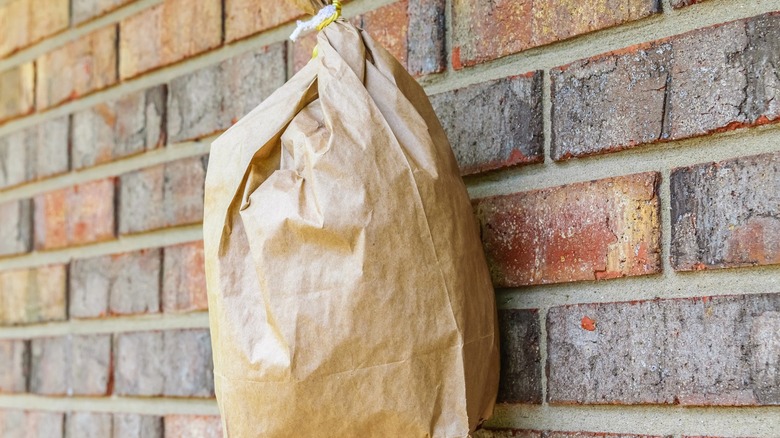
Failing to find a real nest, you can purchase fake wasp nests online, such as this Pamolon outdoor 4-door wasp nest decoy, but you don't have to. Chinese- and Japanese-style paper lanterns have the same size and shape, and they make good substitutes. You can also just use a brown paper bag. When you stuff it with crumpled paper or plastic and tie it off at the top, it resembles a wasp nest as closely as anything you can buy.
When spring comes and carpenter bees become active, hang the decoy in a prominent location where wasps would normally build a nest, such as from a soffit or porch ceiling rafter, near where the bees seem to be setting up homes. If it works, it might not scare away bees with established nests, but it could prevent new bees from moving in.