

Forget The Reno: A Smarter Way To Update Builder-Grade Kitchen Islands

Builder-grade products tend to emphasize functionality over appearance, and some can look downright plain. If this describes your kitchen island, the rest of your kitchen may be experiencing a case of the blahs. Don't worry — you don't need to call a contractor or replace the island. YouTube user HealthyGroceryGirl demonstrates how easy it is to do build your dream kitchen yourself without getting into an expensive renovation project.
No, we're not talking about installing a new countertop or sprucing up the doors with glass or ornate lattice, all of which can get expensive. For this project, you only need some basic wood trim, a nail gun, a can of primer, a can of paint, and some painting supplies. It doesn't sound like much — and it isn't — but with this, you can customize your island to help it better complement the rest of your kitchen décor. HealthyGroceryGirl used a black topcoat to transform her island, but you can use any color, and you don't have to be all monochromatic about it. Different colors on the facing and the trim — or different shades of the same color — can add complexity to an otherwise uninspiring kitchen design scheme.
Besides paint (which should have some gloss to make it easier to clean), you'll need filler to patch nail holes and nicks on the cabinet facing. If you have some left over from another project, drywall joint compound makes an excellent filler. Otherwise, choose a non-shrinking, wood filler that can be sanded.
A simple kitchen island makeover
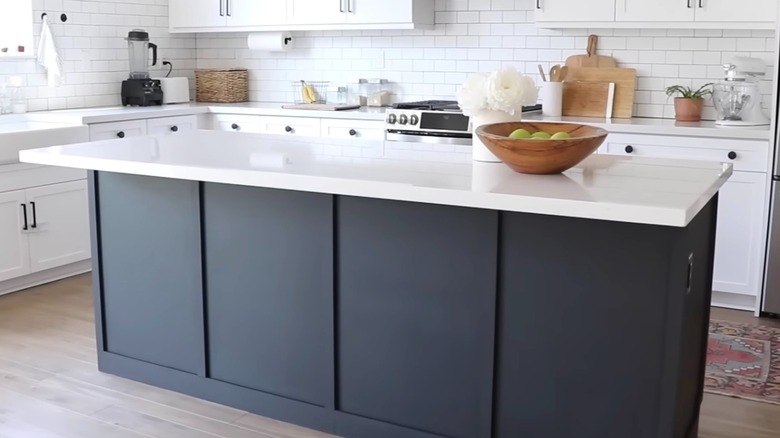
The first step in the upgrade is to give the island facing a thorough cleaning with soap and water to remove greases and oils that will interfere with paint adhesion. Once everything dries, it's time to upgrade the trim. The trim supplied with builder-grade cabinets is often undersized, sparse, and uninteresting. You can do better.
Remove any existing trim boards and replace them with wider ones, if it's easy to do. Some trim isn't easy to remove, so it's okay to leave it, but you can add additional vertical trim to provide the illusion that the cabinet is constructed with better-quality materials than it actually is. Plumb the trim with a level, then secure it with a nail gun. If you prefer a monochromatic tone, install the trim unpainted and paint everything together, but if you want different colors, it's easier to paint the trim prior to installation.
Fill nail holes, nicks, and gouges, sand the filler flat, and apply a coat of primer over the filler and other unpainted parts of the cabinet. Primer is essential for adhesion of the topcoat and for uniform color. You'll need at least two coats of paint, and you'll get the best finish if you scuff-sand the first coat with 220-grit sandpaper, just as you would do if you were painting oak furniture. If you pre-painted the trim, install it after painting the cabinet, fill the nail holes and touch up filler with the trim color.