

Plant This Flower With Your Hostas To Enjoy 10x The Beauty All Summer & Fall Long
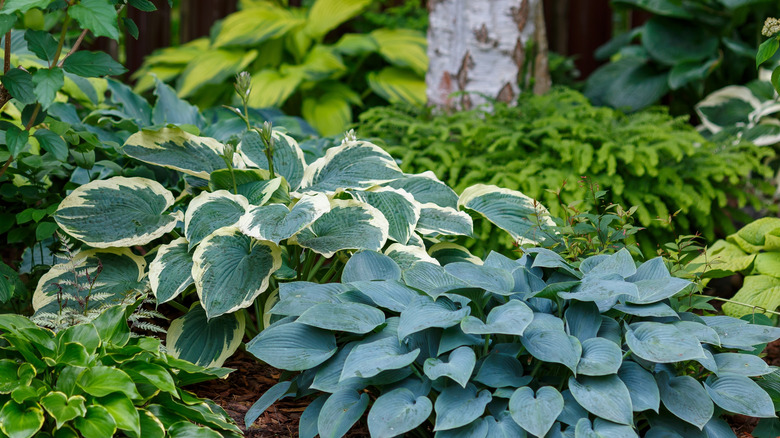
In the garden, some plants get along well, making them perfect for planting together, a technique called companion planting. You can grow basil and tomato plants in the same container, for example. Corn, beans, and squash are all commonly grown together, allowing the plants to benefit from each others' proximity. Companion planting also helps to max out the beauty of your garden, letting you grow plants that complement each other aesthetically, or allowing you to grow a plant that flowers for a long period near one that's better known for its attractive foliage.
Hostas (Hosta spp.) and begonias (Begonia – Semperflorens Cultorum Group) are one such pairing. Hostas are shade-lovers known for their verdant foliage, which can be sunny yellow green or a deep blue-green, often with variegation or a white border. Begonias also love the shade, and while hostas are praised for their leaves, begonias are loved for their blooms, which may be red, pink, or white. When planted together, the contrasting colors and textures make a garden bed really sing. Since begonias bloom from late spring until the first frost, you can enjoy the amplified beauty of your garden all summer long.
How to grow begonias and hostas together
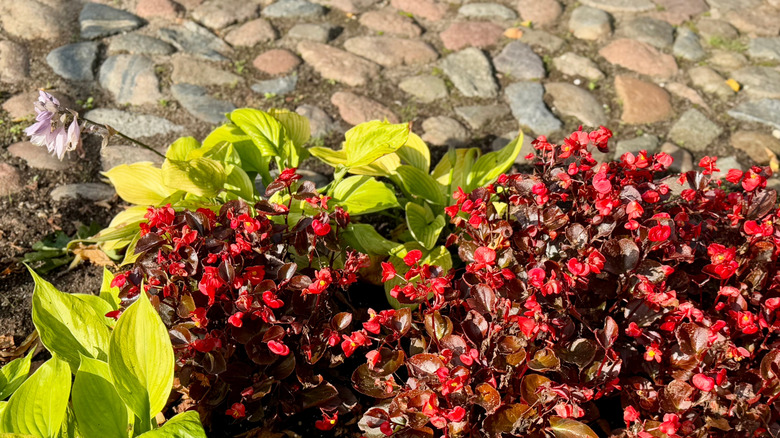
Hostas and begonias look good together, and have similar care requirements, another factor that makes them ideal garden companions. To grow them together, first choose a spot in your garden that gets a fair amount of shade, such as at the base of a large tree. While both plants do best in shade, some morning sun is also beneficial, particularly for begonias, which are more likely to flower with a bit of sun. Both plants prefer soil that is moist but well-drained, so their roots don't get too soggy. When watering, it's best to soak the soil, rather than pour the water overhead, so the leaves don't rot.
When it comes to choosing the variety, keep aesthetics and practical concerns in mind. Hostas with blue-green leaves typically need more shade than those with greener leaves, so choose those varieties with care, especially if you only have a spot in your garden that gets partial shade. Also, pay attention to the leaf size of the hosta you choose. Some varieties can have rather large leaves, measuring 120 square inches. A hosta with giant leaves can easily dwarf or even conceal the more diminutive begonias in your garden.
Finally, keep in mind that begonias will die in a freeze and are only hardy perennials in zones 10 and 11. Hostas, meanwhile, are hardy in zones 3 through 9. Before the first frost hits, add mulch to the soil to winterize your hostas and help them survive the freezing cold. Outside of their winter hardy zones, replant begonia bulbs after final frost in late spring, or start indoors in late winter.