

Keep Carpenter Bees From Re-Nesting In Your Deck With An Easy DIY Solution
We may receive a commission on purchases made from links.
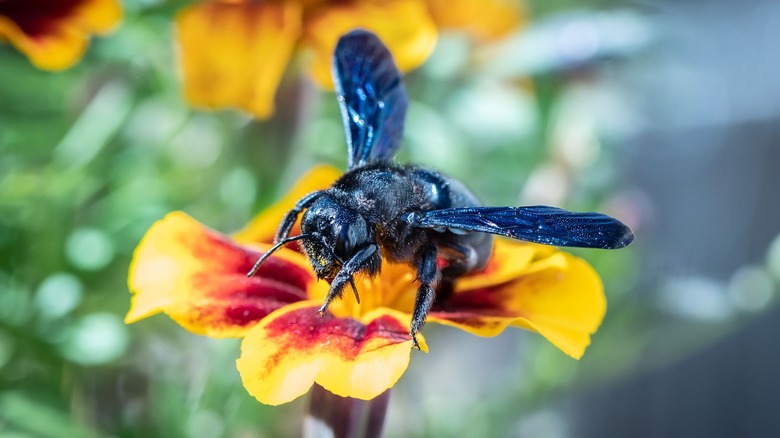
It's easy to mistake a carpenter bee for a bumblebee, if you happen to see one fly by. They're both about the same size and mostly black, and they make deep, loud buzzing sounds. Both bees are excellent pollinators and a benefit to any garden, but they differ in where they make their nests. Unlike bumblebees, which are ground dwellers, carpenter bees dig holes in wood, and when that wood is part of your deck, you've got a problem. A popular DIY solution that seems easy enough is to fill the holes to keep them out.
This trick works as long as all the bees are out of the nest. If they aren't, they'll just dig new exit holes to bypass the ones you block. The tunnels weaken your deck, and any new ones you force them to bore will weaken it even more, not to mention create more unsightly holes.
How can you be sure the bees are out of the nest? During the summer, you can't, because that's when eggs are hatching into larvae and larvae are developing into adults. The females die in the fall, though, and nests are inactive throughout the winter, so that's the best time to seal the holes. If you do it in the summer, you may have to trap the bees or kill them with a natural pest control remedy. That deprives surrounding plants of an important vector for reproduction, and considering there's a better way, it's kind of mean.
How to seal carpenter bee holes to prevent re-nesting
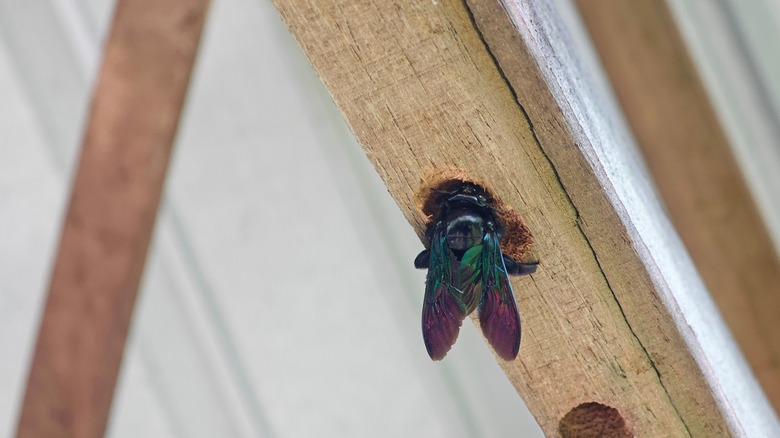
It's important to seal carpenter bee holes, because the bees reuse them every year and expand the tunnel networks, further weakening the wood. Oft-recommended filler materials are caulk and steel wool. They both keep the bees out, but neither looks good unless you top it off with a wood filler you can sand flat. A two-part exterior wood putty, such as Abatron WoodEpox Kit, works well for an exterior deck exposed to the elements, and because it's hard enough to restore structural integrity to the wood, you might want to use it exclusively, and skip the caulk or steel wool.
Carpenter bee holes are something of a marvel. They are perfectly round and about 1/2 inch in diameter, which suggests an alternative way to seal them: Use half-inch wooden doweling. Cut the doweling into 3/4-inch lengths and tap one into each hole after first squirting in some glue or caulk to make it stick. When the adhesive sets, cut the dowel flush with the wood and sand it flat. To prevent the larvae from hatching, stuff a cotton ball soaked in rubbing alcohol into the hole before you seal it.
After the newfound carpenter bee nests in your deck have had their holes filled, you'll now want to discourage the bees from making new ones. A simple way to do this is to drill holes in pieces of old wood and set them around the property to give the bees an alternative nesting place.