

What To Do If You Encounter A Swarm Of Wasps In Your Yard
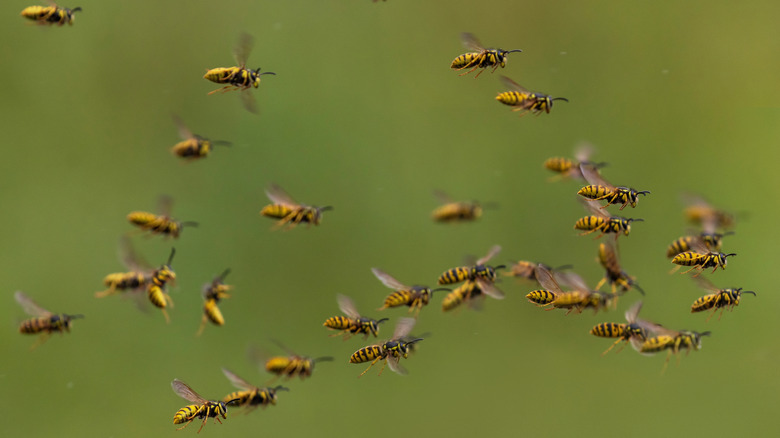
Wasps freak people out, and it's not hard to see why. These sometimes hostile stinging insects fly about us as if trying to start a fight, and they look the part with aggressively segmented bodies that resemble some sort of alien attack craft. Then there are the legs. There's no particular reason to equate dangly legs with evil, but they somehow demand it anyway. And then there's the swarming behavior, which can prompt a gruff lumberjack to squeal, dash a quarter-mile, and jump into a river. That's really not the right response, but it's certainly amusing if you're not the lumberjack. When you happen across a swarm of wasps, you have three options: Stay calm and still, walk slowly away, or run like the wind. And all three are the right thing to do — in different circumstances.
Of course, wasps aren't all bad. Some wasps can be beneficial to agriculture and home gardens — even the dreaded yellow jackets — by feeding on pests and pollinating. It's usually best to find a way to coexist with them, but in our yards, and especially if anyone around is allergic to stings, a swarm of wasps is simply not something you want to deal with, whether they're wasps, hornets, or yellow jackets. Sometimes, though, things can be unacceptable and unavoidable at the same time, like when we deal with a squadron of wasps on our own turf. The best advice depends on knowing a few things about what insect you're looking at and what behavior you're thinking of as a "swarm."
What is a wasp swarm, anyway?
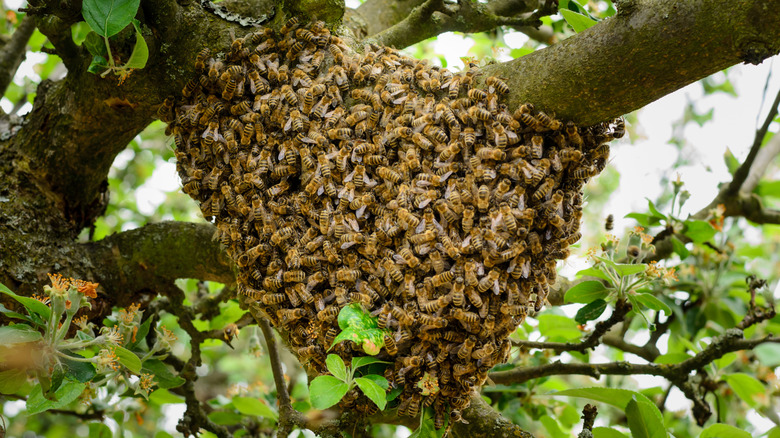
Before we can look at what a wasp swarm is, it might be useful to eliminate one thing that it isn't. If you encounter a large number of flying, stinging insects clinging to some random surface and climbing over each other like Black Friday shoppers on the TV aisle, you're looking at a swarm of bees, not wasps, and you should politely wander away. These swarms are related to colony migration — usually in late spring to early summer — and are temporary and almost always non-threatening.
On the other hand, a large number of Hymenoptera (the order of stinging insects) flying around can be a threatening swarm. The wasps might be gathering in an attack against a perceived threat to their nest ... certainly a cause for alarm. But many are social creatures and can be seen grouped for a number of reasons. One of the most common happens when fall brings on the inevitable collapse of wasp "societies." As food disappears and wasps leave their nests, they continue to be social creatures and gather into new, impromptu, and short-lived social groups. During late summer and early fall, you might see a number of wasps approaching your picnic or garbage cans looking for food as their natural sources dwindle, but rarely in numbers you'd think of as a swarm.
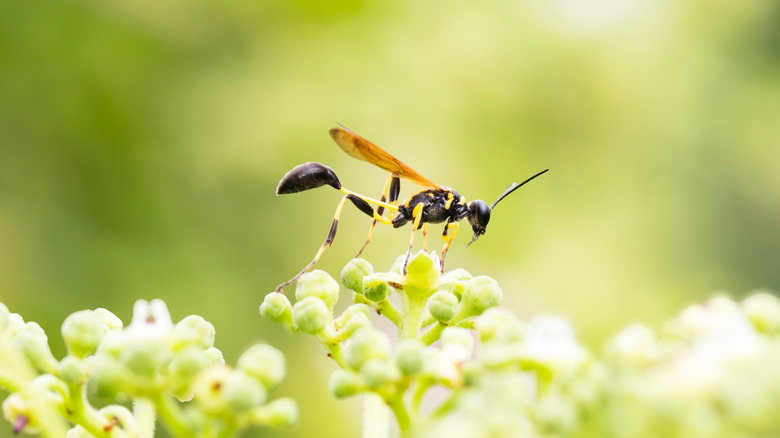
And wasp species like mud daubers that aren't social might be seen in large numbers but won't swarm and aren't aggressive, as they have no nest to defend — they rarely sting people. Swatting a mud dauber might get you stung, but not by a swarm and not for any good reason.
So, should you be still, walk, or run?
There are two approaches to deciding how to handle a wasp swarm. The first is to play entomologist and try to suss out what you're dealing with in terms of species and circumstance. Are they bees or wasps? Are they migrating to a new colony, chasing a dog, or just hanging around in a big group? The problem with this approach is that it's almost impossible to be sure of the answer. European and Africanized honeybees are not distinguishable in the wild, and both look a lot like yellow jackets — actual wasps.
Since, in the heat of the moment, you can't necessarily determine what you're dealing with, it often makes the best sense to decide based on the situation itself. If you've noticed a wasp or two buzzing around, stay still and try to ignore it. Swatting or running away can actually induce the wasps to chase you, which is not something you want. On the other hand, seeing a large number of wasps doesn't imply that you're under attack. And if you are, walk calmly away from them and the nest they're protecting if you happen to spot it.
If you're being attacked or chased, run (in a straight line, if possible) until you are no longer being pursued or until you can take cover in a building or car. Use clothing and hands to cover your head and face, and don't swat at the wasps even as you run, since that just encourages the release of pheromones that invite more of them to the fight. And don't jump in a river — some species will actually wait patiently for you to resurface.