

Your Dinner Guests Are Taking Advantage Of You — It's Time To Put Them To Work

Your dinner guests are taking advantage of you, and you've given them no choice. You were trying to orchestrate the best, most relaxing, most fun evening for them ... which is not how you'd normally describe washing dishes and taking out the trash. Your guests also want you to be relaxed and have fun, so they probably want to help. But even if they ask, you probably say you've got it handled. However, they're actually taking advantage of your kindness by letting you do all the work. So it's time to swallow your pride and go ahead and put them to work doing dishes, clearing the table, and any other tasks you need help completing.
Most of us grew up with family get-togethers, birthday fetes, Thanksgiving feasts to remember, and perhaps even dinner parties. Food is plated, drinks are filled and refilled, plates are scraped and washed, trash is taken out, and leftovers are packaged for whoever has the most kids. A cousin makes everyone deeply uncomfortable with offhand commentary. And someone inevitably makes an ice run. It was, in short, a happy and communal effort: Everyone pitches in. And everyone must.
Today, families are what we make of them, and the more we make of them the better. Restaurant staff regularly have "family meals" before or after a service — a communal breaking of bread in which everyone helps out, because it's what families and friends do. But the kitchen went awry in the 20th century. Chef and food writer Ruth Reichl wrote of the 1950s, "It is, I think, impossible for people raised in our food-obsessed culture to understand the contempt Americans had for food and cooking when I was growing up." The efficiency of the Frankfurt kitchen turned that space joyless, and author John Ota said the kitchen "was off limits and guests were never allowed in." This is madness.
But my guests should enjoy themselves

One common objection to asking your guests for help is that they should be having maximum fun at your expense, which is a particularly offensive way to think about your guests. Sure, you might occasionally find a guest who doesn't want to help. Miss Manners sympathizes. I know this because she says "Miss Manners sympathizes," referring to herself in the mildly off-kilter manner of Elmo, Tigger, and The Dude. Also, Gollum. Miss Manners elaborates, too, though she doesn't say so. She claims that hosts should tell guests they prefer "sitting around with them." This is meant to come off as both generous and as showing that you value your guests' company more than their help.
There are actually several problems with telling guests that you prefer sitting around with them, starting with the obvious fact that you won't be, because you're busy doing all the work. Distinguishing between the conversation had over your coffee table rather than over a Scrub Daddy doesn't only assume that your guests are dolts. It also obscures their worry that all the dishes are being taken care of by the more confident, helpful, and demonstrably more valuable guests ... the ones who didn't ask to help but simply got to work, in the fashion of dinner guests throughout history.
Miss Manners further suggests that offering to help is a good idea so long as "a quorum is maintained at the table for conversation." That is inexpressibly bizarre reasoning. First, obviously, you should not rely on your guests to keep a head count and take personal responsibility for making sure everyone has someone to talk to. More importantly, this is thinking too much about it. Anyone should feel free to converse with whoever's clearing away dishes or refilling drinks.
Even if guests don't really help, it will help them
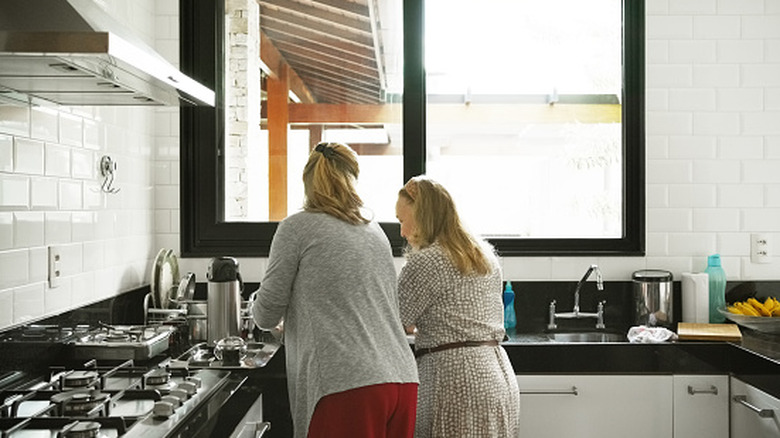
Some of you are thinking that you don't want to spend the three weeks after a dinner party looking for your blender, which is eventually found in that little cabinet over the refrigerator. But it can't be worse than having your teenagers do the dishes, after which you discover that they haven't the faintest idea what anything is or where it goes and have put your measuring cups in your coffee mug cupboard ("I dunno, they have handles") and a ladle, inexplicably, in your garden shed. But even that won't prevent you from asking them to help. And, frankly, if your kitchen storage is so idiosyncratic that smart and charming dinner guests can't unpuzzle it, that's a burden you bought and paid for yourself.
Besides, not all guests are smart and charming. I am not a social person. The idea of laboring over a sink full of dishes while conversing with my hosts and fellow guests is infinitely better that trying to hold my own in someone's sofa-mounted eye contact death match. In fact, I gravitate to this kind of helpfulness as a means of hiding myself in plain sight. I will often engage with the kids — a very helpful course of action, assuming no one gets hurt and nothing important is combusted. I have also been known to take a surprisingly comprehensive interest in any dogs or cats nearby, though this is rarely as useful to my hosts. Allowing someone like me the social buffer of scrubbing a pot or managing the perfect dinner party playlist is the mark of a thoughtful host, not an inconsiderate one.
Aiming for the ideal

Okay, so let's talk about how to do this right. The place to start is with a vision of how your dinner will go ... how your guests will interact, and the feeling they'll take away from the evening. This brings us back to the family meal, with its barn-raising atmosphere of camaraderie and cooperation. Julia Child eschewed the popular, sleek modern kitchen and envisioned the kitchen as a place to cook, but also as a living and dining room. So let's take a page from her book, literally.
In the foreword to "Julia Child's Kitchen," chef Jacques Pepin writes, "She was breaking free from a culture that imagined cooking was not worth people's time — on the contrary, cooking, for her, was to be shared, enjoyed, and experienced together." Child wanted her kitchen table at the center of social gatherings so she could be "right there in the midst of everyone" according to her book "The Kitchen Julia Built."
In this idealized scenario, whoever notices that someone's glass is empty fetches the pitcher or bottle. If you want an aside with the host about when and how he butter-bastes his steak, ask while you help him load the dishwasher. And if you think your guests (or you, for that matter) are too important for such menial chores, consider Julia Child's guest list, which included big names like the aforementioned Pepin, along with M.F.K. Fisher, who defined our current relationship with food, and James Beard, whose name is on the yardstick we use to measure cooking talent.
Some rules for involving guests

If Child's entirely kitchen-focused dinner parties remain beyond your current goals, I've cooked up a handful of rules for both guests and hosts trying to navigate this business of pitching in. But remember that you can get carried away with rules. A piece I once read featured an expert suggesting that guests should take extra care in the bathroom. Hosting expert Patti Diamond told The Spruce, "After using the bathroom, guests should always clean up after themselves and ensure the space is tidy and pleasant for the next person." I'm not sure what goes on at Diamond's dinner parties, but fortunately we are dealing with the kitchen.
In that kitchen, a dinner party host should structure dinners so that guest participation feels natural and pleasant. If a guest asks if he or she can help, don't decline or demur, but give specific directions if you have them, and vague ones if you don't. Engage with your helpers as if this were part of the dinner, because it is. Don't be annoyed if guests don't do things the way you do; there's an excellent chance they do it better. And don't ever expect or demand help, but craft an event that shows your guests the value of their participation and conversation at the same time. Finally, encourage guests to come early if they want to help set up. Build this early start into your planned party time, and use the time to talk about how great they are for offering to help.
It seems obvious to me that this is a better way to be in community In general. And it's just a better way to share a meal. Everyone pitches in. And everyone must.