

Why Do Tape Measures Have Those Little Black Diamonds? Here's What They're For

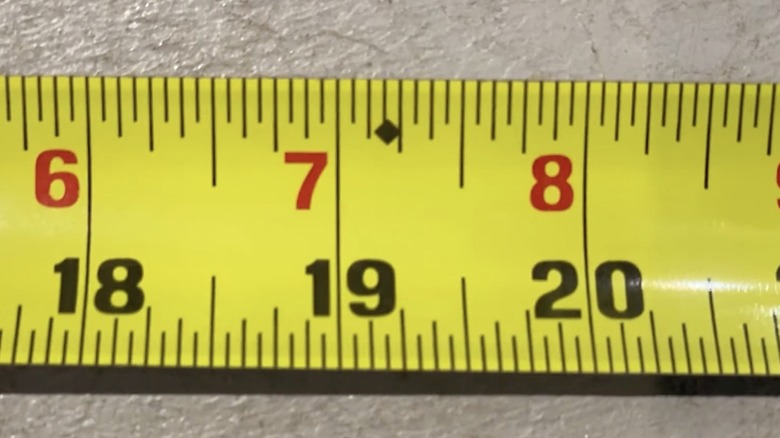
With the sustaining interest in DIY home improvement, it would behoove homeowners to understand exactly how to read all the markings on a tape measure. This includes those small black diamonds that you see spaced every 19.2 inches apart. If you've ever been curious to know why those exist, you're not alone.
Here's what those little diamonds are for: They are an expedited way of measuring joist or stud spacing when framing walls or floors. More specifically, they are for a framing method known in the construction world as "19.2 inches on center" which requires a joist or stud to be installed every 19.2 inches, meaning you will have 5 open bays for each 4-foot by 8-foot sheet of plywood or drywall. Carpenters utilize this method all the time in order to determine equal spacing when installing floor joists, wall studs, or ceiling trusses.
On center measurements are taken between from center-to-center of the joists as opposed to measuring from the inner and outer edges of a piece of lumber or steel. Being on center gives you enough room for insulation between the joists, and ensures ample area for screws or nails to drive into. It also avoids errors that can happen measuring from the edge of dimensional lumber joists that differ slightly in actual size. The center is always in the center, no matter the actual size of the joist.
Having the black diamond markings at equal spacings on the tape measure blade allows anyone utilizing this framing method to have a set mark from which to make their measurements. This negates the need of continually calculating every 19.2 inches. It makes the framing process much more efficient and easy for both pros and novice DIY framers.
Why mark lumber at 19.2 inches on center?
When it comes to framing and measuring things on center, it's important to know that, when framing a floor or wall, joists are commonly spaced every 12 inches, 16 inches, 19.2 inches, and 24 inches on center. The spacing depends on the load requirements of the wall or floor. You'll most commonly see framing measured at 16" on center, as this is the standard for new residential construction. As such, you might be wondering, why even bother to space every 19.2 inches?
While not specifically intended for their use, 19.2 inches on center measurements are ideal when using I-beams. These are a type of construction beam made from engineered timber that remedies a lot of the cracking, bowing, and cupping issues typical of solid lumber. Shaped like a capital "I" with serifs or bars on top and bottom, they are designed with a central artery of oriented strand board (OSB) sandwiched by two solid boards. They can support more weight than traditional lumber, and therefore can be spaced further apart than the standard 16 inches.
Regardless of the spacing, however, all on center measurements are designed to be divisible by 96 inches, which is the standard length of an 8-foot sheet of plywood or drywall. If you divide 96 by 5, you get roughly 19.2. This means you only need 5 joists for every 8 feet, which is a cost savings in terms of material. This alone makes it worth it to know what those black diamond marks on your tape measure are for.