

The Pink Perennial Flowering Shrub You Should Avoid Planting, Despite Its Beauty

If you're looking for gorgeous flowering shrubs for your landscape, you might come across Japanese spiraea (Spiraea japonica). Native to Japan, China, and Korea, the deciduous plant is easy to grow and boasts gorgeous pink flowers. Nevertheless, Japanese spiraea is one of many beautiful perennials you shouldn't grow in your garden, as the shrub is highly invasive. Japanese spiraea can escape your yard or garden and spread rapidly through natural spaces, outcompeting native species.
Its gorgeous flowers emerge in late spring, covering the shrub in tiny pink or white flowers that grow in tight clusters. However, these flowers are also at the heart of what makes Japanese spiraea so harmful to grow. When pollinated, the flowers form seeds that will easily and aggressively spread. Some varieties are sold as "sterile" spiraea, but for those producing seeds that take root, the plant grows quickly, and before long there are more flowers, followed by even more seeds. Since it is a perennial, each plant will continue blooming and spreading seeds for years to come, reducing plant diversity by crowding out native plants.
Japanese spiraea is not equally harmful in every state. It's primarily invasive along the east coast and midwest of the U.S. However, you should still consider skipping it even if you live outside of that range, since it isn't native and carries the risk of becoming invasive. It has a broad hardiness range of zones 3 through 8, meaning it can grow successfully across most of the U.S.
What to plant instead of Japanese spiraea
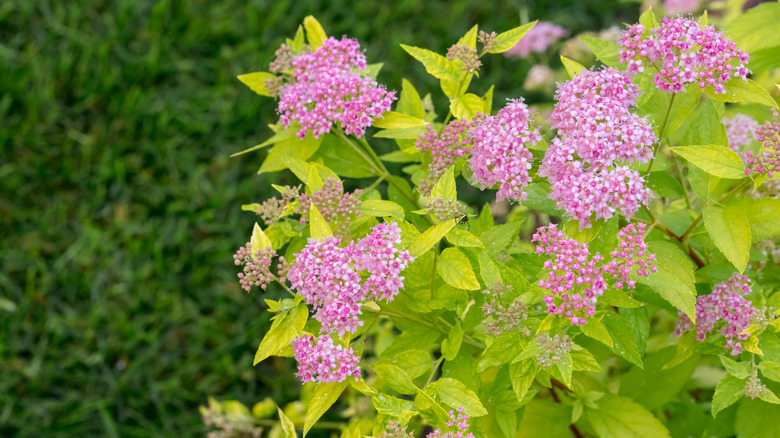
Having a native alternative is helpful when you're trying to avoid invasive garden plants like Japanese spiraea. Since the primary appeal of Japanese spiraea is its beautiful pink flowers, you'll likely be looking for a perennial shrub with similar blooms. The good news is that one of Japanese spiraea's close relatives looks strikingly similar and is native to part of the United States.
Rose spiraea (Spiraea splendens), also called rose meadowsweet, grows naturally along the west coast of the U.S. from California up into Canada and can be grown as a perennial as far north as zone 3. Other than the fact that you should avoid one and consider planting the other, the primary difference between the two is the shade of pink their flowers tend to be. Japanese spiraea flowers are typically lighter than those of rose spiraea. The general aesthetic of the shrubs are quite similar, though, making this a great replacement for Japanese spiraea.
If the shade of pink is a deal breaker, you can still avoid planting Japanese spiraea by opting for mountain laurel (Kalmia latifolia) or Pacific rhododendron (Rhododendron macrophyllum). Both are showy flowering perennial shrubs with pale pink or white flowers, just like Japanese spiraea. Mountain laurel is native to the east coast and hardy in zones 4 through 9, while Pacific rhododendron grows on the west coast and is hardy in zones 6 through 9. The exact shade can vary from plant to plant, but you should be able to find one that matches what you're looking for.